Showing posts with label parrots. Show all posts

Saturday, December 19, 2015

Endangered Species: Just part of natural cycles of extinction?

In many of my artworks to date, I have depicted endangered species of Australian birds, especially parrots. Some of them are listed by the IUCN as Vulnerable, the lowest risk level, and others, like the Orange-bellied Parrot, are listed as Critically Endangered, which is "two steps away" from Extinction. (the next is Extinct in the Wild and then officially Extinct. done. dusted. bye-bye)

In addition to birds, I've recently begun looking into Endangered plant-life and I found out that one of the Eco-systems that used to dominate the ACT and parts of NSW is now Endangered; "Natural Temperate Grasslands". This kind of habitat is dominated by native grasses like Kangaroo and Wallaby grass, tussocky grass and many small flowers and plants. There are very few trees, covering less than 10% of the area. There are also particular insects, lizards and birds that have a reliance or affinity with this habitat, such as the Golden Sun Moth.

The Pre-European settlement (so, pre-1800's) extent of "Natural Temperate Grasslands" or NTE, is estimated at 470,000 ha. Now it is only present across 58,000ha meaning it has suffered a 98.8% decline! You can imagine how European settlers easily pictured the rolling grassy plains as prime sheep-grazing country and began its deterioration.
Some other factors in the loss of NTE have been urban/infrastructure development, invasion by weeds like exotic grass species and changed fire regimes.

an example of Natural Temperate Grassland

It's easy to feel a kind of melancholy or hopelessness about these disappearing habitats and birds. When I depicted them in my work previously, I was alluding to the sadness of their impending loss but also trying to merely capture their present-tense beauty and unique qualities without any specific message; "this is them as their unique beautiful selves."

But I wonder now, whether the sadness we attach to the loss of species is just a human projection of the fear of dying and loss? It's also interesting to realise that cycles of extinction have been taking place since...forever.

Some suggest that whilst the demise and eventual extinction of particular species is a natural process that has been repeating ad-infinitum since we can fathom, the most recent period of loss is occurring 100x faster than previously (than previous extinction events, occuring millions of years apart).
Whilst previous cycles of extinction would have happened "naturally", caused perhaps by changes in climate, ocean levels or eruptions etc, now we are adding in the reckless hand of that pesky Homo sapien.

So of course there are legitimate reasons to be angry and upset about the loss of species, for example where poaching or serious human error is to blame. For other cases though, where introduced species are encroaching on native species habitat's or where the drought has changed a landscape so that a particular bird can no longer survive in that location, maybe we can take a step back from an emotional response and realise that, cruel as it is, nature is just fulfilling its cycle.

There were some interesting articles written about the way that funding is awarded to the rescuing of species that are on the brink, based ultimately upon their cuteness or popularity with the general public (ie Yeah! let's pour loads of money into the conservation of those cute squidgy Koalas we love so much, but a green spotted tree insect? hmmm, nahhh.) Maybe we are wasting our time and money trying to intervene in an inevitable situation? I don't know, I'm just playing devil's advocate here. I want beautiful little Swift Parrots to stay in existence as much as the ANU researchers who are dedicated to studying and protecting them. But why are we trying to keep them on anyway? For our pleasure? for the future generations?

I suppose we are trying to keep all the links of the delicate eco-systems around us in place so that they don't crumble further and another crucial link slips out of place.

Some of Australia's threatened Parrots. L-R: Extinct Paradise Parrot, Critically Endangered Orange Bellied Parrot, Endangered Western Ground Parrot, Endangered Carnaby's Cockatoo and Endangered Swift Parrot...

Another reason I've been thinking about this inevitable process of change and re-shuffling is from observing the natural surroundings of suburban Canberra. There are many designated Nature Reserves that lie around the edges of the Canberra suburbs, walking trails along hillsides, creeks, river tracks, grasslands. Walking and riding my bicycle around and through some of these reserves I've been noticing different species that appear in the different seasons. There are some spectacular flowers, fruits, trees and plenty of "weeds".

What I've noticed is that if I were attempting to be a purist and only depict "native species" in my artwork, for example, I would be having to subtract a significant proportion of what I see in front of me. We have many designated "invasive species" in the ACT. They are considered introduced if they are originally from overseas or even from a different eco-system within Australia; if they are somewhere they haven't been before.

Some of these weeds are beautiful. Pink climbing roses, purple flowering Patterson's curse. Strange fuzzy leaves plants that look like cabbages. Tangled nests of prickly blackberries. They are undeniably a part of the landscape now.


Maybe, just maybe, we accept that environments change; that they are fluid and operating as they will. We can try and intervene in that (goodness knows we are excellent at meddling) or we can observe the beauty of what we see, accept that it has developed from something and will continue to change, without trying to get our itchy fingers in there to try and fix it. (* that said, I do think we have a responsibility to not make things worse, if it is within our ability and to not knowingly harm the environment...)

And it's also interesting to note that a "weed" is just another plant. To quote from a book by Environment ACT, "Animals and plants don't make distinctions between weeds and native species. Weeds to non-human organisms are just another plant..." What we have labelled "weeds" can actually make up 25-33% of the flora present in Natural Temperate Grassland and this does not necessarily transform the habitat because "species richness does not equate to dominance"... Interesting... I'm tempted to draw links here with multiculturalism and ideas about what is native and what is exotic...but that will need some more mental kneading first, I think.

"Hey! I'm not a weed! I'm just a plant who's new around here!"

Soon, I think I'm going to make a series of works that document Natural Temperate Grassland and also these "invasive species". A proud portrait of a sprig of Salvation Jane. A messy nest of flowering Blackberry bushes. A rosehip bush in all its prickly detail. Maybe they will make people squirm? Maybe they will just be a testament to the unique, details of the nature around us, now.

Thursday, August 13, 2015

Solo Exhibition in Canberra open now! キャンベラ市での個展は後8日!

I was only back in Australia for 10 weeks to the day when I found myself in Canberra setting up my next exhibition with my Dad. (Thanks Dad!)
オーストラリアへ帰国したばかりという気持ちがした10週目のところで、キャンベラでの個展の搬入なんてしていました!

My first solo show in Australia, "The Traces Between" opened on August 6th in the long and narrow space of Gallery 3 at M16 Artspace. The opening was a packed event as three separate shows opened all at once. It was great that the visitors who came to see the group show in the main gallery then drifted through to both mine and Keith Bailey's Solo shows in the two smaller galleries. Hooray for capitalising on other people's friends!
オーストラリアで初ての個展です。キャンベラのM16 Artspaceで細長いギャラリーで展示しています。そのArtspaceにて、三つのギャラリースペースがあって、同時に三つの展覧会も開きます。オープニングにたくさんの人が来ました。


Me explaining some of my work on opening night オープニングのパーティーで、友人に作品を説明している私。
Yay! other people's friends (plus lots of my friends and family too :)) 三つの展覧会が同時に始まるので、三つの作家さんの知り合いや友だちが来るわけ。いいシステムですね!
I called my exhibition the slightly vague and arty sounding "The Traces Between". I wasn't trying to be vague or sound arty (goodness knows I've learnt a whole dictionary of meaningless arty tripe I could roll out if I wanted to). Instead I was referring to a variety of gaps both literal and not.
展覧会のタイトルを「The Traces Between」にしました。訳したら「間の跡」に近いと思います。かなり微妙と思うかもしれないですが、色々な「間」をほのめかしたかったわけです。

One is the physical and visible gap that appears between areas of dyed colour when you use a resist technique like Katazome or Yuzen. In yuzen, that will be where you have drawn fine lines of paste with a metal-tipped tube. They leave behind the colour of the fabric below; white traces. A stencil is used for katazome, so you get a distinctive silhouette-style image. This positive image is merely the reverse of lots of blank gaps and spaces where resist paste was applied.
一つの「間」は、作品に見える防染された間です。友禅の場合では、防染糊の線の所ですね。型染の型紙を通した糊のところは出来上がった作品には、ただの間にすぎないです。

That is to say, resist-paste techniques rely on the preservation of the under fabric and then upon revealing them in the final piece.
つまり、防染糊の技法を使うと、糊が守った生地の色は、完成した作品には跡になります。

Yuzen detail: the writing is where the resist paste was. In the final piece it is just a trace. A blank space. 友禅の防染した文字。染め上がった作品から糊の存在が消されて、跡しか残らない。
In the case of Katazome, the blank negative space forms the image. In between all those gaps, the imagery is brought to life. 型染の場合、余白があるからこそ、イメージが見えてくる。
Another gap I was trying to allude to is the physical space between layers of fabric; the gaps that air can flow through. Since late 2012, I have been layering sheer silks in my pieces, leaving gaps in between them and allowing them to catch the breeze or the draft from an air conditioner.
もう一つの見える「間」は、生地の層のあいだにある空気です。2012年後半から、何枚かの絹を染めて、重ねる作品を作り続いています。この薄くて透明絹が風もちくはエアーコンに振られます。

By not framing my work, or stretching them tightly over a wooden board, they have a sense of life.
縁やパネルを使わないと、何かのイキイキ感がでる気がします。

sometimes the gaps between layers are even big enough to get inside! 2枚を重ねた作品です。時には入れるぐらいの間です! 
Degradation series from 2014 where I made a point of spacing layers out from each other. 2014年のシリーズでは3枚の絹を重ねて、わざと5センチずつの間で展示してみたら、良い感じでした。

Cross cultural spaces? Australian foliage meets Japanese noren
A non-physical gap is that between Art and Craft. I don't yet know where my work fits in those terms but I get the feeling it's somewhere in between; somewhere on the divide.
作品には見えない間もあると思います。それは「美術」と「工芸」の間。自分の作品はどちらに近いというのがまだわかりませんけど、確かにその真ん中に寄っていると思います。

You could also say that it straddles cultures too, swaying somewhere in the grey area between Australian and Japanese but let us not get carried away with ourselves! 文化の間というのもあると言えるでしょうが、今はあんなに自慢するのをやめよう!笑

This show is a combination of larger works that I completed whilst undertaking my Master's degree in Kyoto as well as a collection of new work. My graduation piece from Kyoto Seika University which features the migration cycle of the endangered Swift Parrot is the centrepiece (it can be helped since it's over 5 metres long!) and it catches the air nicely as people walk by in the space. 
今回の展覧会は、京都で作った大き目の作品と、帰ってから創ってみたもっと小さな作品の組み合わせです。

My Graduation work from Kyoto Seika in March 2015 is the star centrepiece of this show. 京都精華大学の大学院終了作品で作った「オトメインコの渡り」が今回の個展では、メイン作品になっています。5メートル以上なので仕方ないですけど!
Amongst the new work (some of which were completed at very VERY closely to the finish line!) are some small pieces I'm excited about that combine the fine line-work of yuzen with locally sourced natural dyes. In some inital research (much more to be had), I managed to find foliage from three eucalypts found around my suburb and boiled them down to extract some shades of yellow-brown and peachy orange-brown. Then I used those dyes to dye little "portraits" of Eucalyptus blooms and leaves. Haha! see what I did there? it's like a textiles pun or something.
新作の中、近所にあるユーカリから煮出した染料でユーカリのイメージを染めたちいさな作品もあります。まだまだ植物染料について沢山調べないといけないと分かりましたが、はじめての実験としてとてもうれしい結果です。

New small experiments in natural eucalyptus dyes are also on show.
Anyway, the show is on at M16 Artspace in Canberra until Sunday August 23, so be sure to check it out if you are in town. Otherwise, look forward to more photos after the show is complete!
さて、個展は8月23日までです!終わったらまた写真をアップしますから楽しみにしてください!

Wednesday, July 30, 2014

Creativity within Constraints - Kimono Design 着物をデザインする自由・規則

You may recall that I dyed my own Kimono about a year and a half ago.
You might also remember that the whole process took a full 6 months from beginning (trying to get my brain around how you even design a kimono) to end!! (holding the precisely folded, shiny, freshly sewn, expensive beast in my very own hands) 
前に振袖を染めたと覚えていますか。
六ヶ月間もかかったことも覚えていますか?!「着物をいったいどうやってデザインするんの?!」という始点から、綺麗に仕上げて貰ったものを両手に持つ終わりまでに。

my kimono. started in September 2012, finished march 2013.

They say that things which you fear are probably the things that are most worthwhile doing. There's a mild pulse of terror going through me when I admit to myself that I may want to try dyeing another...kimono *gasp! There, I said it. I'm envisioning vivid flocks of parrots streaming across the sleeves of a pale heavy silk or white Corellas on a desert sand rusty orange background...
できないだろうと思うことこそすれば価値があると言われていますね。もう一回着物を染めてみたいと思ったら、恐ろしい気分になるのはそのためのでっしょう。怖いからいい経験になるでしょうが。。。薄い色の紬に、鮮やかなインコが飛んでいる着物とか、濃い落ち葉色の生地に真っ白のオウムの群の着物とか想像したら作りたくなります。

Little Corellas in Central Australia by Geoff Thompson 
But I'm held back from committing to it by a whole array of reasons and things I don't understand.
The thing that confounds me most when it comes to designing Kimono is the dilemma that you can do anything on a kimono but at the same time, you can't. There is this push and pull between absolute freedom and very defined limitations.

でも、分からないことばっかりで、色んな理由のせいで、「作ろう!」となかなか決められないです。
着物をデザインする際に最も分からないのは、着物に何の模様でもいいだが、同時に何でもいいというわけではない、という点です。つまり、完全な自由さがあるのに、かなり窮屈な規則もあるというアンバランスを感じます。

the age of the wearer determines various features of formal kimono: brightness, size of motifs, level of decoration, sleeves...and on and on... 年齢によって礼儀もかなり変わりますね。袖、色合い、模様の位置など。
Colour, motifs, size of said motifs, sleeve length, fabric type, fabric weight, location of pattern on the body, amount of decoration, lining... these are just some of the variables you can adjust to give infinite outcomes. How about that for freedom of creative expression!?

色、模様、模様の大きさ、袖の長さ、生地の種類、生地の厚さ、体に模様がどこに来るか、装飾の程度、裏地など、これ以上の可変によって無限の違っている着物も作れるわけです。

the variations are endless....着物のバリエーションは無限でしょう。
Oh, but wait, that's right! There's also rules for each of those variables. Young women wear long sleeves, older women wear more subtle patterns, unlined kimono can't be worn in winter, heavy silk is too nice for everyday kimono, spring flower patterns shouldn't be worn in autumn, a giant flower that sits right on the wearer's behind when worn is probably not a good idea, et cetera, et cetera.
それで、上の可変の全部にもルールがあります!例えば、袖の長さだと20代の女には長い袖、50代には短い袖。50代だと模様を少なめに。冬だと裏地が付いていない着物が着れない。日常生活では、上級な絹は不適切。おしりの真ん中に来るデカい花模様は考え直した方がいいなど。考えないといけないことがいっぱいあります。

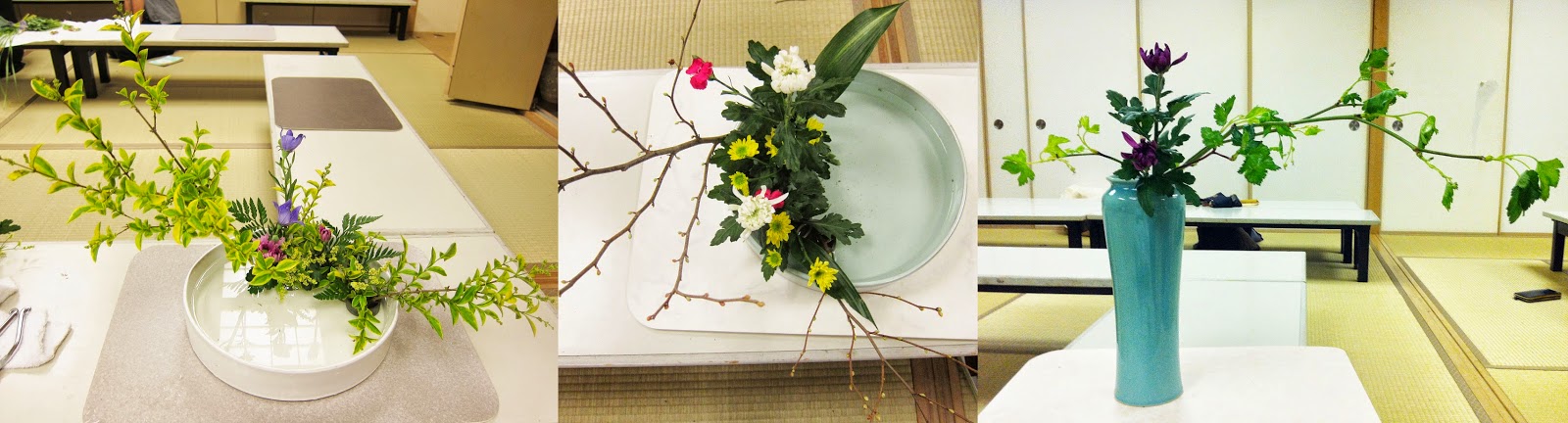
So while it seems like a creative free-for-all which then has all the fun taken out of it, this is something that is present in many art-forms in Japan. Take the example of Ikebana - Japanese flower arranging. I was actually a member of Ikebana club for one year at my university and it was the very embodiment of taking virtually any kind of flower or plant, and creating something of beauty within very strict principles.
着物はとても自由な「キャンバス」であっても、デザインする楽しさは全部ルールでおさえられると感じます。こういうコントロールは他の芸能にもよく見えます。例えば生花。生花では、様々な自然のままの枝や花を手に取って、それを決まっている形、線に従わせて、美しさを求めます。

some of my arrangements from 1 year in Ikebana club. Arrangements have to take into account curves, negative space, colours, simplicity, shape of vase....嵯峨御流の華道部に入っていた1年間の写真から。色、花瓶、枝の形、花が咲く方向などを考えないと。
We were being taught to take into consideration the natural curvature of the stems you are working with, the spirit of each of the materials, the negative space created in the arrangement, the choice of vessel, the season, the angle from which to view it...and so on.
生け花にも、色んな事を考えないといけないです。植物の季節感、枝の自然の動き、枝の間の空間、器の種類、まだ咲いていない花はどこに咲いてくるとか。

I suppose what I am saying is that I am encountering this concept of 'controlled beauty' and finding that it is not an approach that comes naturally to me. 「抑えた美しさ」という考え方はなかなか慣れないわけです。

old kimono with a pattern of books
kimono with a pattern depicting the old capital, Kyoto

Despite the rules, (in terms of kimono these are probably just perpetuated and perceived rules, not as hard and fast as some would have you believe) there are some fantastic examples of fun, unique and sometimes just plain wacky kimono even from the Edo period (1603-1867). We are so used to the serene and conservative kimono of today that some of these designs seem pretty edgey. We tend to forget that there has always been innovation and boundary pushing; in every generation.
「ルール」にもかかわらず、(着物に対するルールは多分みんな思っているよりゆるいなんですが)江戸時代でも楽しい、独特の着物の例はあります。現在、晴着の着物に慣れてきた私たちにはこういう例は結構変わっているかもしれないが、どの時代にも革新的なファションがありますね。

Some great examples can be seen in so-called 'hinagata' booklets which flourished around the 1660's to the 1820's. They were basically printed catalogues of fashionable kimono designs which were used by dyers and kimono producers as a kind of custom order starting point. The black and white line drawings give a broad design idea which a customer could then have dyed to their size and colour preferences. Some of these would have been pretty interesting if they were actually created. (These books are amazing, I think I'll have to do another post just on hingata)

「雛型本」(ひながたぼん)には色んな着物デザインが見えます。雛型は1667年~1820年ごろに刊行されました。「小袖のデザインブック」のような本で、客さんの好み等に合わせて独自の着物が作れたガイドでした。

two-page spread of fairly classic kimono designs in a hinagata book. 雛型に見える古典的な着物デザインもあるけど。。。
or how about some scholarly young boys all over your kimono!?
or a selection of caged animals? 籠に入っている動物の模様どうですか?
perhaps some swords...I guess this is intended for Men's or Boy's kimono刀の模様。多分男性用。
This design appears to be imitating imported block printed designs これは更紗に似ていない?
Perhaps some flower arrangements dancing around your back? 生花はいかが?!

When I made my first kimono, I think I was trapped by ideas of "what a kimono should be like" and also some professors seemed to be telling me certain 'rules' about kimono. But you know what, after seeing these old hiinagata and looking around me, the kimono is as diverse of a  'canvas' as it is standard. 
私は初めて着物を作った時、「着物はこうだ」と硬く考えていたと思います。でも、雛型の独特の着物やあちこち着られている着物をよく見たら、着物のなかで信じられない多様性もあります。

Anything goes: Designs 67 & 68 from this particular hinagata book, showing design options for some very extravagant hem linings.
Like any venture into a field you are inexperienced in, the more you step inside, the more you realise just how deep and vast the place is! You scrape the surface of kimono design and realise what a can of worms it is. Having sort of bluffed my way through my first kimono I am having visions of can after can of worms if I were to dye another one.
素人として新しい分野へ入って勉強すればするほど、自分が何も知らないと分かリます。着物の世界も、知識が深い玄人がいっぱい居ますし、とても複雑な勉強だと思います。初めての着物をなんだか染めましたが (ビギナーズラック)もう一回染めたら、色んな失敗が出そうです。 

I also have doubts about dyeing kimono as a foreigner. Whilst in no way do I have plans to make some kind of sloppy imitation kimono or treat it like a novelty, I am worried that people may see it as an unusual novelty, once they know I am not Japanese. This is an idea I come across often in making my work in traditional techniques and I don't think it is easily explained away or ignorable. I am still feeling with this topic and I'm still not sure how I feel about it.

Japanese fashion
foreigners + kimono. contentious. from flickr
But Kyoto is THE Textile and kimono industrial centre of Japan. Around me I have the facilities, the space, the tools, the traditional materials, the old traditional shops selling the various fabrics, the teachers with the knowledge to impart...
Perhaps it's time to take the risk of being misread and just put my parrots on a kimono. 
色んな疑問があっても、京都って染の中心地であり、作らないのがもったいないかもしれない。京都には染める場所、設備、道具やさん、生地やさんもあって、知識を持っている先生もいます。
日本に居る間にしか作れない独特なインコの着物を制作してみようかな。。。

Thursday, July 17, 2014

Budgerigar murmurations on linen セキセイインコの群が舞い上がった。

At what point does a flock of birds cease to be beautiful and start to become overwhelming or even grotesque? Perhaps when they number in the hundreds of thousands and form a moving, evolving mass that moves across the sky in unbelievable formations.
鳥の群って、何匹で美しい光景からグロテスクなものになるのだろう?何万匹の鳥が一つの巨大な生き物になって空を流れて行っているのはそのところかもしれない。

This was something I wanted to explore in my new artwork "Murmurations".
最近の作品「Murmurations」(流動的な大群の意味)にはこういう風な巨大群をテーマにしたかったです。

凄いでしょう!?スコットランドでのムクドリ大群。I mean, seriously?! Murmuration of Starlings in Scotland. More images from BBC here

A few posts back, I shared with you a little about these flock formations called murmurations. The most well known of these dancing, swarming, phenomena are those created by starlings in various parts of Europe. But in true Aussie style, not to be outdone by the old mother country, we have our own version, and I would say its a whole lot more amazing.
いくつかの投稿前に、この「Murmuration」について書いたと思いますが、一番知られているのはヨーロッパで見えるムクドリの大群の光景です。しかし、オーストラリアにはもっと鮮やか、もっと豪華なバージョンがありますよ!

Budgerigar murmurations!
セキセイインコの大群!

オーストラリアの中心に見えるセキセイインコ大群。Budgie Murmurations in Central Australia by Steven Pearce
綺麗でしょう!Budgie Murmurations in Central Australia by Steven Pearce

Budgerigars which are well known around the world as caged pet birds are actually Australian native parrots and remained that way up until the early 1800's. In the wild, they are intelligent little creatures with vividly coloured green and yellow plumage and slender bodies. They form these giant flocks in order to better locate food and water and to make things difficult for predators like falcons.
セキセイインコといったら、世界中に飼い鳥のイメージが強いですが、実はオーストラリア原産の野生インコです。19世紀の初めまでにそうでした。野生のセキセイインコが鮮やかな黄緑で、賢くてすらりとした鳥です。こういう大群になると、水や餌をより簡単に見つけれるし、ハヤブサなどから逃げやすくなります。

Budgie Murmurations in Central Australia by Steven Pearce
I wanted to depict budgerigars in these formations, wild and on mass; the complete opposite image of the fluffy, variously coloured, singular budgerigar pets we are now so used to.
作品では、鳥籠に入っている一匹の青とかグレーのふわふわなセキセイインコのイメージを逆にして見たかったです。

From Canberra Times article: Wild budgerigar at left versus modern caged budgie. It's like putting a little flyweight next to an Arnie... 左は野生のインコ、右は慣れて来た飼い鳥のセキセイインコ。普通のサラリーマンと力士を並べてみているって感じ。
So here is my take on Budgerigar murmurations:

Murmurations 2014. 240 x 180cm


budgies in flight
Whilst this work is not as big as I might have liked (about 180cm tall x230cm wide), it's still of a scale that envelopes you or overwhelms you, I hope. もっと大きく作ってもよっかった気がしますが、圧迫感はあるでしょうか。

I made this work using katazome and over-dyeing. The idea of 'en masse' and repetition seemed best done in a technique that is repeatable. I cut about 20 small budgerigar stencils, some singular birds, some a set of two or three birds. I made various sizes, ranging from small parrots to be used in the "distance" and larger ones to create the effect of a "foreground".
型紙へトレースTracing Budgies
onto Katagami stencil paper

この作品を型染や引き染めで作りました。型染っていう技法では「繰り返す」ことは大事なので、複数の鳥を染めるにはちょうどいいと思いました。20枚ぐらいのインコの型紙を彫りました。大きいのも小さいのも。

Cutting budgie stencils: one of
 the fun parts!
型紙を彫るのが楽しいよ!
Because I planned to use these katagami stencils over and over again, I decided to strengthen them with a layer of fine synthetic mesh called "sha". You attach this to the front of the stencil with a thinned down lacquer. Usually, this is used to print paste with the mesh-attached side facing up. I wasn't sure if I could flip the stencils and use them to print with the mesh on the fabric side but I was able to just fine. This meant I could use the same stencils for flying budgerigars facing in both directions. (Less stencil cutting!)


Hard to see but this stencil has a fine mesh attached to the front surface with a black lacquer. stinky stuff but it makes the stencil much stronger and more versatile. 紗を張った型紙。張る時に使うカシュ―のにおいがきついですが、紗がついていると使いやすいし、丈夫になります。
Here's a few more low quality photos (sorry!) of the work in the making! 制作中の写真を何枚か、


in the middle of pasting the budgies using various stencils. You can see the blue aobana ink on the fabric which i was using as a rough guide and later dissolved in water. 糊置きの途中。生地に見える青い線はまたあとで水で消える「青花」です。
explaining my work to some wonderful Australian ladies who happened to be visiting Kyoto and Nara on a textiles tour. Good fun! 京都と奈良へテキスタイルを見に来ていたオーストラリア人のおばさん組に自分の作品を説明最中。楽しかった! 

first dyeing finished, paste still on fabric. 1回目の色差しを終わった時。糊はまだ生地に置いている。
first dyeing finished, steamed and paste removed 一回目の色差しが終わって、蒸して、糊と余った染料を見ずで落とした。

This work will be in display for the first time at a 3-person group exhibition starting next week. It will be at a gallery in downtown Kyoto, Gallery Maronie, which is quite well known for shows of contemporary art and craft. More details here. Although it's very hot in Kyoto at the moment, here's hoping we get a pretty good turnout. Perhaps people will flock to see it?!? Hardy har. And that terrible Dad joke I'll take my leave to go and finish the hand sewing on the other piece I will exhibit next week!
この作品を初めて展示するのは来週からのグループ展でします!京都の四条河原町に近い「ギャラリーマロニエ」に京都精華大学染織コースの大学院生3人でやる展示会です。詳しいことはここへ。京都は今の時期すごい暑いけど、たくさんの人が見にくれるのだろう。群のように?!へへ。また展覧会場の写真を見せます。とりあえず来週までに一つの展示する作品を仕上げないと!

「外から来た人たち」ギャラリーマロニエ2014年7月22-27日 京都 3 person group show at Gallery Maronie in Kyoto starting next Monday (July 22nd) and running until Sunday July 27th. 

Saturday, November 23, 2013

熱心がある間に On running with the stroke of inspiration

It's been coming to my attention more and more recently that making good work is all about running when the inspiration hits.
最近、何回も気付いて来たのは、やる気・感激するアイディアが浮かぶと動かないといけないということです。

There are enforced arbitrary deadlines set by my professors where I have to come up with new work and often I really struggle to get a new work done in time. Sometimes it just doesn't flow and I struggle with the design stage for weeks before even starting in dyeing. Sometimes you just have no creative juice whatsoever and making new work becomes a real task.
大学で勉強しているから、もちろん(残念ながら!)先生の都合により指定される作品の締め切りがあります。その締め切りまでに新しい作品を仕上がるやる気がまったくない時もあります。やる気がないと何週間もデザインや下図に手間をかけてしまって、辛いことになってしまいます。

Which is why it's so awesome when inspiration strikes and you suddenly know exactly what you want to try and make and you're actually excited about it. I've found these moments often come when I'm already in the middle of working on something else, so it's easy to just think, oh well I'll write that awesome exciting idea down and save it for the next work; for when I'm done with this. But you know, I have a notebook full of those saved-for-later ideas. 
なので、ワクワクされるアイディアが出ると本当に素晴らしいことです!この「あっ!それを作りたい~!!」瞬間のほとんどは、他の作品を作る最中に起こりますね。だから、また後で作るためにノートに書いて置くのが簡単です。だけどさぁ、そういうアイディアだらけのノートがまるまる2冊があります!!

What if you just act on them as they come? Sure, it might mean you are doing multiple things at once and sure, it might mean you don't sleep properly for a weeks and sure, you might not get all that plan done BUT! I think if you don't act on that idea and start making or start doing some preparations on it, the moment is lost, the freshness of the idea is gone and most likely you'll never come back to it. 
その貴重なアイディアをその場で、熱心が覚める前に何かすれば?!アイディアを実現すると、しばらく寝不足可能、仕事が二倍になる可能もあるんです。でも!すぐにその感激したことをやらないと、熱心ややる気がなくなって、アイディアの新鮮さがおちてしまって、いつかやろうと言っても結局しないでしょう!

So what spurred all this was a recent body of work: a set of hand cut decorative stencils. I was in the middle of making work for our recent exhibition (which I'll write about soon!) and had this idea to make a set of katagami stencils that depict various endangered and vulnerable parrot species. I was inspired by old Ise stencils and I wanted to use katagami (persimmon juice strengthened stencil paper made from washi- how's that for long winded?!) in a way that Japanese people wouldn't; to do something surprising. And I had a great idea for it. 
この話を考えさせたのがとくにこの型紙シリーズです。展覧会へ向けて(もうすぐその写真などもアップロードします!) 他の作品を染める最中で、絶滅危惧種のインコを描写している装飾的な型紙も彫りたかったんです。日本人が思いつかない風に型紙を生かしたかったですね。
Some inspiration. Very delicately carved katagami stencil depicting an abacus and documents. 伊勢型紙からインスピレーション
Another inspiration image. This stencil uses the very fine metal punches to get these effects with dots. 細かい点々を使った型紙からインスピレーションを受けました。
I had the idea, I had most of the materials, I had the skills and tools, 
I just had very little time. A week to be exact. It was a fight or flight moment: Do I preserve my sanity and just take it easy for a week leading up to this exhibition and display what I have already made? Or do I run, and work right up to the last minute to create this work I'm excited about and exhibit it with all my other work? I decided to run.
アイディアがあった。道具や素材のほとんどを持っていた。技術もある程度知っていた。足りないのが時間だけだった。一週間しかなかった。今のところであきらめて、もう作ってある作品を展示して余っている一週間でちょっとゆっくりと準備とかするか、
今ちょうど勢いで作ってみて他の作品と一緒に展示するか?という選択だった。作ろうとしました。
ideas!!! at my desk at school 大学の机で。アイディアいっぱい!
Here's some images of the work installed. I called them 'Red Listed' as these 5 birds are all on the IUCN "Red List" of threatened species worldwide. I wanted to depict the birds as if they were fading out or being hidden. I tried various ways of showing this.完成した作品の写真です。「red listed - 消えてゆく」というタイトルをつけました。それは、この型紙の五種類のインコは前に説明したIUCN Red Listに書いてあるインコです。鳥が無くなっている・隠されているように描写しようとしました。
Paradise Parrot (Psephotus Pulcherrimus) 
Swift Parrot (Lathamus Discolour) オトメインコ
Orange-bellied Parrots (Neophema Chrysogaster) アカハラワカバインコ
detail of Orange-bellied Parrots stencil アカハラワカバインコの学名
Bit hard to see but this one is a Superb Parrot (Polytelis Swainsonii) ミカヅキインコ
Golden Shouldered Parrot (Psephotus Chrysopterygius) キビタイヒスイインコ
I had wanted to make 8. Then resigned myself to the fact that I only had time for 6. Then ran out of time and made 5. But I think the point is that I acted on that idea.
最初は8枚を彫りたかった。それで、時間的には6枚しか作れないと思うようになった。で、結局5枚に力を注ぎました。大切なのは、作ってみたことだと思います。

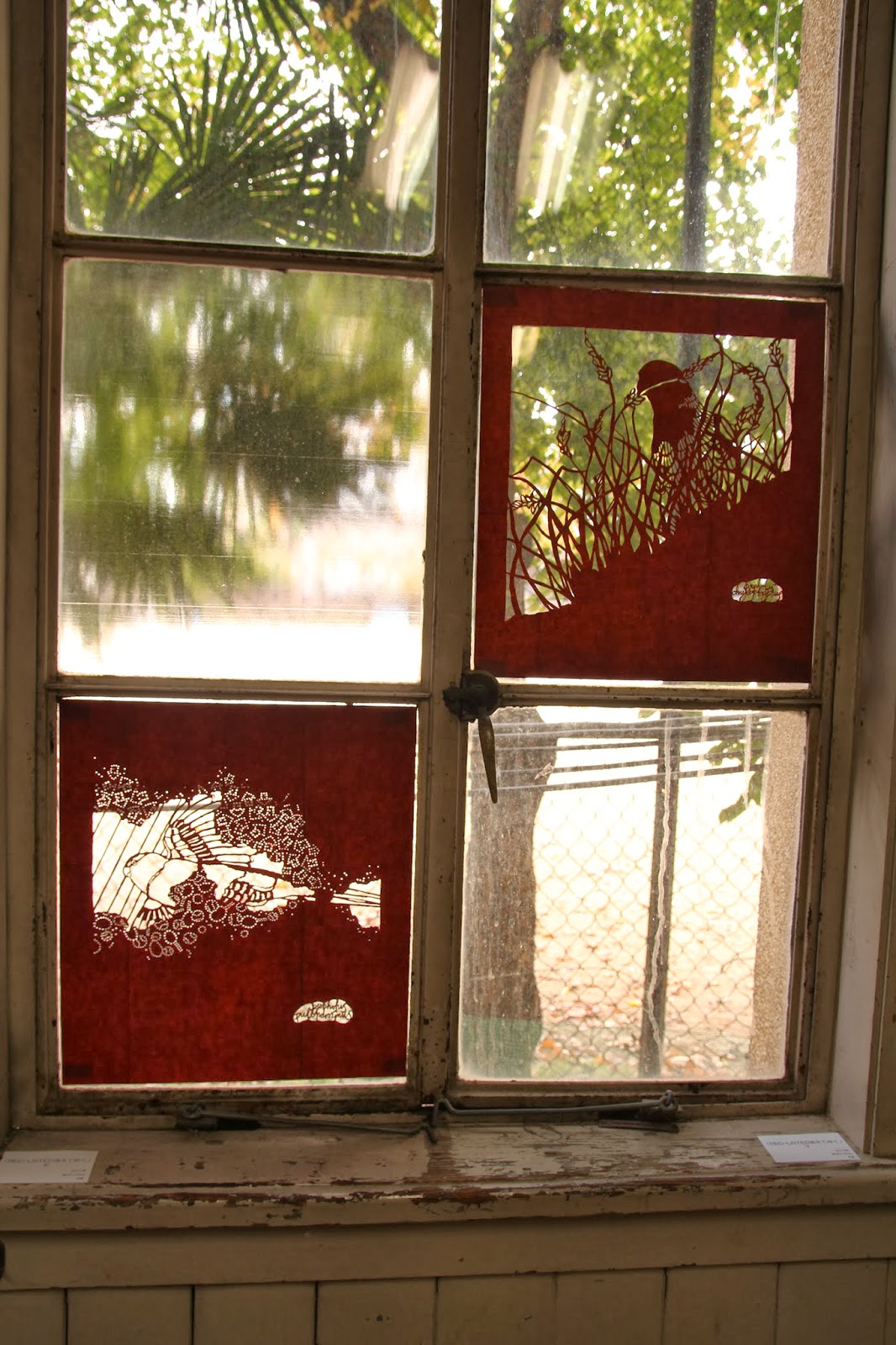
In making these, I was able to try out some new techniques, in particular using these tiny sharp circular stamps and to challenge myself on just how detailed I could cut. These are things that will help me in making new work. I also tried a different way of displaying them by having them up on windows in the gallery space so that they were backlit. This way you could see the intricate detail and it also brought out the warm brown colour of this traditional stencil paper.These days you can get a paler more plastic-y stencil paper that is less prone to shrinkage and more water resistant but this katagami stencil paper is the real deal that has been used for hundreds of years and it really has a different feel all together.
この五枚を作るとは勉強になりました。この小さい穴をあける「丸切り」を使ったり、どれぐらい細かく切れるかということも挑戦してみました。今からの作品にも役に立つ体験ですね。それで展示スペースの窓につけてみました。光が通ってくると細かいディテールが見えるし、型紙のあたたかい茶色が出ています。現在、一般に使われている型紙というのはもっと防水力を持っているプラチックっぽさがある洋型紙なんですが、何百年も使われているこの「渋紙」のほうが味がいいですね!

practicing using tiny punches on modern (less expensive) stencil paper.
現代の型紙で丸切り」の練習
I actually cut three layers at once, one of the traditional katagami for display, one of coloured paper as a decorative paper cut and another from modern plastic-like katagami for using to dye textiles with. Here you can see the design in ink on rice paper stuck to the stencil paper and cuttting through the whole lot. 同時に三枚も彫りましたー渋紙、洋型紙、色紙。墨で薄い和紙にデザインを描いて型紙に貼ってから全部彫っていく。
cutting three stencils at once and here peeling them delicately apart 一緒に彫った三枚を丁寧に引き離している。
detail of paradise parrot stencil with little house motifs 小さい家のモチーフを入れたゴクラクインコの型紙。
Since I made them just in time to exhibit, I was also able to receive feedback from my teachers and from the public about them. I got some good reactions and I think I even impressed the one hard-to-crack traditionalist professor who's always telling me I'm copying too much and need to find my own style.
展覧会までに作れたから、先生やお客さんの反応も聞こえました。いいコメントも貰いました。

Stencils as installed on the windows in our exhibition at Rissei Former Elementary school in Kyoto. 今間京都にある元の小学校「立誠小学校」の教室に型紙をこういうふうに展示しました。
stencils on the windows with the afternoon sun coming in 窓に貼って、陽射しが入ってくると暖かい感じですね。
It was nice that there was a small gardern just outside the windows so you could see real leaves through the leaf sections of the stencils too. 型紙の葉っぱの部分に、そとの実際の植物が見えて面白かった。

I've since caught up on the lost sleep and cleaned up the tornado that swept through my apartment in the week of non-housework and I want to encourage people who are making and creating to give in to the challenge and make what you want when the fancy takes you.
寝不足が直って、制作していた間に山ほどになっていた家事もできました。作って良かったと思っているので、制作している人を励したいです!作りたいものがあれば、熱心いっぱいの間で作りましょう!