I was only back in Australia for 10 weeks to the day when I found myself in Canberra setting up my next exhibition with my Dad. (Thanks Dad!)
オーストラリアへ帰国したばかりという気持ちがした10週目のところで、キャンベラでの個展の搬入なんてしていました!

My first solo show in Australia, "The Traces Between" opened on August 6th in the long and narrow space of Gallery 3 at
M16 Artspace. The opening was a packed event as three separate shows opened all at once. It was great that the visitors who came to see the group show in the main gallery then drifted through to both mine and Keith Bailey's Solo shows in the two smaller galleries. Hooray for capitalising on other people's friends!
オーストラリアで初ての個展です。キャンベラの
M16 Artspaceで細長いギャラリーで展示しています。そのArtspaceにて、三つのギャラリースペースがあって、同時に三つの展覧会も開きます。オープニングにたくさんの人が来ました。
 |
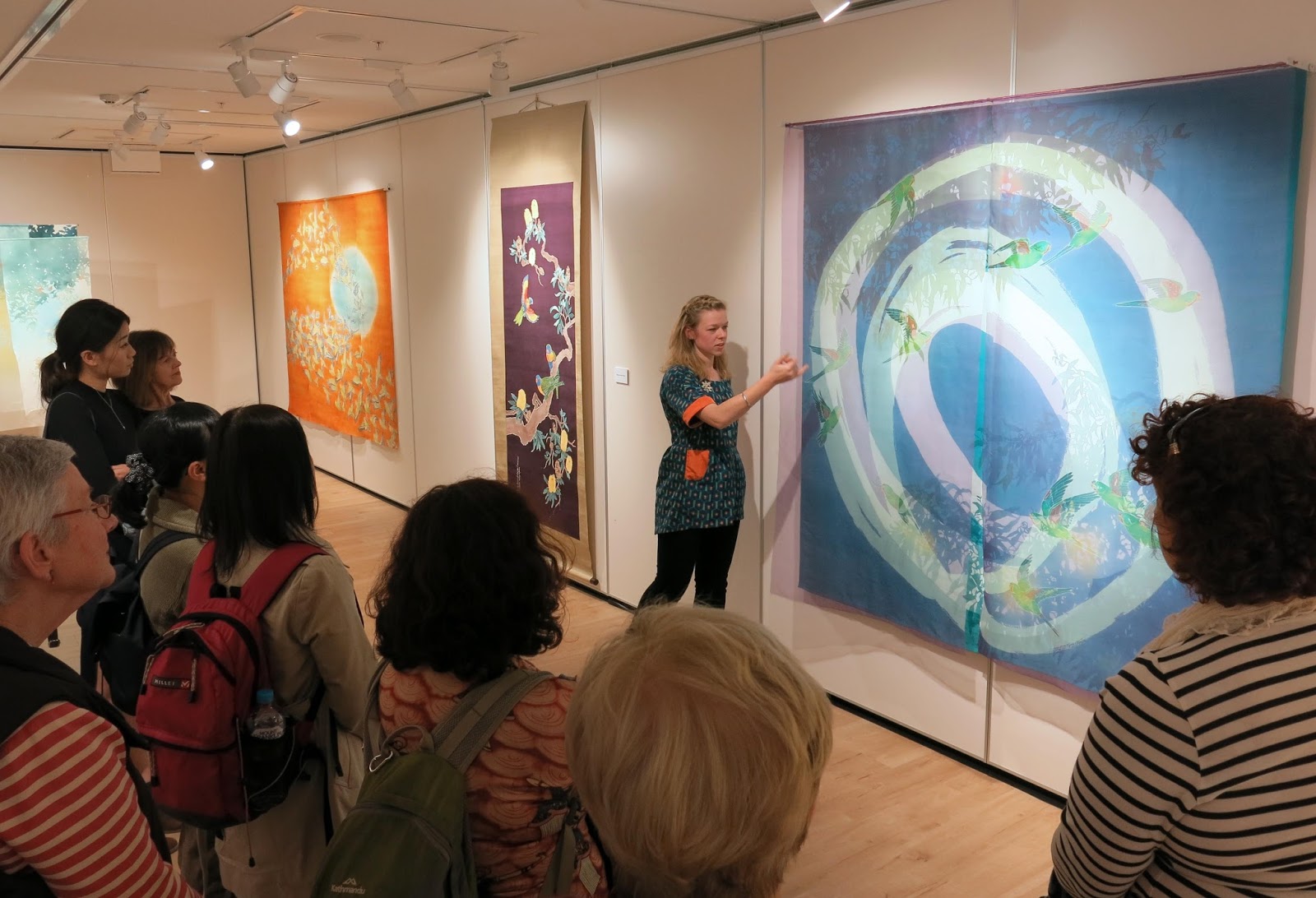
| Me explaining some of my work on opening night オープニングのパーティーで、友人に作品を説明している私。 |
 |
| Yay! other people's friends (plus lots of my friends and family too :)) 三つの展覧会が同時に始まるので、三つの作家さんの知り合いや友だちが来るわけ。いいシステムですね! |
I called my exhibition the slightly vague and arty sounding "The Traces Between". I wasn't trying to be vague or sound arty (goodness knows I've learnt a whole dictionary of meaningless arty tripe I could roll out if I wanted to). Instead I was referring to a variety of gaps both literal and not.
展覧会のタイトルを「The Traces Between」にしました。訳したら「間の跡」に近いと思います。かなり微妙と思うかもしれないですが、色々な「間」をほのめかしたかったわけです。
One is the physical and visible gap that appears between areas of dyed colour when you use a resist technique like Katazome or Yuzen. In yuzen, that will be where you have drawn fine lines of paste with a metal-tipped tube. They leave behind the colour of the fabric below; white traces. A stencil is used for katazome, so you get a distinctive silhouette-style image. This positive image is merely the reverse of lots of blank gaps and spaces where resist paste was applied.
一つの「間」は、作品に見える防染された間です。友禅の場合では、防染糊の線の所ですね。型染の型紙を通した糊のところは出来上がった作品には、ただの間にすぎないです。
That is to say, resist-paste techniques rely on the preservation of the under fabric and then upon revealing them in the final piece.
つまり、防染糊の技法を使うと、糊が守った生地の色は、完成した作品には跡になります。
 |
| Yuzen detail: the writing is where the resist paste was. In the final piece it is just a trace. A blank space. 友禅の防染した文字。染め上がった作品から糊の存在が消されて、跡しか残らない。 |
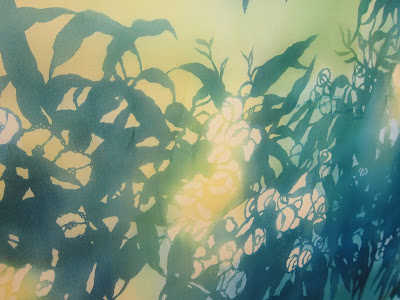 |
| In the case of Katazome, the blank negative space forms the image. In between all those gaps, the imagery is brought to life. 型染の場合、余白があるからこそ、イメージが見えてくる。 |
Another gap I was trying to allude to is the physical space between layers of fabric; the gaps that air can flow through. Since late 2012, I have been layering sheer silks in my pieces, leaving gaps in between them and allowing them to catch the breeze or the draft from an air conditioner.
もう一つの見える「間」は、生地の層のあいだにある空気です。2012年後半から、何枚かの絹を染めて、重ねる作品を作り続いています。この薄くて透明絹が風もちくはエアーコンに振られます。
By not framing my work, or stretching them tightly over a wooden board, they have a sense of life.
縁やパネルを使わないと、何かのイキイキ感がでる気がします。
 |
| sometimes the gaps between layers are even big enough to get inside! 2枚を重ねた作品です。時には入れるぐらいの間です! |
 |
| Degradation series from 2014 where I made a point of spacing layers out from each other. 2014年のシリーズでは3枚の絹を重ねて、わざと5センチずつの間で展示してみたら、良い感じでした。 |
 |
| Cross cultural spaces? Australian foliage meets Japanese noren |
A non-physical gap is that between Art and Craft. I don't yet know where my work fits in those terms but I get the feeling it's somewhere in between; somewhere on the divide.
作品には見えない間もあると思います。それは「美術」と「工芸」の間。自分の作品はどちらに近いというのがまだわかりませんけど、確かにその真ん中に寄っていると思います。
You could also say that it straddles cultures too, swaying somewhere in the grey area between Australian and Japanese but let us not get carried away with ourselves! 文化の間というのもあると言えるでしょうが、今はあんなに自慢するのをやめよう!笑
This show is a combination of larger works that I completed whilst undertaking my Master's degree in Kyoto as well as a collection of new work. My graduation piece from Kyoto Seika University which features the migration cycle of the endangered Swift Parrot is the centrepiece (it can be helped since it's over 5 metres long!) and it catches the air nicely as people walk by in the space.
今回の展覧会は、京都で作った大き目の作品と、帰ってから創ってみたもっと小さな作品の組み合わせです。
 |
| My Graduation work from Kyoto Seika in March 2015 is the star centrepiece of this show. 京都精華大学の大学院終了作品で作った「オトメインコの渡り」が今回の個展では、メイン作品になっています。5メートル以上なので仕方ないですけど! |
Amongst the new work (some of which were completed at very VERY closely to the finish line!) are some small pieces I'm excited about that combine the fine line-work of yuzen with locally sourced natural dyes. In some inital research (much more to be had), I managed to find foliage from three eucalypts found around my suburb and boiled them down to extract some shades of yellow-brown and peachy orange-brown. Then I used those dyes to dye little "portraits" of Eucalyptus blooms and leaves. Haha! see what I did there? it's like a textiles pun or something.
新作の中、近所にあるユーカリから煮出した染料でユーカリのイメージを染めたちいさな作品もあります。まだまだ植物染料について沢山調べないといけないと分かりましたが、はじめての実験としてとてもうれしい結果です。
 |
| New small experiments in natural eucalyptus dyes are also on show. |
Anyway, the show is on at M16 Artspace in Canberra until Sunday August 23, so be sure to check it out if you are in town. Otherwise, look forward to more photos after the show is complete!
さて、個展は8月23日までです!終わったらまた写真をアップしますから楽しみにしてください!