Showing posts with label canberra. Show all posts

Saturday, August 4, 2018

Rocks Rock! Experiments with local Pigment Colours

Rocks are so cool. In case you hadn't noticed.
More on that later! First, a bit of background...

When I was in Japan studying katazome, I was introduced to dyeing paper (and sometimes fabric) using 'ganryo' pigments.

"Ganryo" just means colourant, it is the colour in powdered form without any binder. (Though it can be sold in the form of paint-pans or solid sticks). It can be a naturally occuring colourant, like yellow ocher (ohdo) calcium carbonate (gohfun), cinnabar (ginshu which is natural but ironically, toxic!) indigo (ai), ultramarine (gunjoh) or iron oxide (bengara) etc etc. They can also be chemically altered versions of these (to produce whitened tones etc) or just straight up synthetic pigments (basically a chalk substrate dyed different, sometimes nasty colours)

A small portion of my collection of commercially available Ganryo pigments. The ones in stick form are already mixed with a binder.


Pigments are also used in Nihonga (Japanese-style Painting) but they are slightly more complicated - see my older post all about it, and painting broccoli, here.

That one time, when I spent 5 days painting a broccoli portrait in Japanese pigments...

As I was saying, pigments are also used in combination with the katazome technique. Most famously, rich pigment colours are used in the Okinawan Bingata technique (similar to katazome - see more here) and I suspect that's why they are in the katazome repertoire in the first place. In both cases, the powdered pigment is mixed with a binder - soymilk - to create a thick paint-like liquid. These can then be applied to the fabric or washi being dyed in the same manner as dyes (with a stiff bristled brush, from the front side).

Mixing commercial pigments with soymilk to a painty consistency.
Some bits and pieces I dyed on washi (kozo paper) using commercial pigments and the katazome technique. 

Just to point out that pigments have different characteristics to dyes, it might be important to remember:
A DYE is colourant dissolved in liquid which grabs onto a fibre - it really gets into the fabric and you faciliate a chemical reaction (with steam or an alkali etc to ensure that it links sucessfully and stays on that fibre).
A PIGMENT, on the other hand, is insoluble and the particles sit on the fabric, rather than seep into the fibres. They are matte finish and can appear to look more like paint.
Bingata technique utilises this unique difference by dyeing colours first (transparent colours, which grip the fibres) then adding details on top in pigment colours (matte colours that sit on top of the fibres. This step is called "kuma-doi" lit. adding shadows). This creates a sense of depth which can't be achieved by using only layers of dye.

a detail of a bingata pattern on cotton cloth from the 19th Century. You might be able to see the heavy red pigments in the centre of the petals creating depth, versus the translucent blue dye of the background.

ANYWAY!

Having known that pigments can be used with the katazome technique and having played around with them in a short Nihonga course, I wondered if I could make my own, Australian pigment colours. Canberra is well known for "Canberra Red Bricks", churned out here from 1913 to the 1970's, so I knew that at the very least there would be a clay around here that I could use for pigment.

Rewind a bit to last September.

sketching with dirt and a lump of charcoal,
September 2017
As one of four artists chosen to take part in Craft ACT's inaugural 'Spring Tidbinbilla Residency", I spent time out at Tidbinbilla Nature Reserve, sketching, hiking and photographing. During a hike back down from Gibraltar Peak, I stopped to sketch the view of the mountains. I had found a pinch of some clay-ish dirt up the track and little and wanted to try using it as paint. Nearby where I'd sat to draw I also found some burnt tree stump and it worked perfectly as a charcoal.
This simple drawing sparked an obsession.


Fast forward and I've collected 100 Natural Pigments and counting.

a growing collection of local pigment colours.

Since February this year, I have been keeping my eyes on the ground. In non-descript walking paths and parks, along rivers, on the tops of hills and some trips to beaches, I've found colours in rocks, dirt, shells, ash and charcoal.

Mostly, I've smashed, sifted, ground, re-sifted and re-ground rocks to get these colours. Some rocks give themselves up easily, crumbling after one strike. Others are like trying to shatter steel.

smashing up rocks - this one gave itself up easily.
after sifting and grinding.

I've been sort of playing at faux-Geologist. Mostly I've been smashing and seeing what happens. I've also been trying to understand which rocks are found where by using these visually stunning but scientifically overwhelming Geological maps.

beautiful but cryptic Geological Map from Geosicence Australia

WOOO! Rocks!

The most exciting part of this whole experiment has been to do what I first intended - use these colours I've collected as pigments for katazome. The chance for this arose when an exhibition was borne of Craft ACT Spring Residency at Tidbinilla last September. The show wrapped up this past weekend at the Tuggeranong Arts Centre in Canberra. The work all came together beautifully, without intending to, all four of us artists used complementary textures, colours, as well as references to stones and foliage. Narelle Phillips at the Tuggeranong Arts Centre did an excellent job of curation and organising everything.

Traversing Tidbinbilla, Tuggeranong Arts Centre July 6-28, 2018. To the right is work by fellow artist Sally Mumford.

Here are a few close ups of the work I exhibited. You'll see works on paper - these are all made with my pigments mixed with soymilk, applied to kozo washi. I also tried the pigments on different weights of silk, in an installation piece depicting Eucalyptus Cinerea foliage. Finally, I wanted to display my vials of pigment in the manner of a old fashioned museum, you can see this in the wooden box in the pictures.

Foliage Series, 2018. Katazome on washi using local pigments. 38 x 40cm
Left to Right, 'Welcome Swallow', 'Eastern Yellow Robin' & 'Grey Shrike-thrush' 2018. Katazome on washi using local pigments. each 25 x 31cm
Flame Robin (Male) 2018

In all these works on paper, I selected ground pigments from what I had collected, mixing them with soymilk in small mortars. I didn't really mix different colours together, just used what I had as is or layering one colour over another. Charcoal from found burnt logs was good for giving strong blacks. The hardest colours to represent were a vivid yellow and red for the Flame robin and the Eastern Yellow Robin. In real life, the breast feathers of these birds are nearly fluorescent. I had to settle for earthier versions.


Cinerea Breeze. 2018. Katazome and earth pigments on silk. The cottage we stayed at out at Tidbinbilla during the residency is called Cinerea Cottage, so this piece has extra meaning :)
Floaty detail of Cinerea Breeze. The foliage is dyed using pigments and the background beige and orange tones were dyed in a natural dye bath of Eucalyptus Cinerea leaves. 


Lastly, here's my (Tiny) Museum of Natural Pigments. I love that colours which seemed so ordinary and similar when I spotted them, appear completely different when crushed and lined up next to each other. Many of these were successful as pigments to dye paper but a lot of them were too gritty or crystal-y to be an effective colourant. Still, they are pretty as a powder amongst their fellows.

*I'd like to make clear that I have only taken small amounts of colour from locations that aren't national park or designated nature reserves. I definitely didn't take from spots where it would damage the area. I know there will be some people who will take issue with me having done this. I have tried to honour the spirit of nature and her beauty through these works. If I'm found to have done something wrong, I'm sure I will hear about it...*

In an exciting development, this exhibition will now travel to be exhibited in the gallery at the Tidbinbilla Visitors Centre, from Friday August 3rd until the 14th of October 2018! It will be great to see the works so close to the location that inspired them and I hope lots of interstate and international visitors get to see them too.

The next step in this Pigment adventure is looking further afield for different colours that aren't present in the ACT and also, trying to make pigment colours from natural dye baths - as 'lake pigments'. This a science-y process that I haven't had much luck with yet (though admittedly, I haven't tried very hard yet!). Watch this space!

Saturday, July 28, 2018

Weeds - Beautiful but Complicated

For about two years now, I have been making artworks that focus on the subject of "Beautiful Weeds". Taking those plants we know as roadside pests, garden over-growers or paddock infiltrators and making 'portraits' of them.

First "Beautiful Weeds" series, 2016. Blackberries and Sedges on silk. Shown at solo exhibition at the Japan Foundation Gallery, Sydney. Photo by Document Photography.

At first, this was a kind of straight-up visual fascination. Plants which I hadn't considered drawing before, let alone dyeing, were suddenly everywhere I looked. Actually, that was the clincher - realising that in trying to depict a realistic and natural Australian landscape, I was editing out many plants in order to represent just the natives - the Eucalypts and the Wattles. When I looked at the natural environment most familiar to me though, (the nature reserve at the back of our suburb), it was quickly evident that trying to depict the area without weeds would mean some serious editing. A vast majority of the intriguing plants up on that hill ARE weeds (according to lists and information compiled by our local government).

my 2017 edition of "The Beautiful Weeds of Canberra" shown in solo exhibitions in Canberra and Kyoto, October 2017. Series including Blackberry, Fennel, Yellow-Flag Iris, Salvation Jane....


Scarlet robins love sitting on these Greater Mullein stalks.
It's a Weed. Just saying.


Blackberries, sedges, "rosehips", cootamundra wattles, plantation pines, purple-top, mullein, salvation jane...all of these co-exist on the hill with Silver wattles, Eucalypts, Native Bluebells. Not to mention Crimson Rosellas, Black Cockatoos, Scarlet Robins, Superb Fairy Wrens, Golden Whistlers...(some of which, by the way, FAVOUR perching and feeding on the plantation pine trees, cootamundra wattles and greater Mulleins...but anyway, I digress)

So this whole "Beautiful Weeds" obsession that I've had going for 2 years or more began as an attempt to render a realistic depiction of the landscape before me; a more faithful conglomerate of present species than if I were to edit the 'weeds' out and leave only the 'natives'.


Since diving into this topic, it turns out - as it always does when you dig a little deeper into anything - that I'm not the first to think weeds could actually be beautiful.
Like, I'm about 500 years late to the party.

'Large Piece of Turf' 1503 by Albrecht Dürer

Here's a beautiful close up of some ordinary grasses by Albrecht Dürer from 1503. Even in 1503, artists were recognizing the beauty of the ordinary plants at our feet.

Albrecht Dürer, 'Large Piece of Turf' 1503 (detail)

It's also been interesting to find other people out there doing cool things to do with weeds. Here's just a couple.

  • Spontaneous Urban Plants, is a research project based in New York with a website and instagram account that aims to spur discussions about the place of weeds in an urban environment and the cultural perceptions we attach to them.  
  • Diego Bonetto based in Sydney calls himself "The Weedy One" and is leading a revival of foraging and edible weeds education. His website includes a link to this great "Wild food Map" sharing information about locations of different edible species. He is also an artist and has some wonderful prints of common weed species here.

Now don't get me wrong.
This isn't to say that weeds are all great and that they don't come with a whole load of emotional and political baggage. Because they do. I acknowledge that but I am merely acting as observer, depicting the environment as I see it.

"Narrabundah Hill", katazome and yuzen on silk, 2017. On show at Solo Exhibition at Galerie h2o, Kyoto October 2017. This piece was an ode to my "local hill" with it's co-existing Cootamundra wattles, Mulleins, Blackberries, Scarlet Robins and native grasses.

Slowly, I am reading opinions of scientists and researchers who know far more than I do and learning from them.

One book I eventually made it through was "Beyond the War On Invasive Species", by Tao Orion. Whilst her book was written more for those working in environmental restoration, she had some really poignant things to say about the role of weeds and our interactions with them.

"Invasions are happening faster now than at any point in recent history, a fact that leads to a great deal of concern since invasive species appear to disrupt the "fragile balance" of nature...however, evolution is at work even in these scenarios...." pg 91
Tao notes that even though weeds can be unpredictable in a new environment, they are often favoured by local birds and insects for food or nesting habitat.

"..All organisms, including invasive species, require the participation of other organisms to ensure their survival - plants depend on pollination and seed dispersal to survive and spread, and animals need adequate food and habitat. If invasive species are spreading and thriving, then they benefit from, and are benefiting, such ecological assiciations...even the world's "worst" invasive species are being used by other organisms in their new habitats." pg 94.
This observation is seconded by Australian biologist and author Tim Low in "New Nature". Low lists different relationships between Australian native animals and foreign weeds: Lantana provides protection for fairy-wrens, bandicoots and reptiles. Red-Tailed Black Cockatoos feed on the seeds of weed 'Spiny Emex'. Muir's Corellas, a rare member of the Cockatoo family, eat another weed, Guildford grass. Low goes as far as to say "Many species now rely largely on alien tucker. If Australia's foreign contingent vanished overnight, many eco-systems would be kicked into chaos." pg 93

Low also points out that the birds or animals themselves are simply being opportunistic in their use of foreign weeds as food or habitat. "...no law of nature forces native animals to prefer their natural foods, or even to recognise them." pg 104.

I call these next images "Native Birds happily tucking into Alien Tucker"
Satin Bowerbird raiding berries off next door's ivy vine. They don't see a foreign plant, they see food! 
Crimson Rosella eating pansies outside the Legislative Assembly (silly parrot)
Sulphur Crested Cockatoos destroying, I mean eating, Cherry Blossoms in the Canberra-Nara Peace Park. 

Admittedly, the birds above aren't eating weeds exactly, they're eating non-native plants. Still, the sentiment is the same: non-native plants can serve a purpose in an eco-system too.

Back to Tao Orion, she brings the subject of weeds back to the bigger picture of how the environment is shifting, and will continue to change.
"we will not achieve anything...by continuing to eradicate these novel organisms in the vain hope that the ecosystems where they live will be the same as they were at some idealized time in the past. We are here now, on the cusp of the sixth great planetary extinction, with climate change intensifying, and the ways that we relate to the land that sustains us will become ever more central to designing our way through the challenges to come."
It reminds me of the problems faced by traditional crafts and this attempt to stem alterations to the long-held traditions when change is the only certaintyWhen we can step back from our own points of view and ego for a moment, we see that our worldviews are based on our human expectations of how something should be in order to benefit us. Not everything exists in the way that humans would like. Nature is a far more complicated and interconnected system than we can hope to exert control over.

ANYWAY!
This has become a long and winding, probably flawed, musing on weeds. I am still focusing on them in my work. I plan to expand my "Beautiful Weeds of Canberra" series into next year. You can see more on my homepage here, too.

Beautiful Weeds works on my website
I want to finish with a snatch from "The Book of Thistles" by Noelle Janaczewska. I loved this book, it's part poetry, part musings on the nature of the weed and the thistle in social history.

 "Australia's relationship with hardhead thistles digs into a series of deeper, thornier questions. About what we believe counts as responsible citizenship. About evolving notions of national identity, the siting of frontiers, and how we relate to each other across our differences. About deserving and undeserving nature. All those shades of green - Legal. Scientific. Romantic. Tragic."

Saturday, July 30, 2016

Solo Exhibition Coming up soon! Somé: Dyeing the Australian Landscape

"Somé: Dyeing the Australian Environment" will be on show at the Japan Foundation Gallery in Sydney from August 13 to September 17!!
It's a large space to work with and it means I can show some of my older works alongside new ones - all incorporating varying ratios of Australian imagery x Japanese dyeing techniques. 

I titled the show "Somé : Dyeing the Australian Environment" to emphasise a few things.

One is that I've been coming more and more to the conclusion that the term Textiles, in the manner that it exists in Australia, doesn't fully explain the work I do. I don't mean that in an arrogant way like "I'm so unique, the categories don't apply to me". I mean that the term Textiles in a bit misleading. I don't think just saying "dyeing" comes across the right way either. Especially with the surge of popularity in Natural dyeing and "eco-dyeing" in the last few years, perhaps the wrong image of simmering fabric in a pot is what people will think.

Somé (pronounced so, as in socks and me as in melinda)
means "dye" or "dyed work" and in Japan that is understood to include all manner of dyeing work - wax resist, paste resist, dip dyeing, natural dyes, hand painted dyes - plus more.
Textiles in Australia tends more to refer to woven, embroidered, printed and sculptural fibre-work. Though there are plenty of artists using dyeing as their medium in Australia, I don't know that the term Textiles alone describes pictoral dyed textiles.

It would be a whole lot easier if the term somé just existed in English!
There are already plenty of Japanese words bouncing around in everyday English. How about karate, sushi, manga, tempura, wabi-Sabi, bokeh and lately even Kaizen and Kintsugi! Why not add a new concept to the import list? After all sometimes a word in another language just does a feeling or concept better justice. 

So I titled the exhibition to reflect that aspect of textile work that doesn't tend to feature for Australians.

Also, it's about the Australian environment - and more broadly, imagery of Australian nature. When I first started learning katazome, my first urge was to mix in some Aussie influence - parrots, english lettering, rusty orange and bright blues. I think I went a bit too far in those early works on the "cheesy scale" but the same intent still remains: I want to show what the techniques can do when turned toward a whole new set of imagery and cultural connotations. 

Instead of plum blossoms and sparrows or cranes and pine trees, my works depict Rainbow Lorikeets and Banksias, Cockatoos and Gumtrees. In place of subdued landscapes with bamboo or chrysanthemums, I'm dyeing vibrant colours of wild-flowers and dry grasses.

I'm excited to be showing so much of my work all at once in Australia, especially in Sydney where I've never had the chance to do so before. I've also been lucky enough to get a grant from ArtsACT which means I can be present at the opening and run a couple of workshops too!

You can see the information about the exhibition here:
http://www.jpf.org.au/jpfevents/16-some/index.html


Beautiful Weeds and the Sixth Extinction

What is a weed? A plant whose virtues have not yet been discovered.


Ralph Waldo Emerson

I've muttered a bit before about weeds and how they might not be the baddies we've condemned them to be - and can also be quite beautiful.

Since then, I've started doing some reading about said weeds - mostly to see whether I was being naive to suggest that "weeds" and "exotic pests" will probably just take over the landscape as part of the natural cycle of things. So far I'm still straggling through the thick scientific-ness of the books but I've found some interesting insights.

For one, I'm certainly not the first one to show a little sympathy to the poor weed. Really, it's a matter of nomenclature.

Beautiful invasive "weed" - Lantana Camara, spotted in Wakayama prefecture, Japan

Because really, there's no difference between a so called "plant" and a "weed". Weeds are just something we humans have decided are plants in the wrong place and are not advantageous for our purposes - eg invading an otherwise productive crop area, messing up a paddock we decided to graze sheep or cows in graze (also exotic, by the way), etc etc.
Some weeds can also be classified "invasive species", which, if you want to get finicky and historical, is mildly unfair, given we Australians got off boats from overseas and spread all over this place. (ha!) As a side note, see this interesting explanation of why some call Australia Day, which falls on January 26th "Invasion Day.

One book I've started reading is "Beyond the War on Invasive Species" by Tao Orion. She's all for taking a natural approach to controlling weeds and restoring habitats and one thing she says stands in the way of that is the way we talk about weeds using unscientific and emotional words like "invasive" and "noxious".

http://www.chelseagreen.com/beyond-the-war-on-invasive-species
Tao explains how some ecologists will make the case that introduced species are a threat because it can't be predicted exactly what long term effects they might have on their adopted habitat or neighbouring species. And yet, there are actions taken to eradicate certain invasive species using herbicides that have, when you look into it, highly questionable ingredients and effects which no doubt pose risks in the future that cannot be fully predicted.

Wouldn't it be easier to just let the "weeds" be? Probably that is too naive of me. I haven't read far enough into the book yet to see what Tao suggests instead of severe chemical eradication.

It's interesting how things have come to this point of demonising some plants over others. I guess it's a side effect of agricultural society. When really, 
the idea of "invasive species" is peculiar since all plants and animals are native to our singular and unique planet. 
Tao Orion, "Beyond the War on Invasive Species"pg 10

Blackberry - Invasive (and delicious...) image from Eurobodalla Shire Council

On a different note, did you know there is an official list called "Weeds of National Significance" in Australia? Sounds quite noble, doesn't it? (Not as much when you use their abbreviation of WoNS...) It's a list of 32 weeds that is: 
"a proactive attempt to strategically manage priority weeds that pose future threats to primary industries, land management, human or animal welfare, biodiversity and conservation values. It is an effective tool that...assists States/Territories to prioritise their weed management strategies for the benefit of Australians"

On the list of 32 WoNS, only some are found in the ACT. You can find more info here, if you're into that kinda thing. http://www.environment.gov.au/biodiversity/invasive/weeds/weeds/lists/wons.html

More info HERE
One more book I found, which is not as relevant for the humble weeds issue but interesting in general is "The Sixth Extinction" by Elizabeth Kolbert. Her book title refers to the wave of extinctions that have occurred in the last 500 million years or so; "The Big Five" Extinction events which have been altering the species on the planet and suggests that we are now in the Sixth wave. In other extinction events, climate and sea level changes could have been the triggers but this "Sixth Extinction" is said to have been caused by Humans. There's also suggestions we may be in a new epoch, the Anthropocene, marking the overwhelming human impact on recent modern history.

Kolbert's book documents, amongst other things, some of the species that are becoming extinct around the world, at remarkable rates and the efforts by scientists to study them. She makes an interesting point about the mixing of species across continents in the modern era. To me it seems unavoidable that plants will mix and collide and naturalise.

"From the standpoint of the world's biota, global travel represents a radically new phenomenon and, at the same time, a replay of the very old. The drifting apart of the continents that Wegener deduced from the fossil record is now being reversed - another way in which humans are running geologic history backwards and at high speed. Think of it as a souped-up version of plate tectonics minus the plates. By transporting Asian species to North America, and North American species to Australia, and Australian species to Africa, and European species to Antarctica, we are, in effect, reassembling the world into one enormous superccontinent - what biologists sometimes refer to as the New Pangaea."

(pg 208 The Sixth Extinction, An Unnatural History)

Some examples of plants "jumping continents". It's all give and take though...

Prickly Pears - weed gift from the Americas to Australia

Sweet Hakea a weed gifted from Western Australia to South Africa

Tasmanian Blue Gum - hey California, you're welcome!
Camphor Laurel - Thanks for that China & Japan! now a weed in NSW and QLD

ANYway. I'm still reading these books (well, let's be honest, there's not a whole lot of reading happening at the moment) and these are just tid-bits that have tickled my interest.

It's all been part of thinking about a new series of work I'm making, "The Beautiful Weeds of Canberra"

For this series, I've been sketching and dyeing some of the weeds found aoround nature reserves and suburbia in Canberra, kind of elevating them from ordinary stragglers to elegant, proud plants. As I've been sketching them, which takes a lot of concentrated observation, I've noticed how many are really quite beautiful. Well, re-noticed. I already had an inkling this was the case and it's proven true. I hope the weeds will come across as I intended when the works are complete. 

Here are a few progress shots. The finished works will be in show in Sydney next month. More to come on that next time!


Friday, April 29, 2016

Enlightened - Creating Artwork for Projections プロジェクションマッピング

Although the Enlighten Festival for 2016 wrapped up in Canberra last month, I wanted to share some images of the works I created and give a bit of a summary of the experience.

What is Enlighten, you ask?

Enlighten Canberra is an annual outdoor art and cultural festival featuring light installations and projections, performances from local and interstate musicians, dining and film events. This year it ran for nine nights and included free late-night openings at many cultural institutions and the ever-popular Night Noodle Markets.

The festival is an Australian Capital Territory (ACT) Government initiative held annually in early March, encouraging people to "See Canberra in a whole new light." The centrepiece of Enlighten Canberra is the illuminating of Canberra's cultural institutions after dark, including Old Parliament House, Parliament House, the National Gallery of Australia, the National Portrait Gallery and Questacon
You can see a general rundown of the festival in this video:


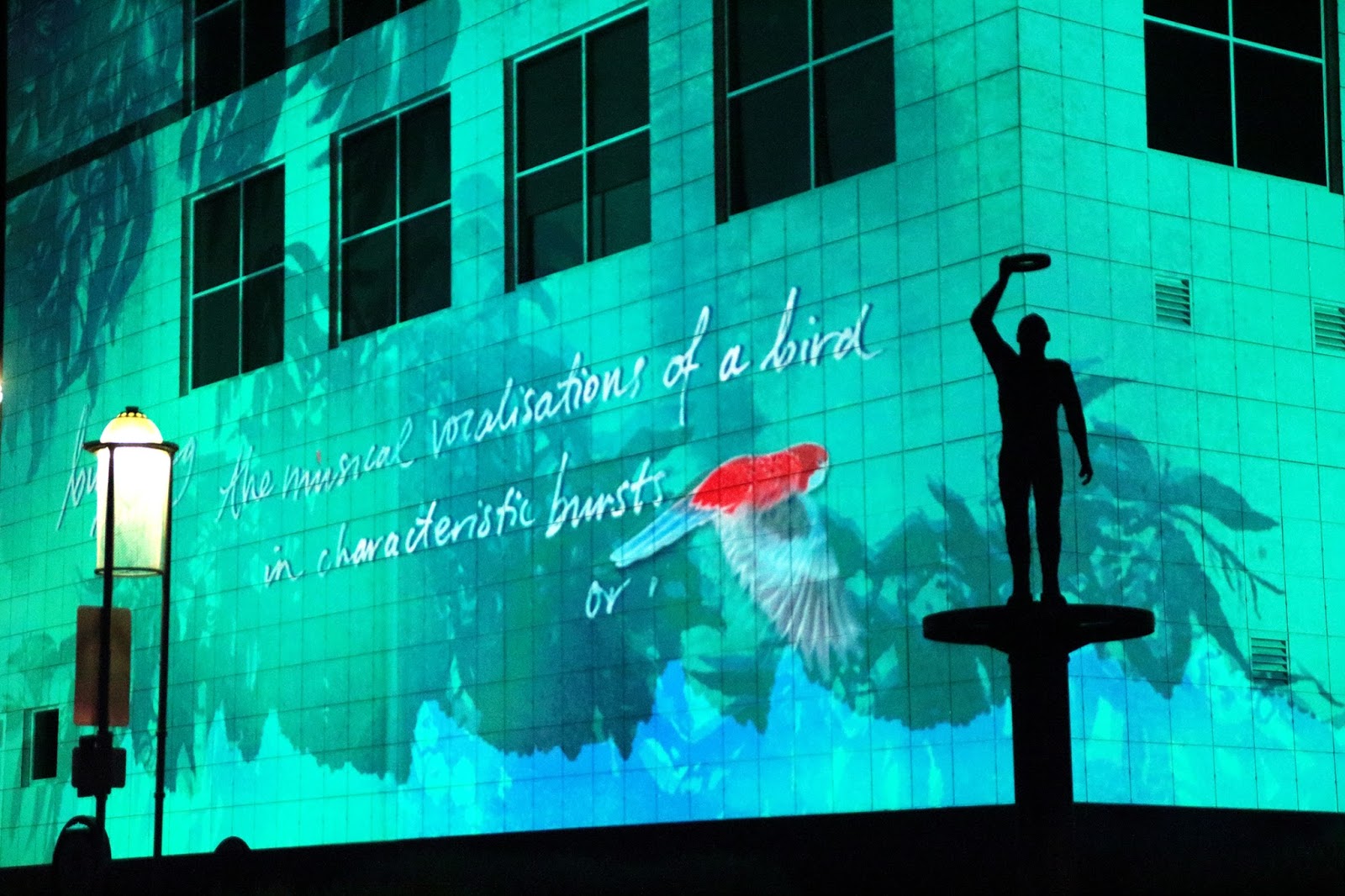
I was involved in creating some digital artworks for projection this year. It was something totally outside of my skill set, and a great chance to see my own creations splashed across some of Canberra's National buildings. I was asked to create pieces for the National Portrait Gallery, Questacon (The National Science & Technology Centre) and Old Parliament House.

The Electric Canvas is a Sydney company who were responsible for the projections - both finalising the digital artworks and all the physical equipment and technology to actually project the imagery. The six of us artists selected were able to make our projection imagery in our own style, encouraged to tie themes to the buildings themselves if we wanted to but not necessarily. After approval by the national institutes themselves, we turned our concepts into digital templates, with assistance from the Electric Canvas.

I'd like to show you the end result on the three buildings I was assigned, along with the official "blurb" I wrote to be displayed on small signs nearby the buildings.

The National Portrait Gallery
A Swift Migration


"Despite their size, these Swift Parrots make an impressive migratory journey each year from Tasmania to Victoria and back again, following the seasons. After breeding in the cooler Tasmanian summer, they fly over Bass Strait to spend the winter in South-east mainland Australia, apparently without stopping. They follow the flowering of gumtrees – a favourite food source.

One of only three migratory parrot species in the world, Swift Parrots are now Endangered. They are affected by predation, loss of nesting trees and habitat degradation.

This artwork is an attempt to capture and celebrate the Swifties’ unique journey and colourful characteristics."


Questacon
Call of the Crimson Rosellas

"Crimson Rosellas are a common sight around Canberra, flashing their red and blue plumage as they fly over the suburbs and nature reserves. Seeing and hearing them outside is always a nice reminder that this really is the “Bush Capital”. In this work, Crimson Rosellas take flight, accompanied by visual representations of their calls.

The data taken from their flight-call is transcribed in the style of a sonogram, visualising the change in the sound signal over time. Though you cannot hear this birdsong tonight, perhaps you can imagine their noisy cries, rising into the air as they fly by."


Old Parliament House (The Museum of Australian Democracy)
Imagining the Grassland


"When the construction of Old Parliament House began in the 1920’s, much of Canberra was still native grassland. Based upon historical photographs, paintings and newspaper articles, I have tried to imagine what this location would have been like prior to construction.

You can see native flora and fauna species as well as maps and quotes from the time. Several of these demonstrate the controversy of early Canberra; whilst some dismissed the new Capital as dry wasteland, others had grand visions for a modern city. Thankfully we can enjoy that visionary city today, still surrounded by a rich natural environment."


I have to say, working digitally is definitely not my forte; give me a pen, paper and scissors over a mouse and screen any day! I had some basic competence in Photoshop before starting this project - thanks to mandatory classes back at Art School and dabbling since then, but this work with templates really stretched me - and was at times incredibly frustrating. It's hard to have a vision in mind of what you want to achieve but not have quite the level of skills necessary to pull it off.

I did what I could with my templates but with two of them, the final creative work of animating and refining the files was carried out by the Electric Canvas. What they did was amazing - I have no idea how they did it (which is a shame because I can't replicate anything like this in the future) but the final animated pieces were impressive. It's hard to relinquish creative control over something so personal as an artwork you made and of course, somethings will be lost in that process. However, a collaboration like this means that your work is brought to life in a way you could never have achieved by yourself.


There was a lot of talk in the media and on social media following Enlighten when it was made clear that the artists (me and 5 others) were not paid for our work on the projections. I entered into this project knowing it would be unpaid in return for "exposure" and skills gained - whilst I can't say I got an awful lot of either of those, I'm resolved to the fact that sometimes that's just how the dice roll. Nonetheless, it would have been awfully nice to be financially compensated for the ridiculous number of hours I spent hacking away on Photoshop. When I heard that artists HAD been paid in previous years that made me feel pretty cheated and it's unfortunate because it reinforces the pattern of artistic work not being compensated in the same way as other professionals involved - I'm sure the security guards, noodle market workers, acrobats and projector/equipment operators were getting paid in money and not exposure...

If you are interested you can see articles here:  "The Dark Side of Enlighten", "Gov't Defends Unpaid Mentoring Program" and "Enlighten Artists Unpaid but Ecstatic" (to be taken with a grain of salt)

In any case, it's nice for Canberra to have an Autumn event as big as this which draws crowds out in the evenings and enjoying Art and Culture. It's events like these that help us celebrate our city and allow anybody to experience the arts without the pretension; without feeling like it's not for them. Hopefully with a little re-thinking of the budget for next year, this event can continue to be an engaging and exciting event for our city.


Saturday, December 19, 2015

Endangered Species: Just part of natural cycles of extinction?

In many of my artworks to date, I have depicted endangered species of Australian birds, especially parrots. Some of them are listed by the IUCN as Vulnerable, the lowest risk level, and others, like the Orange-bellied Parrot, are listed as Critically Endangered, which is "two steps away" from Extinction. (the next is Extinct in the Wild and then officially Extinct. done. dusted. bye-bye)

In addition to birds, I've recently begun looking into Endangered plant-life and I found out that one of the Eco-systems that used to dominate the ACT and parts of NSW is now Endangered; "Natural Temperate Grasslands". This kind of habitat is dominated by native grasses like Kangaroo and Wallaby grass, tussocky grass and many small flowers and plants. There are very few trees, covering less than 10% of the area. There are also particular insects, lizards and birds that have a reliance or affinity with this habitat, such as the Golden Sun Moth.

The Pre-European settlement (so, pre-1800's) extent of "Natural Temperate Grasslands" or NTE, is estimated at 470,000 ha. Now it is only present across 58,000ha meaning it has suffered a 98.8% decline! You can imagine how European settlers easily pictured the rolling grassy plains as prime sheep-grazing country and began its deterioration.
Some other factors in the loss of NTE have been urban/infrastructure development, invasion by weeds like exotic grass species and changed fire regimes.

an example of Natural Temperate Grassland

It's easy to feel a kind of melancholy or hopelessness about these disappearing habitats and birds. When I depicted them in my work previously, I was alluding to the sadness of their impending loss but also trying to merely capture their present-tense beauty and unique qualities without any specific message; "this is them as their unique beautiful selves."

But I wonder now, whether the sadness we attach to the loss of species is just a human projection of the fear of dying and loss? It's also interesting to realise that cycles of extinction have been taking place since...forever.

Some suggest that whilst the demise and eventual extinction of particular species is a natural process that has been repeating ad-infinitum since we can fathom, the most recent period of loss is occurring 100x faster than previously (than previous extinction events, occuring millions of years apart).
Whilst previous cycles of extinction would have happened "naturally", caused perhaps by changes in climate, ocean levels or eruptions etc, now we are adding in the reckless hand of that pesky Homo sapien.

So of course there are legitimate reasons to be angry and upset about the loss of species, for example where poaching or serious human error is to blame. For other cases though, where introduced species are encroaching on native species habitat's or where the drought has changed a landscape so that a particular bird can no longer survive in that location, maybe we can take a step back from an emotional response and realise that, cruel as it is, nature is just fulfilling its cycle.

There were some interesting articles written about the way that funding is awarded to the rescuing of species that are on the brink, based ultimately upon their cuteness or popularity with the general public (ie Yeah! let's pour loads of money into the conservation of those cute squidgy Koalas we love so much, but a green spotted tree insect? hmmm, nahhh.) Maybe we are wasting our time and money trying to intervene in an inevitable situation? I don't know, I'm just playing devil's advocate here. I want beautiful little Swift Parrots to stay in existence as much as the ANU researchers who are dedicated to studying and protecting them. But why are we trying to keep them on anyway? For our pleasure? for the future generations?

I suppose we are trying to keep all the links of the delicate eco-systems around us in place so that they don't crumble further and another crucial link slips out of place.

Some of Australia's threatened Parrots. L-R: Extinct Paradise Parrot, Critically Endangered Orange Bellied Parrot, Endangered Western Ground Parrot, Endangered Carnaby's Cockatoo and Endangered Swift Parrot...

Another reason I've been thinking about this inevitable process of change and re-shuffling is from observing the natural surroundings of suburban Canberra. There are many designated Nature Reserves that lie around the edges of the Canberra suburbs, walking trails along hillsides, creeks, river tracks, grasslands. Walking and riding my bicycle around and through some of these reserves I've been noticing different species that appear in the different seasons. There are some spectacular flowers, fruits, trees and plenty of "weeds".

What I've noticed is that if I were attempting to be a purist and only depict "native species" in my artwork, for example, I would be having to subtract a significant proportion of what I see in front of me. We have many designated "invasive species" in the ACT. They are considered introduced if they are originally from overseas or even from a different eco-system within Australia; if they are somewhere they haven't been before.

Some of these weeds are beautiful. Pink climbing roses, purple flowering Patterson's curse. Strange fuzzy leaves plants that look like cabbages. Tangled nests of prickly blackberries. They are undeniably a part of the landscape now.


Maybe, just maybe, we accept that environments change; that they are fluid and operating as they will. We can try and intervene in that (goodness knows we are excellent at meddling) or we can observe the beauty of what we see, accept that it has developed from something and will continue to change, without trying to get our itchy fingers in there to try and fix it. (* that said, I do think we have a responsibility to not make things worse, if it is within our ability and to not knowingly harm the environment...)

And it's also interesting to note that a "weed" is just another plant. To quote from a book by Environment ACT, "Animals and plants don't make distinctions between weeds and native species. Weeds to non-human organisms are just another plant..." What we have labelled "weeds" can actually make up 25-33% of the flora present in Natural Temperate Grassland and this does not necessarily transform the habitat because "species richness does not equate to dominance"... Interesting... I'm tempted to draw links here with multiculturalism and ideas about what is native and what is exotic...but that will need some more mental kneading first, I think.

"Hey! I'm not a weed! I'm just a plant who's new around here!"

Soon, I think I'm going to make a series of works that document Natural Temperate Grassland and also these "invasive species". A proud portrait of a sprig of Salvation Jane. A messy nest of flowering Blackberry bushes. A rosehip bush in all its prickly detail. Maybe they will make people squirm? Maybe they will just be a testament to the unique, details of the nature around us, now.