Showing posts with label 染色. Show all posts

Monday, November 28, 2016

Somé - Dyeing the Australian Environment

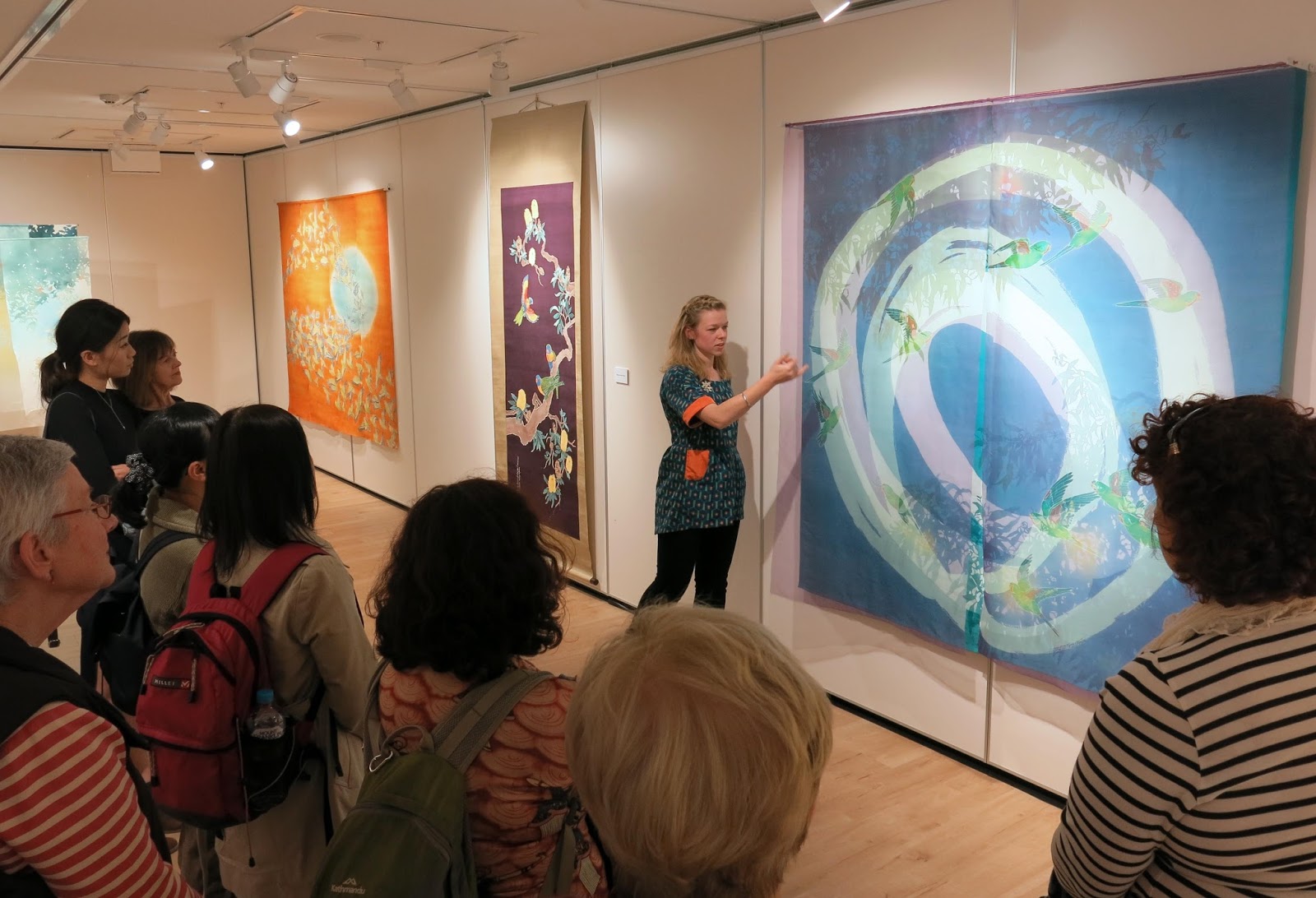
In August/September this year I was lucky enough to be invited to hold a solo exhibition of my work at the Japan Foundation Gallery in Sydney. It was titled "Somé - Dyeing the Australian Environment".
It's been a long while coming but here are some images from the show.


I made some new work for this show, a large noren for the entry to the gallery space and a series of pieces called "The Beautiful Weeds of Canberra".

Entrance to the exhibition. "A Hearty Welcome" on left

I called the noren "A Hearty Welcome", referencing its function as a gateway to the exhibition. I dyed it using katazome on hemp fabric which I sourced in Australia. Previously I'd dyed several noren but on Japanese linens which have a certain stiff feel to them and are rather open weaves so that a glimmer of the space behind the curtain is also visible. I'm yet to find a fabric with similar qualities in Australia but the hemp fabric was a new experiment using a natural looking slubby cellulose fibre. It's a little softer than I would like, as it creases easily and softens in the washing stage of katazome.

The noren was tied back during the opening event - Photo by Document Photography
The imagery I used for the stencil was of the droopy branches of Eucalyptus Cinerea (Argyle Apple). I've used them as subject matter before because I love their dusty blue-green leaves with their almost circular forms. They really lend themselves to being carved into a silhouette-y stencil.


The other new work I produced was a series I've been calling "The Beautiful Weeds of Canberra". I've become even more obsessed with weeds since starting these pieces but the idea behind them is that our natural environment is a composite of all kinds of species native and otherwise. When you look closer you realise that a good many of them are actually "weeds" but to me they are familiar parts of the landscape and also quite beautiful in their own right. 

Keeping a little distance from the complex conservation and environmental problems connected with "weeds" I'm trying to just depict them in all their weedy glory - kind of weed portraits.


This is a series I will be further developing and expanding for future exhibitions but the initial weeds I've dyed are Wild Blackberry, Rosehip, Umbrella Sedges and Japanese Honeysuckle. For these pieces I used vibrant acid dyes to dye the weeds themselves - true to nature- and applied natural dyes as the background colour. I really like the russets and orange tones you can extract from local eucalyptus varieties and onion skins so I've used a combination of these against the vibrant colours of the weeds I chose.

Blackberries and Sedges - first trials in "the Beautiful Weeds of Canberra" series.

Japanese Honeysuckle - Beautiful Weeds of Canberra. A garden favourite in Japan but a creeping weed in South East Australia.

For future pieces I'm planning on featuring many many more beautiful weeds and trying to get even deeper, richer background colours. I've also started research for a series on "the Beautiful Weeds of Kyoto". It's interesting to see which weeds overlap with Australia; the weeds which we "share". It's also cool finding those species which are natives in Australia but invasive in Japan or the reverse. I think there's some deeper subject you could read into that if you chose to. 

detail of "Sedges" - Beautiful Weeds of Canberra Series. 2016
Anyway, back to my exhibition in Sydney, the general response from the audience was really good. I had never shown work in Sydney, let alone so many pieces all at once before, so it was great to come across all these people who I'd never have had the chance to meet. I held a floor talk and two workshops whilst I was there too. Both went really well. It was my first time to hold workshops with so many participants but everyone was very enthusiastic and got great results.
Each participant dyed two washi postcards using powdered pigments.

looking like a pro giving my floortalk for Japan Foundation Members before the opening

during the opening

the opening

workshops underway


workshops

Participants results from the workshops. really nice!!
It would be nice to do more workshops in future, maybe on less of a tight schedule next time!

Anyway, I'm now working towards new things for 2017. A few exhibitions on the horizon so I have to get making! 

Thursday, August 13, 2015

Solo Exhibition in Canberra open now! キャンベラ市での個展は後8日!

I was only back in Australia for 10 weeks to the day when I found myself in Canberra setting up my next exhibition with my Dad. (Thanks Dad!)
オーストラリアへ帰国したばかりという気持ちがした10週目のところで、キャンベラでの個展の搬入なんてしていました!

My first solo show in Australia, "The Traces Between" opened on August 6th in the long and narrow space of Gallery 3 at M16 Artspace. The opening was a packed event as three separate shows opened all at once. It was great that the visitors who came to see the group show in the main gallery then drifted through to both mine and Keith Bailey's Solo shows in the two smaller galleries. Hooray for capitalising on other people's friends!
オーストラリアで初ての個展です。キャンベラのM16 Artspaceで細長いギャラリーで展示しています。そのArtspaceにて、三つのギャラリースペースがあって、同時に三つの展覧会も開きます。オープニングにたくさんの人が来ました。


Me explaining some of my work on opening night オープニングのパーティーで、友人に作品を説明している私。
Yay! other people's friends (plus lots of my friends and family too :)) 三つの展覧会が同時に始まるので、三つの作家さんの知り合いや友だちが来るわけ。いいシステムですね!
I called my exhibition the slightly vague and arty sounding "The Traces Between". I wasn't trying to be vague or sound arty (goodness knows I've learnt a whole dictionary of meaningless arty tripe I could roll out if I wanted to). Instead I was referring to a variety of gaps both literal and not.
展覧会のタイトルを「The Traces Between」にしました。訳したら「間の跡」に近いと思います。かなり微妙と思うかもしれないですが、色々な「間」をほのめかしたかったわけです。

One is the physical and visible gap that appears between areas of dyed colour when you use a resist technique like Katazome or Yuzen. In yuzen, that will be where you have drawn fine lines of paste with a metal-tipped tube. They leave behind the colour of the fabric below; white traces. A stencil is used for katazome, so you get a distinctive silhouette-style image. This positive image is merely the reverse of lots of blank gaps and spaces where resist paste was applied.
一つの「間」は、作品に見える防染された間です。友禅の場合では、防染糊の線の所ですね。型染の型紙を通した糊のところは出来上がった作品には、ただの間にすぎないです。

That is to say, resist-paste techniques rely on the preservation of the under fabric and then upon revealing them in the final piece.
つまり、防染糊の技法を使うと、糊が守った生地の色は、完成した作品には跡になります。

Yuzen detail: the writing is where the resist paste was. In the final piece it is just a trace. A blank space. 友禅の防染した文字。染め上がった作品から糊の存在が消されて、跡しか残らない。
In the case of Katazome, the blank negative space forms the image. In between all those gaps, the imagery is brought to life. 型染の場合、余白があるからこそ、イメージが見えてくる。
Another gap I was trying to allude to is the physical space between layers of fabric; the gaps that air can flow through. Since late 2012, I have been layering sheer silks in my pieces, leaving gaps in between them and allowing them to catch the breeze or the draft from an air conditioner.
もう一つの見える「間」は、生地の層のあいだにある空気です。2012年後半から、何枚かの絹を染めて、重ねる作品を作り続いています。この薄くて透明絹が風もちくはエアーコンに振られます。

By not framing my work, or stretching them tightly over a wooden board, they have a sense of life.
縁やパネルを使わないと、何かのイキイキ感がでる気がします。

sometimes the gaps between layers are even big enough to get inside! 2枚を重ねた作品です。時には入れるぐらいの間です! 
Degradation series from 2014 where I made a point of spacing layers out from each other. 2014年のシリーズでは3枚の絹を重ねて、わざと5センチずつの間で展示してみたら、良い感じでした。

Cross cultural spaces? Australian foliage meets Japanese noren
A non-physical gap is that between Art and Craft. I don't yet know where my work fits in those terms but I get the feeling it's somewhere in between; somewhere on the divide.
作品には見えない間もあると思います。それは「美術」と「工芸」の間。自分の作品はどちらに近いというのがまだわかりませんけど、確かにその真ん中に寄っていると思います。

You could also say that it straddles cultures too, swaying somewhere in the grey area between Australian and Japanese but let us not get carried away with ourselves! 文化の間というのもあると言えるでしょうが、今はあんなに自慢するのをやめよう!笑

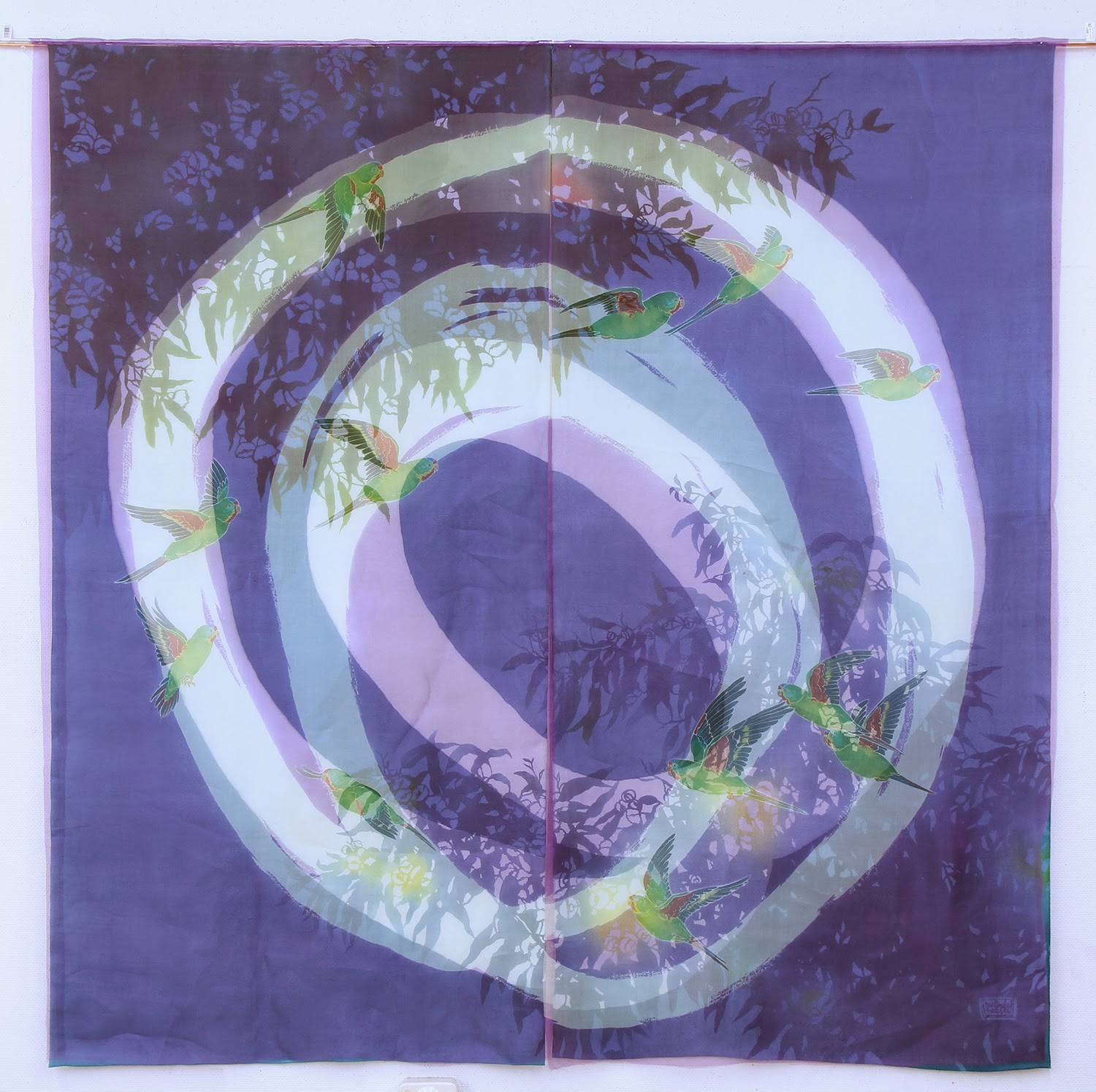
This show is a combination of larger works that I completed whilst undertaking my Master's degree in Kyoto as well as a collection of new work. My graduation piece from Kyoto Seika University which features the migration cycle of the endangered Swift Parrot is the centrepiece (it can be helped since it's over 5 metres long!) and it catches the air nicely as people walk by in the space. 
今回の展覧会は、京都で作った大き目の作品と、帰ってから創ってみたもっと小さな作品の組み合わせです。

My Graduation work from Kyoto Seika in March 2015 is the star centrepiece of this show. 京都精華大学の大学院終了作品で作った「オトメインコの渡り」が今回の個展では、メイン作品になっています。5メートル以上なので仕方ないですけど!
Amongst the new work (some of which were completed at very VERY closely to the finish line!) are some small pieces I'm excited about that combine the fine line-work of yuzen with locally sourced natural dyes. In some inital research (much more to be had), I managed to find foliage from three eucalypts found around my suburb and boiled them down to extract some shades of yellow-brown and peachy orange-brown. Then I used those dyes to dye little "portraits" of Eucalyptus blooms and leaves. Haha! see what I did there? it's like a textiles pun or something.
新作の中、近所にあるユーカリから煮出した染料でユーカリのイメージを染めたちいさな作品もあります。まだまだ植物染料について沢山調べないといけないと分かりましたが、はじめての実験としてとてもうれしい結果です。

New small experiments in natural eucalyptus dyes are also on show.
Anyway, the show is on at M16 Artspace in Canberra until Sunday August 23, so be sure to check it out if you are in town. Otherwise, look forward to more photos after the show is complete!
さて、個展は8月23日までです!終わったらまた写真をアップしますから楽しみにしてください!

Saturday, March 14, 2015

Why can't you touch Art? 作品を触っちゃダメって何?

The lady in her lurid yellow fitted jacket raced over to me and told me not to touch the artwork.

I told her, "But I'm the one who made it; this is my artwork!"

She frowned and did that Japanese suck-air-through-your-teeth thing and said that if I touched it, other people would think it's okay to touch it too.
In the moment, I couldn't gather my thoughts well enough to give a level-headed response so I just sort of nodded. What I really wanted to say was "So what?! What if I actually don't mind people reaching out and touching my work? Its fabric, it's washable, it's FINE!"

Pretty sure it's not just me that sees something like this fabric and hears a little voice scream "touch me!!!!" こういうのを見て、触りたくなるのが私だけじゃないでしょう?!

派手な黄色スーツ姿のおばさんが走ってきた。「すみません、作品にはさわらないでください。」

「あっ、でも、私の作品です」と返事したら、黄色のおばさんが困ったように歯の間から息を吸って、「すみませんが、他のお客様が触っているのを見るなら、触ってもいいと思ってしまうので」と言った。
その場で上手く返事ができなかったけれども、言いたかったのは「それで!?別に触ってもいいんだよ。生地だし、洗えるし、逆に触って欲しいかも」

This was just another glimpse of conservative Kyoto that I got when I exhibited at the Kyoto Museum last month.まあ、京都のミュージアムでも、世界のミュージアムでもそういう態度ですね。

The work I recently exhibited at the Kyoto Museum: "floriferous - 咲き乱れる" 
京都文化博物館で展示した作品です。

Perhaps a MUSEUM is not the place for textiles.
ミュージアムという場所は、もしかしたら染色の作品を展示するには合ってないのではないか?

As a kind of pipe dream, I would love to make textile installations. Wait! Don't roll your eyes at the word "installation", often used by arty-farty types as a blanket term to legitimise anything from a room full of bits of garbage to an empty room with a soundtrack on loop.
いつか将来に作りたいの一つは「染色インスタレーション」なのです。「インスタレーション」という言葉がこの頃使われすぎで、意味なくなるぐらいように色んなものがインスタレーションと呼ばれています。(何も置いていない暗い部屋がインスタハレーションだとか、古い工場の床に散らされたゴミがインスタレーションだとか)

Fly free my pretties! "Freshly" dyed and washed pieces of fabric hanging out in this wicked autumn wind as if trying to get free. It was a beautiful sight and I stopped there and thought: "THIS! this is what a textile is supposed to be like" 水洗いしたあと、乾かしている生地の動きが本当に綺麗で感動した!その瞬間に「テキスタイルってこれや!!」と思った。

What I mean is, a room or even better a semi-outdoor space full of hanging dyed fabric, that you walk through, look at, which moves as you walk by and shows off the best of Australia's brilliantly coloured scenery or birds. And it would be something you are free to touch.
そういうわけわからないインスタレーションではなく、私が作ってみたいのが自然光がたっぷり入る一部屋(または半野外の場所)に染めた生地をいっぱい吊り下げたインスタレーションです。生地にオーストラリアの鳥や色や言葉を。人が通ると生地が動く。森へ覗きこんでいるように感じる。何よりも、触ってもOKの物を作りたいと思っています。

This time there was no gallery minders and no alarms to set off!
卒展で自分の作品をよく触ったよ!
You can't do this kind of installation in your average museum or city gallery-type space. For one thing, they often don't allow you to hang anything from the ceiling (another sticking point I'm still annoyed about with the Kyoto-city Municipal Museum of Art), which reduces you to hanging against a wall or to creating some kind of nifty wall-fittings. And then there's those sneaky Gallery Minders (as in the ones in yellow suit jackets) who are going to tell you off for touching, photographing, getting too close, using your phone, reaching for a pen... This kind of stuffy, rigid atmosphere somehow doesn't allow the artwork to be what I intended.
普通の美術館または博物館では、こういったインスタレーション作品は無理ですね。できない理由の一つは、ほとんどの場合、天井から作品を吊り下げるのは不可。それと、触ろうと・携帯を使おうと・ペンを出そうと・近すぎに行こうとしたら、最初に書いた厳しい当番の人に言われますね。このかたい雰囲気で作品が楽しめますか??

Sneaking a photo amongst my own work at Some-seiryukan Gallery in Kyoto, November 2014. 自分の作品に入って写真を取っちゃった。去年の11月、京都の染・清流館で。
I liked the way the author of this article “PLEASE DON’T TOUCH THE (TOUCHABLE) ART” described this gap between museums and the art shown in them: 
"...more and more contemporary art is created by artists who intend you to play with it. The full meaning and experience of the work requires you to interact...
Unfortunately, for...contemporary artwork that gets its primary meaning, emotion and significance from interacting with it, keeping it locked behind glass isn't good enough. Most museums and galleries have not caught up to this idea...All objects, regardless of the artist’s intent, are treated the same."
*私の適当な訳*「作品と遊んで欲しい作家さんが増えています。その作品を理解・経験するには、作品と接する必要があると。しかし、ミュージアムでのガラス張りの所に展示したりすると、そういった作品の意味がなくなる。殆どのミュージアムやギャラリーはこのギャップを気付いていない。つまり、作家(が触ってほしいなど)の意志にかかわらず、ミュージアムで展示するすべての物は同じく扱われる。」*

So it doesn't really matter how eccentric or open an artist might be about displaying their work, when you go it stick it in the museum mould, you're stuck playing by their rules.
つまり、作家さんが作った物に対していくらでも自由に考えていても、ミュージアムで展示してしまうと、ミュージアムでのルールに従わないといけないですね。

Weee--ooooo---Weeee-ooooo! Can you hear the alarms going off?
It's an unfortunate catch 22 (which is probably changing for the better but still remains, especially in the considerably conservative art scene of Kyoto) that artists feel they have to exhibit in museums or art galleries to feel validated as a "real", "made-it-and-can-afford-to-stop-eating-cereal-as-dinner" artists when those are the very places curbing the unique creative streaks which make them artists in the first place.
作家たちが、いわゆる「プロの作家」になりたかったらギャラリーやミュージアムで展示しなきゃと思ってしまうですね。でも、そういった場所はルールがいっぱいあるから、作家になるには必要な「創造性」こそが抑えられます。ジレンマですね。。。

Another part of this is the way we've managed to make art so precious and segregated; raising it to un-touchable status (literally) in galleries and museums. The art world manages to segregate itself with it's words too.
この問題に含んでいるのが、Artが手が届けないもの(文字通りの意味でも!)にする概念です。ミュージアムやギャラリーで展示することによって偉いものにしてしまうし、ARTについて話す時に使う言葉によっても、別の世界にしてしまうことがあります。

An old favourite, http://www.artybollocks.com/ which generates random artist statements and shows you just how meaningless they really are
and you can refresh and refresh the page into increasing obscurity...
I was reading this really great article by Steve Lambert about artists using vague speech and losing the chance to engage ordinary people because of their wordiness. Here's a quote,

"artists are already too cloistered off from the rest of our culture; isolated in elite institutions, appreciated by small numbers, and/or segregating ourselves in confusing social difference alone as some kind of admirable attribute. Around 45 years ago John Berger disparagingly called this phenomena the needless “mystification” of art. If we want to change this, and we should, we need to speak clearly in a language people can understand – not by adopting academic language for institutional appeal or trying to cover over our insecurity with pompous nonsense"

*適当な訳*
作家さんはもう一般社から離れすぎている。偉い学校に閉じ混んでいたり、少人数にしか認められていない。あれは尊敬する資質のように思っているのか?45年前にジョン・バージャーさんが、この行為を「アートの秘訣化」と呼びました。この事情を変えたたかったら (変える必要がある)、使っている言葉を変えるべき。学的な言葉や、自分自身不足を隠すようなわけわからない言葉じゃなくて、皆が分かるような言葉ではっきり表現しないといけない。


The way we show and speak about art has the potential to scare people away. The kinds of airy-fairy words as in the randomly generated statements like the ones above can make people uncomfortable. Hey, even just the word ART can make some people feel out of place.
アートについて話す時に使う言葉を考える必要があると思います。ARTというだけで、避ける人もいるから、もっとリアルに作品やコンセプトを説明したりしないともったいないと思います。

There's a need for artists to be less exclusive and more relate-able. One way to do that could be to bring art out of the museums and galleries and put it into real life. I don't mean reproducing artworks onto cushions for the masses or in the sense of having beautiful things in our homes, I mean actually putting the real deal artwork into public places. Why not? What's the point of making art if you're going to show it to only some  people, or let it be touched only sometimes ?
美術の作品をもっと日常の物にすればいいじゃないか?作品をより日常生活にありそうな雑貨にするのではなく、美術作品自体を色々な場面に出すのはどうでしょうか?

Maybe it's fabric dyed with plants that hangs from a naturally lit ceiling in a shopping centre? Maybe it could be dyed birds and John Gould text across the walls of the cafe? Maybe it's a see-through hanging beside the rest area in a hospital? Maybe it's an artwork in an office space, as a giant room divider? Maybe it's in artwork hanging in a national park information centre?
例えば、モールの天上から草木染の生地の作品を吊り下げる?カフェの壁に鳥と鳥類者の文章が染めてある作品を展示する?大きな半透明の作品を事務室の間仕切りに使ってもらう?病院の接客室に掛ける?国立公園のビジターセンターに展示する?

I touched that thing endlessly to make it, but for some reason, you're not allowed to touch it once its done. 作る最中は触るばかりのに、出来上がった作品は触っちゃダメだ。不思議だなぁ。
I don't know but I'm getting the feeling that making artworks needs to involve an act of generosity, of adding value to peoples lives. Not the unconscious act of telling people they are not worthy because they are not "art people".
色々が分からないし、考え方は甘いかもしれないですが、最近はこういう人々にすこしでも何か貢献する作品は一番いいだろうと思ってきました。ちょっとでも日常生活にアートとの接する機会があると。

Because in the end, we are all born artists and you show me one person out there whose first natural instinct is to NOT touch the artwork.

だって、人間はみんな生まれながらのArtistだもの。本能的に作品に触りたくない人間って世の中居ないはずのだ。

Sunday, March 8, 2015

Kyoto's backstreet Textile Industry 京都の裏道にある染色世界

When people call Kyoto the Textile Capital of Japan, it's easy to write it off as some kind of nostalgic comment.
京都が「染織の都」と呼ばれているのは、昔を懐かしむくせに過ぎない、と思いやすいですね。

But there is still a very real and functioning network of textile companies in Kyoto today, tucked between carparks and petshops, incomprehensible from the next house on the street besides a small company sign, and taking up multiple floors on non-descript 1980's office buildings.
しかし、決まり文句っぽいのに、今でも本当にその通りです。もちろん、昔のように盛んでいるとは言えないですが、今の京都では染織関係の会社がいっぱい残っています。コンビニとペットショップに挟まれたり、80年代っぽいオフィスビルや何も目立たない町屋で営業しています。

Looks like any old house right? 普通の家に見えるでしょう?
Almost all of the signage and information about these companies is in Japanese, of course, so visitors to Kyoto probably don't even notice. These businesses also tend to be concentrated in pockets of the city that are removed from the tourist areas, so it's easy to miss them. I think even Kyoto residents don't even really notice.
この会社の看板はほとんど漢字で書いてあって、観光客はもちろん、京都人でも気づいてないだろうと思います。場所的に、街からちょっと外れている通りに集中しているから、気づかないでしょう。

近く見たら、染織関係だ!看板小さいね。A closer look at the building above shows it houses a Textile Artists' Association and a decorative textile research office.
As a kind of experiment last week, I walked around some of the streets I know to be textile areas just to see how many of these companies I could spy. The answer? In just 30 minutes, stacks!
先週、京都市内の染織が有名な町を散歩したら、何軒の染織関係の会社が見えるのかという実験をしました。その結果は?いっぱい見えました!

I was excluding those specialising in weaving (you can hear the whirrs and clacks of the looms beyond the frosted windows); trying to just narrow it down to businesses related to dyeing and the kimono industry. The number is practically exponential, once you start looking up and reading the signs.
織物関係を別にして(窓の向こう側に織り機のカシャカシャが聞こえます!)、染物屋さんだけに限りました。それでも、上を見て看板を探し始めたら、数え切れないほどあります!

A company specialising in dyeing Black. Black is known as a very technically difficult colour to dye well, hence entrusting that step to a separate business. 黒染屋さん。黒って、染めにくいから、分業して、黒染専門の工場が作られたでしょう。
黒染屋さんの看板。着物の形。Black Dyeing shop with it's Kimono shaped Sign.
tiny sign to indicate this is a dye workshop. In the Nishijin district of Kyoto. 西陣にある染め工房。
This one was a triple line-up. Dyeing workshop with the blue signs, then a business that does dye finishing processes and then a flag business. 三つも並んでいた!
Right next to a pet shop, this one is more weaving oriented, silk fibre company. 
Typical looking house on a typical looking street.. 普通の通りに普通に見える家は
but it turns out to be another business that does specialised Black Dyeing. 黒染屋さんでした!

Business making chirimen silk kimono
Another dyeing company...
and another...

And another...

and another!!
This business sews Japanese clothing like kimono or haori etc.
This one specialised in Kyoto style embroidery. Probably for embellishing kimono
the shop with the red noren curtain sells kimono lining fabrics.
これは紅型の会社だそうです。This one is a Bingata (okinawan style stencil dyeing) business.
I think you can start to get a sense of how numerous these businesses are. There were many others I didn't take photos of because it felt rude. I know there were also many more that I missed or that are not specifically marked on the building even though they are operating some kind of textile business. You can see below where these businesses are concentrated.

the red dots are dyeing-related businesses in Kyoto
Now that kimono are no longer standard everyday wear, many businesses such as these presumably have less work than they used to. I wonder what will happen to them in the future? They are powerhouses of knowledge and specialised equipment as well as links in the chain of kimono production. The division of labour means that when one business closes down (such as a steaming company that shut down 2 years ago) then the rest of the chain is affected. As more start to close, the chain will end up with some big holes. Can the individual businesses find ways to keep their services relevant in future? I guess it remains to be seen.