Showing posts with label 京都. Show all posts

Sunday, October 18, 2015

One last Studio Visit - Edo-style Komon Dyeing 工房見学 ‐ 「古今」 江戸時代の小紋を守りながら、現代の染色を作り出す

**This post is really going back now...I visited this studio over 6 months ago! I was so warmly welcomed there though, that I at least owe them this blogpost...better late than never!**

In the last weeks of my big Kyoto Adventure, I was invited out to visit a dyeing Atelier in the west of Kyoto called "古今 Kokon". I was taken there by a friend of a friend, Kumie-san, resulting in Chinese-whispers style communications that meant all I knew was that we were going to see a dyeing studio that does "amazingly detailed katazome". Okay, I figured, count me in!


**この投稿はもう6ヵ月間も下書きのままに残しちゃったけど、工房のスタッフにとても暖かく迎えられたから、遅くても書かないよりはまし!**

4月、京都で最後の二週間に帰る準備でバタバタしていましたが、友だちから「すごく細かい型染をやっているところがあるのよ!絶対見に行った方がいいよ!」と言われたので、友だちの友だち久美江さんに連れて行ってもらいました。「染処古今」という工房で、四条西小路の交差点から徒歩10分ぐらいのところで、普通の住宅街に挟んでいる感じでした。

We walked for about 10 mins from Shijo/Nishikoji streets through backstreets and L-shaped short-cuts to arrive at the Kokon Atelier, established on a narrow suburban street in between ordinary looking family houses.

Mr Yasue, the fourth-generation head of the company, was there to greet us and kindly showed me all the different steps of their process in creating their unique line of kimono and obi. Turns out I even got a mention on Mr Yasue's Blog as "a very enthusiastic" visitor!

古今四代目の安江さんに迎えられて、古今の独特な着物や帯を作る工程を丁寧に説明してくれました。安江さんのブログにも登場しました!

You can see Kokon's website HERE ←これは古今のホームページです!
The process they are using at Kokon is "komon", (lit. small motif) very fine and detailed stencilled patterns. It is a form of katazome, popularized during the Edo-period when elaborate and showy clothing was periodically banned by the government.

Super-fine Komon-dyed fabric on display at Kokon 古今の超細かい小紋はステキな色で染められています。
Komon-style dyeing, in it's most traditional form, involves: 

- Carving a stencil from katagami stencil paper, using fine metal-tipped punches, or by hand with a fine cutting blade

- Applying a soft, sticky rice-flour based resist-paste through the stencil onto the fabric

- Dyeing the fabric by brush or dip-dyeing (in the latter case, the stencil is used to print the resist paste onto both the front and back of the fabric, matching the tiny pattern perfectly!!! brain explosion!!)

- Steaming the fabric to set the dye

- Rinsing off the resist-paste and revealing the delicate tiny komon patterns, which remain the white colour of the base fabric.

Just one of the crazy detailed Katagami stencil papers on display at Kokon, this one carved by a National Treasure, Nanbu Yoshimatsu 1894-1976 人間国宝南部芳松に彫られた細か~い型紙!


古今で、小紋を染めています。伝統的な小紋の工程を簡単に説明したら、

☆ 型紙を細かい刀で彫る、それとも丸きりなどの道具で模様を彫リます。

☆ 場合によって型紙を丈夫するため、漆で絹の紗を表に張ります。

☆ 型紙を布に載せて、柔らかい餅粉と糠からできている糊をヘラで敷いて、模様は布に置かれます。

☆ 刷毛で布の表を染めます。乾いた糊は染料を防ぎます。浸染する場合もあって、その時は布の両面に糊を置かないといけない。しかも、両面の模様がぴったり合うようにしないと!(なんてこと!!)

☆ 染料を布に定着するため、100度で蒸します。

☆ 布を洗って、糊を落とします。やっと繊細な模様が見えます。糊が置かれたところは布の色のままです。つまり模様は白いです。


multicoloured patterns are their trademark at Kokon. Yasue-san said he spends hours figuring out colour combinations that  are just right. 古今に特有の色合い。

At Kokon Atelier, they are using a more modern technique which allows the application of multiple colours. That is, instead of applying plain resist paste onto white fabric resulting in a dyed background with a fine white pattern, 
they are also sometimes applying a coloured resist paste and dyeing the background, resulting in both a coloured background and finely detailed coloured patterns. This way, none of the white base fabric is left showing through.

If I managed to confuse you just now (sorry!), then check out the below photo.
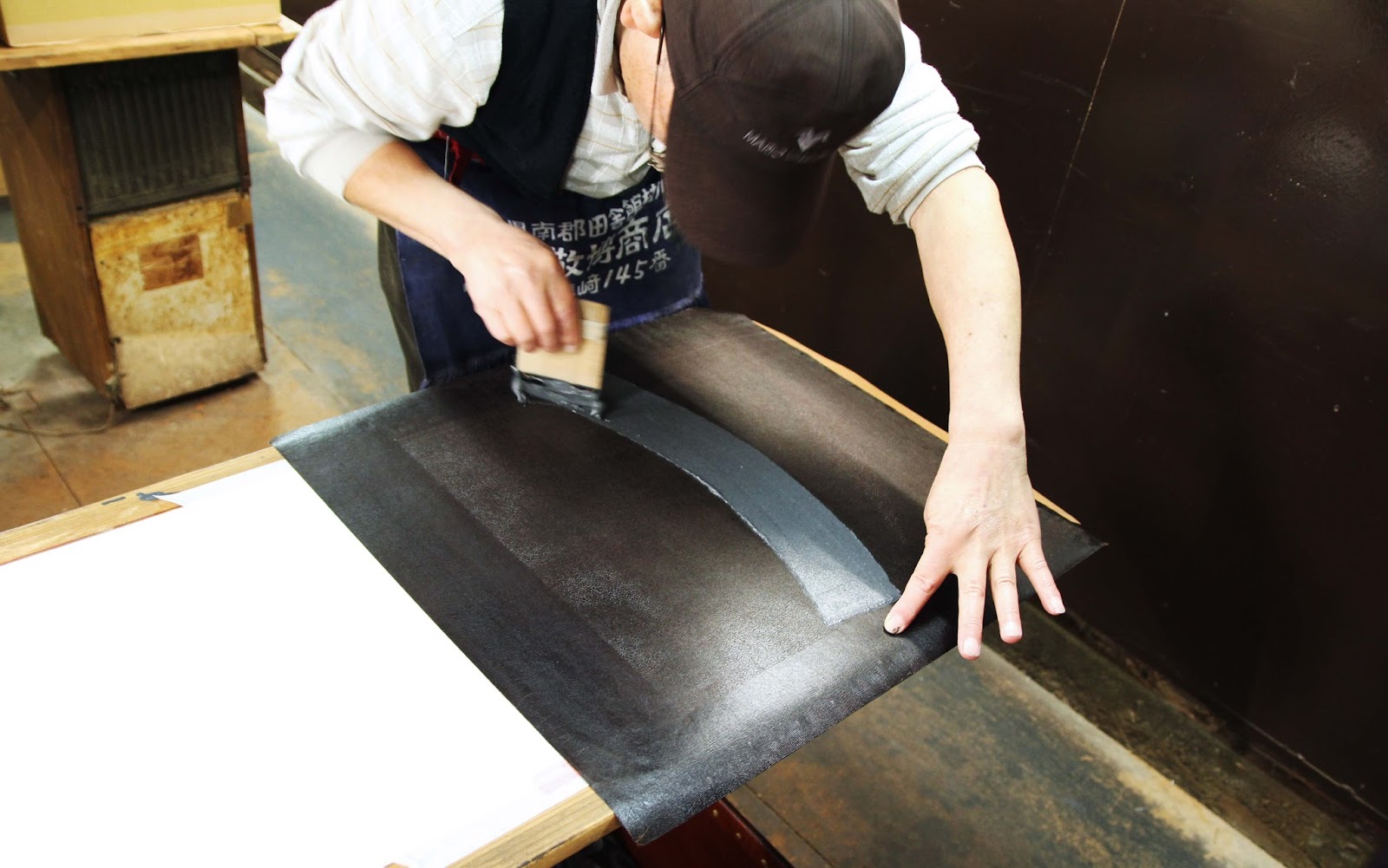
The black and white fabric has used traditional resist paste + black dye, whilst the second fabric has used a khaki paste, then a black dye.

Top fabric= normal rice/bran resist paste, then dyed black.
Bottom fabric= a green tinted resist paste, then dyed black.

染めどころ「古今」にて、伝統的な小紋の知識を守りながら、現代な雰囲気も加えていると感じました。得に使っている色によって感じます。昔の小紋といったら、白い生地に一色の模様が染められました。(細かい模様はもう織物に見える!)古今で、色糊の使用によって、生地も模様の所も染められます。(上の写真を参考に)。また、色糊の上に暈し染をしたり、何枚かの細かい小紋をデザインの中に使ったりするから、とてもフレッシュな雰囲気の染物が出来上がります。

The practice of using coloured resist paste became popular during the Meiji era when chemical dyes were introduced from Europe (they had been discovered and developed in France, England and Germany) which could be mixed straight into the traditional rice flour/rice bran resist paste. This meant the paste was both colouring the fabric where it was applied as well as resisting the colour of any additional layers on top of it. Clever, huh!

色糊は明治時代に発達されました。ヨーロッパ(特にイギリス、ドイツ)の研究者が開発した化学染料は日本へ輸入されました。化学染料は糊と混ぜることができて、新しい染め方が現れました。
染料が入っている色糊は、上から挿される染料を防ぎながら、置いた所も染めてしまいます。
かしこいでしょう!

見学した時、糊の作る段階が見えました。古今では、色糊は毎回、職人さんの感覚で作られています。染料は何パーセントとかのレシピが無しで、普通の糊に、染料を少しづつ加えて、良さそうな色になると、生地に敷いて、蒸して洗います。色は予想と異なると、染料の量を調整して、もう一回蒸して洗ったりするの繰り返しでやっと糊ができます。
すごい努力の要る作業だと思っていましたが、安江さんたちがこだわっている綺麗な「生じゃない色」を作るにはやっぱり必要ですね。

Normal paste on left, dye concentrates, then a Blue paste getting mixed on right. 左は普通の防染糊、真ん中は各色の染料、右はできた青色の色糊。とても濃く見えますが、蒸して洗うとかなり薄い色になてしまうから何回も確認しないと。

Mr Yasue showed me their rows of tubs of mixed coloured resist paste and was explaining to me how they mix the colours.  He told me they don't use measures or a notebook of dye to paste ratios but by mix their colours by eye. Every time!

To do this, they have various dye concentrates all lined up and add these to a bucket of plain paste little by little to produce a batch of paste in the desired colour. This colour sample needs to be dried, steamed and washed to check what the true resulting colour will be. They continue to adjust and repeat the tests until the desired colour is achieved. This seems like an awfully tedious way of mixing colours, but as Mr Yasue pointed out, this ensures they achieve rich, subtle colours; colours that do not look like they came "straight-out-of-the-tube".

Yasue-san showing me their swatch book of paste colours. This is only a visual reference though because they remix the colours by eye each time! (写真は古今のブロッグから)

糊の作業場から、型紙の展示へ移動しました。何人かの人間国宝に彫られた型紙も所蔵されているそうです。「道具彫り」に使う道具も見せてもらいました。道具自体は美しいと思いました。丸、葉っぱ、月などの形を切る道具もあって、これらは職人さんが自分で作るらしいです。型紙を彫る職人さん、何名も「人間国宝」とされていますが、この道具も近いうちに国宝にもなるのではないか?将来に作れる職人さんが減ると貴重品になるでしょうね。

After the paste-mixing room, we had a look at the different kinds of stencils and cutting tools for komon. Aside from tiny blades, punch shapes are also used for cutting stencils (dougu-bori). The stencil-cutting artisans tend to make their own punches, hammering fine strips of metal to form the desired blade shapes (like dots or moons or small leaves). Many stencil-carvers have been designated as "National Treasures"; their craft is so skilled. Aren't the punches also beautiful objects?? They will become national treasures themselves before long because there are now very few craftsmen actually making these amazing tools.

The one-off handmade cutting tools, some shaped like crescent moons, others circles and dots 美しい道具。
次は大きな作業場へ入りました。頭の上に5メートルの糊板がたくさん並んでいて、背が高い人はここで働けないなあと思いました!笑 いくつかの板に帯や着物の反物が貼っていました。
Next, we went into the biggest workroom. The ceiling is very low as all the 5 metre long wooden pasting boards are stored up above their heads. Many had kimono and obi-belt fabric in progress pasted on them.
Three staff were working in the space. One was applying layers of lacquer to old stencils to prolong their use. Another was printing fabric, matching a ridiculously fine repeat pattern down a length of fabric and washing the stencil between every repeat (! they take pride in their product!)

Lacquering old stencils to extend their life. 古い型紙に漆を引いていました。 All the 5 metre long narrow pasting tables are stored overhead. Couldn't be a tall person working here!

In the middle of printing a fine pattern with coloured resist paste, very carefully matching the pattern repeat each time. You can barely even see the pattern at all here, but check out the next photo!!
小紋の糊置きの最中。毎回、柄がぴったり合うように練習が必要ですね!模様はここで見にくいですが、次のショットで見ると...

ギャー!こまかい!eeeeek! Super fine komon pattern freshly printed with a coloured resist paste.

Best of all though, was Mr Nomura. He has been with the company since he left school at 16 (I think his spine kind of gives that fact away..) and as such, he is the resident expert. He was printing when we went in, working to combine multiple fine patterns on what will become the ornate hemline of a kimono. 

最後に野村さんの仕事をお邪魔しました。16歳からこの工房で働いていたそうで、(姿勢を見るだけで分かるんですがね)小紋のプロです!見学のときは、ちょうど着物の裾の所に色んな小紋を一枚ずつ「熨斗」のデザインに入れ込んでいました。とても複雑な仕事ですが、結果はきれいですね。

Nomura-san, looking like a pro. because, well...he is. プロのしぐさですね!

Nomura san printing different patterns selectively to create the impressive effect below ↓
野村さんは小紋を部分的に糊を置くと下のような効果がでた↓
various komon patterns printed carefully within the design of "noshi" a curly ribbon-like motif in Japanese art and design.


Yasue-san surrounded by his company's products
古今の着物や帯に囲まれている安江さん


帰る前に、古今の商品が置いてあるビルを案内させていただきました。古今の複雑な工程を見たばかりので、完成品の帯や着物に感動しました。
Before heading out to a sushi lunch, Mr Yasue took us to a second compant building and showed us some of their finished products. After having seen the complex process Kokon uses to dye their fabrics, it was even more impressive to see the final products, all shiny and packaged up.

Obi with the same pattern in different colourways.
同じ柄の帯。ぜいたく!

I was really taken with the modern colour pallete they are using in their products. Without modifying the traditional process, tools or fabrics, they are giving their kimono and obi a really contemporary look just by using really unique colour combinations.

After all, this is reflected in the name of the company: Kokon. The two characters mean "Old" and "Now"; Bringing together the knowledge and expertise of the past generation and utilising it to skillfully make beautiful clothing for the generation of today.

古今でうまいことに小紋の道具、生地、素材を伝統のままにして、色やデザイン感覚だけを変えることによって、面白い染物を作り出していると思います。

「古今」の字のように、過去の職人さんの知識と技法を使って、現在の人々のテーストにあう染物をフレッシュな感じに作っている、と思います。小紋の伝統を次の世代にも伝えたらいいですね。

Saturday, March 14, 2015

Why can't you touch Art? 作品を触っちゃダメって何?

The lady in her lurid yellow fitted jacket raced over to me and told me not to touch the artwork.

I told her, "But I'm the one who made it; this is my artwork!"

She frowned and did that Japanese suck-air-through-your-teeth thing and said that if I touched it, other people would think it's okay to touch it too.
In the moment, I couldn't gather my thoughts well enough to give a level-headed response so I just sort of nodded. What I really wanted to say was "So what?! What if I actually don't mind people reaching out and touching my work? Its fabric, it's washable, it's FINE!"

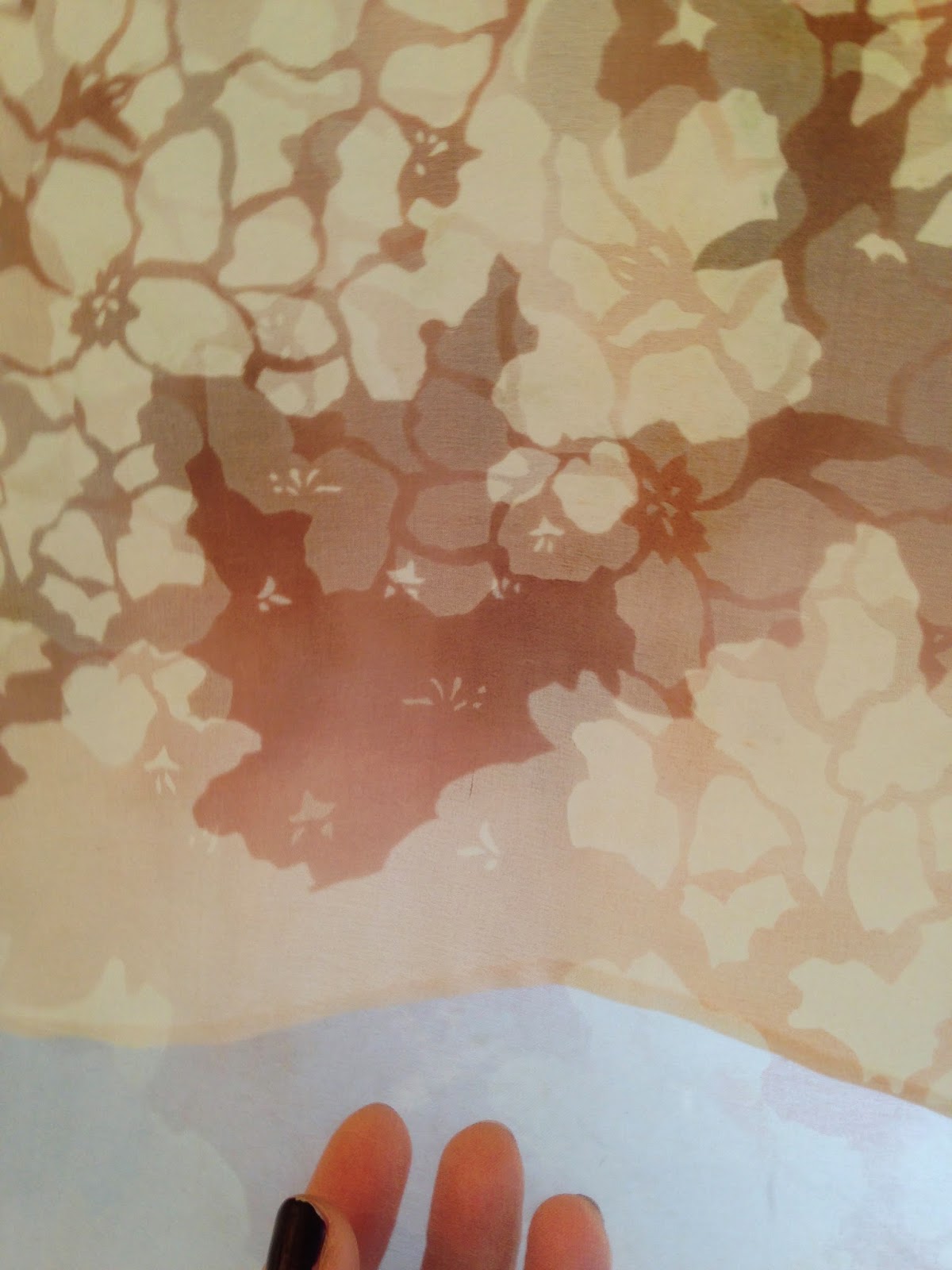
Pretty sure it's not just me that sees something like this fabric and hears a little voice scream "touch me!!!!" こういうのを見て、触りたくなるのが私だけじゃないでしょう?!

派手な黄色スーツ姿のおばさんが走ってきた。「すみません、作品にはさわらないでください。」

「あっ、でも、私の作品です」と返事したら、黄色のおばさんが困ったように歯の間から息を吸って、「すみませんが、他のお客様が触っているのを見るなら、触ってもいいと思ってしまうので」と言った。
その場で上手く返事ができなかったけれども、言いたかったのは「それで!?別に触ってもいいんだよ。生地だし、洗えるし、逆に触って欲しいかも」

This was just another glimpse of conservative Kyoto that I got when I exhibited at the Kyoto Museum last month.まあ、京都のミュージアムでも、世界のミュージアムでもそういう態度ですね。

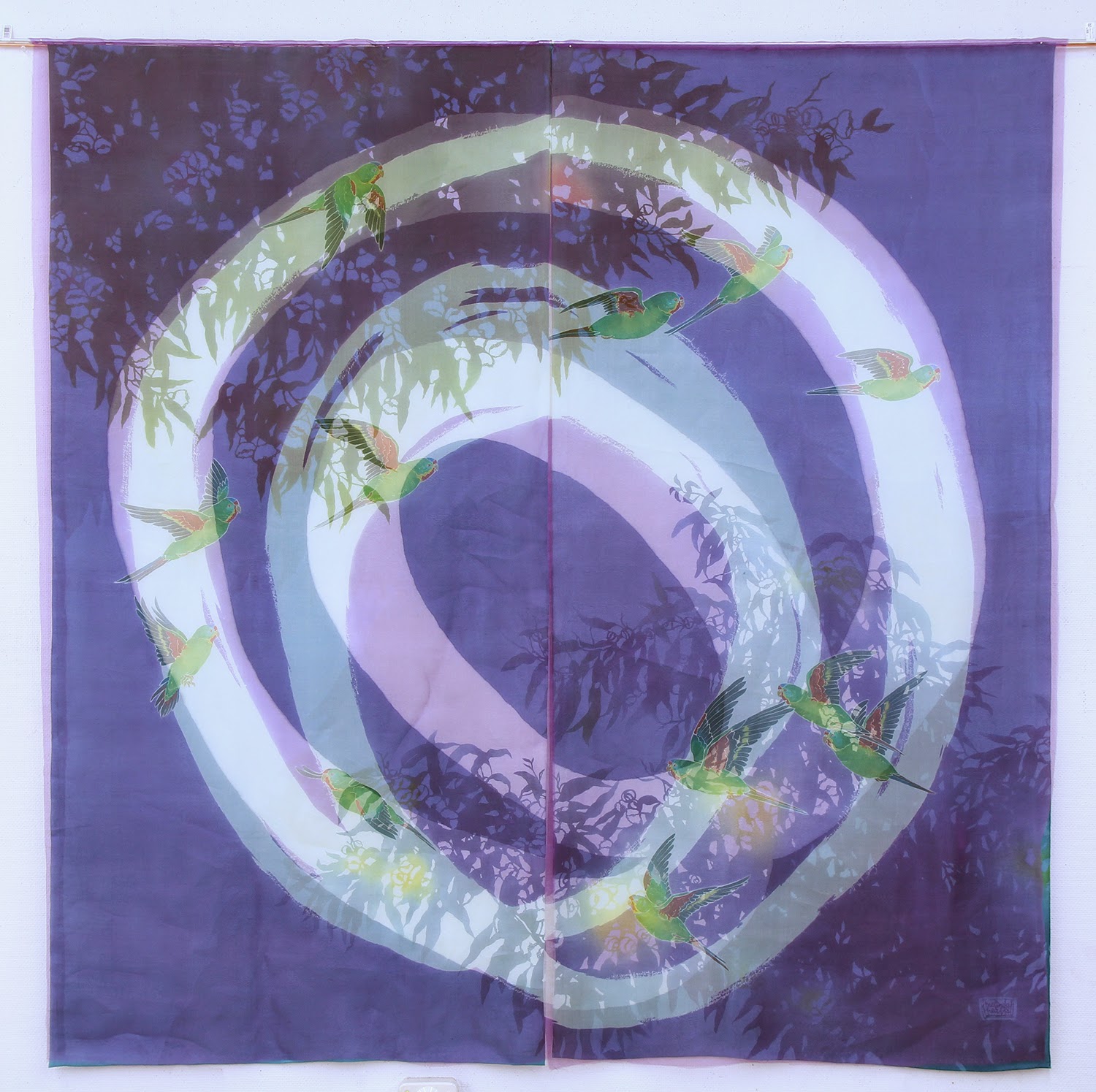
The work I recently exhibited at the Kyoto Museum: "floriferous - 咲き乱れる" 
京都文化博物館で展示した作品です。

Perhaps a MUSEUM is not the place for textiles.
ミュージアムという場所は、もしかしたら染色の作品を展示するには合ってないのではないか?

As a kind of pipe dream, I would love to make textile installations. Wait! Don't roll your eyes at the word "installation", often used by arty-farty types as a blanket term to legitimise anything from a room full of bits of garbage to an empty room with a soundtrack on loop.
いつか将来に作りたいの一つは「染色インスタレーション」なのです。「インスタレーション」という言葉がこの頃使われすぎで、意味なくなるぐらいように色んなものがインスタレーションと呼ばれています。(何も置いていない暗い部屋がインスタハレーションだとか、古い工場の床に散らされたゴミがインスタレーションだとか)

Fly free my pretties! "Freshly" dyed and washed pieces of fabric hanging out in this wicked autumn wind as if trying to get free. It was a beautiful sight and I stopped there and thought: "THIS! this is what a textile is supposed to be like" 水洗いしたあと、乾かしている生地の動きが本当に綺麗で感動した!その瞬間に「テキスタイルってこれや!!」と思った。

What I mean is, a room or even better a semi-outdoor space full of hanging dyed fabric, that you walk through, look at, which moves as you walk by and shows off the best of Australia's brilliantly coloured scenery or birds. And it would be something you are free to touch.
そういうわけわからないインスタレーションではなく、私が作ってみたいのが自然光がたっぷり入る一部屋(または半野外の場所)に染めた生地をいっぱい吊り下げたインスタレーションです。生地にオーストラリアの鳥や色や言葉を。人が通ると生地が動く。森へ覗きこんでいるように感じる。何よりも、触ってもOKの物を作りたいと思っています。

This time there was no gallery minders and no alarms to set off!
卒展で自分の作品をよく触ったよ!
You can't do this kind of installation in your average museum or city gallery-type space. For one thing, they often don't allow you to hang anything from the ceiling (another sticking point I'm still annoyed about with the Kyoto-city Municipal Museum of Art), which reduces you to hanging against a wall or to creating some kind of nifty wall-fittings. And then there's those sneaky Gallery Minders (as in the ones in yellow suit jackets) who are going to tell you off for touching, photographing, getting too close, using your phone, reaching for a pen... This kind of stuffy, rigid atmosphere somehow doesn't allow the artwork to be what I intended.
普通の美術館または博物館では、こういったインスタレーション作品は無理ですね。できない理由の一つは、ほとんどの場合、天井から作品を吊り下げるのは不可。それと、触ろうと・携帯を使おうと・ペンを出そうと・近すぎに行こうとしたら、最初に書いた厳しい当番の人に言われますね。このかたい雰囲気で作品が楽しめますか??

Sneaking a photo amongst my own work at Some-seiryukan Gallery in Kyoto, November 2014. 自分の作品に入って写真を取っちゃった。去年の11月、京都の染・清流館で。
I liked the way the author of this article “PLEASE DON’T TOUCH THE (TOUCHABLE) ART” described this gap between museums and the art shown in them: 
"...more and more contemporary art is created by artists who intend you to play with it. The full meaning and experience of the work requires you to interact...
Unfortunately, for...contemporary artwork that gets its primary meaning, emotion and significance from interacting with it, keeping it locked behind glass isn't good enough. Most museums and galleries have not caught up to this idea...All objects, regardless of the artist’s intent, are treated the same."
*私の適当な訳*「作品と遊んで欲しい作家さんが増えています。その作品を理解・経験するには、作品と接する必要があると。しかし、ミュージアムでのガラス張りの所に展示したりすると、そういった作品の意味がなくなる。殆どのミュージアムやギャラリーはこのギャップを気付いていない。つまり、作家(が触ってほしいなど)の意志にかかわらず、ミュージアムで展示するすべての物は同じく扱われる。」*

So it doesn't really matter how eccentric or open an artist might be about displaying their work, when you go it stick it in the museum mould, you're stuck playing by their rules.
つまり、作家さんが作った物に対していくらでも自由に考えていても、ミュージアムで展示してしまうと、ミュージアムでのルールに従わないといけないですね。

Weee--ooooo---Weeee-ooooo! Can you hear the alarms going off?
It's an unfortunate catch 22 (which is probably changing for the better but still remains, especially in the considerably conservative art scene of Kyoto) that artists feel they have to exhibit in museums or art galleries to feel validated as a "real", "made-it-and-can-afford-to-stop-eating-cereal-as-dinner" artists when those are the very places curbing the unique creative streaks which make them artists in the first place.
作家たちが、いわゆる「プロの作家」になりたかったらギャラリーやミュージアムで展示しなきゃと思ってしまうですね。でも、そういった場所はルールがいっぱいあるから、作家になるには必要な「創造性」こそが抑えられます。ジレンマですね。。。

Another part of this is the way we've managed to make art so precious and segregated; raising it to un-touchable status (literally) in galleries and museums. The art world manages to segregate itself with it's words too.
この問題に含んでいるのが、Artが手が届けないもの(文字通りの意味でも!)にする概念です。ミュージアムやギャラリーで展示することによって偉いものにしてしまうし、ARTについて話す時に使う言葉によっても、別の世界にしてしまうことがあります。

An old favourite, http://www.artybollocks.com/ which generates random artist statements and shows you just how meaningless they really are
and you can refresh and refresh the page into increasing obscurity...
I was reading this really great article by Steve Lambert about artists using vague speech and losing the chance to engage ordinary people because of their wordiness. Here's a quote,

"artists are already too cloistered off from the rest of our culture; isolated in elite institutions, appreciated by small numbers, and/or segregating ourselves in confusing social difference alone as some kind of admirable attribute. Around 45 years ago John Berger disparagingly called this phenomena the needless “mystification” of art. If we want to change this, and we should, we need to speak clearly in a language people can understand – not by adopting academic language for institutional appeal or trying to cover over our insecurity with pompous nonsense"

*適当な訳*
作家さんはもう一般社から離れすぎている。偉い学校に閉じ混んでいたり、少人数にしか認められていない。あれは尊敬する資質のように思っているのか?45年前にジョン・バージャーさんが、この行為を「アートの秘訣化」と呼びました。この事情を変えたたかったら (変える必要がある)、使っている言葉を変えるべき。学的な言葉や、自分自身不足を隠すようなわけわからない言葉じゃなくて、皆が分かるような言葉ではっきり表現しないといけない。


The way we show and speak about art has the potential to scare people away. The kinds of airy-fairy words as in the randomly generated statements like the ones above can make people uncomfortable. Hey, even just the word ART can make some people feel out of place.
アートについて話す時に使う言葉を考える必要があると思います。ARTというだけで、避ける人もいるから、もっとリアルに作品やコンセプトを説明したりしないともったいないと思います。

There's a need for artists to be less exclusive and more relate-able. One way to do that could be to bring art out of the museums and galleries and put it into real life. I don't mean reproducing artworks onto cushions for the masses or in the sense of having beautiful things in our homes, I mean actually putting the real deal artwork into public places. Why not? What's the point of making art if you're going to show it to only some  people, or let it be touched only sometimes ?
美術の作品をもっと日常の物にすればいいじゃないか?作品をより日常生活にありそうな雑貨にするのではなく、美術作品自体を色々な場面に出すのはどうでしょうか?

Maybe it's fabric dyed with plants that hangs from a naturally lit ceiling in a shopping centre? Maybe it could be dyed birds and John Gould text across the walls of the cafe? Maybe it's a see-through hanging beside the rest area in a hospital? Maybe it's an artwork in an office space, as a giant room divider? Maybe it's in artwork hanging in a national park information centre?
例えば、モールの天上から草木染の生地の作品を吊り下げる?カフェの壁に鳥と鳥類者の文章が染めてある作品を展示する?大きな半透明の作品を事務室の間仕切りに使ってもらう?病院の接客室に掛ける?国立公園のビジターセンターに展示する?

I touched that thing endlessly to make it, but for some reason, you're not allowed to touch it once its done. 作る最中は触るばかりのに、出来上がった作品は触っちゃダメだ。不思議だなぁ。
I don't know but I'm getting the feeling that making artworks needs to involve an act of generosity, of adding value to peoples lives. Not the unconscious act of telling people they are not worthy because they are not "art people".
色々が分からないし、考え方は甘いかもしれないですが、最近はこういう人々にすこしでも何か貢献する作品は一番いいだろうと思ってきました。ちょっとでも日常生活にアートとの接する機会があると。

Because in the end, we are all born artists and you show me one person out there whose first natural instinct is to NOT touch the artwork.

だって、人間はみんな生まれながらのArtistだもの。本能的に作品に触りたくない人間って世の中居ないはずのだ。

Sunday, March 8, 2015

Kyoto's backstreet Textile Industry 京都の裏道にある染色世界

When people call Kyoto the Textile Capital of Japan, it's easy to write it off as some kind of nostalgic comment.
京都が「染織の都」と呼ばれているのは、昔を懐かしむくせに過ぎない、と思いやすいですね。

But there is still a very real and functioning network of textile companies in Kyoto today, tucked between carparks and petshops, incomprehensible from the next house on the street besides a small company sign, and taking up multiple floors on non-descript 1980's office buildings.
しかし、決まり文句っぽいのに、今でも本当にその通りです。もちろん、昔のように盛んでいるとは言えないですが、今の京都では染織関係の会社がいっぱい残っています。コンビニとペットショップに挟まれたり、80年代っぽいオフィスビルや何も目立たない町屋で営業しています。

Looks like any old house right? 普通の家に見えるでしょう?
Almost all of the signage and information about these companies is in Japanese, of course, so visitors to Kyoto probably don't even notice. These businesses also tend to be concentrated in pockets of the city that are removed from the tourist areas, so it's easy to miss them. I think even Kyoto residents don't even really notice.
この会社の看板はほとんど漢字で書いてあって、観光客はもちろん、京都人でも気づいてないだろうと思います。場所的に、街からちょっと外れている通りに集中しているから、気づかないでしょう。

近く見たら、染織関係だ!看板小さいね。A closer look at the building above shows it houses a Textile Artists' Association and a decorative textile research office.
As a kind of experiment last week, I walked around some of the streets I know to be textile areas just to see how many of these companies I could spy. The answer? In just 30 minutes, stacks!
先週、京都市内の染織が有名な町を散歩したら、何軒の染織関係の会社が見えるのかという実験をしました。その結果は?いっぱい見えました!

I was excluding those specialising in weaving (you can hear the whirrs and clacks of the looms beyond the frosted windows); trying to just narrow it down to businesses related to dyeing and the kimono industry. The number is practically exponential, once you start looking up and reading the signs.
織物関係を別にして(窓の向こう側に織り機のカシャカシャが聞こえます!)、染物屋さんだけに限りました。それでも、上を見て看板を探し始めたら、数え切れないほどあります!

A company specialising in dyeing Black. Black is known as a very technically difficult colour to dye well, hence entrusting that step to a separate business. 黒染屋さん。黒って、染めにくいから、分業して、黒染専門の工場が作られたでしょう。
黒染屋さんの看板。着物の形。Black Dyeing shop with it's Kimono shaped Sign.
tiny sign to indicate this is a dye workshop. In the Nishijin district of Kyoto. 西陣にある染め工房。
This one was a triple line-up. Dyeing workshop with the blue signs, then a business that does dye finishing processes and then a flag business. 三つも並んでいた!
Right next to a pet shop, this one is more weaving oriented, silk fibre company. 
Typical looking house on a typical looking street.. 普通の通りに普通に見える家は
but it turns out to be another business that does specialised Black Dyeing. 黒染屋さんでした!

Business making chirimen silk kimono
Another dyeing company...
and another...

And another...

and another!!
This business sews Japanese clothing like kimono or haori etc.
This one specialised in Kyoto style embroidery. Probably for embellishing kimono
the shop with the red noren curtain sells kimono lining fabrics.
これは紅型の会社だそうです。This one is a Bingata (okinawan style stencil dyeing) business.
I think you can start to get a sense of how numerous these businesses are. There were many others I didn't take photos of because it felt rude. I know there were also many more that I missed or that are not specifically marked on the building even though they are operating some kind of textile business. You can see below where these businesses are concentrated.

the red dots are dyeing-related businesses in Kyoto
Now that kimono are no longer standard everyday wear, many businesses such as these presumably have less work than they used to. I wonder what will happen to them in the future? They are powerhouses of knowledge and specialised equipment as well as links in the chain of kimono production. The division of labour means that when one business closes down (such as a steaming company that shut down 2 years ago) then the rest of the chain is affected. As more start to close, the chain will end up with some big holes. Can the individual businesses find ways to keep their services relevant in future? I guess it remains to be seen.

Thursday, January 22, 2015

New Works and Revelations 新作と気づいたこと

I was bent over the outdoor wash trough wearing industrial rubber gloves and washing resist paste off my fabric in FREEZING cold water as it SNOWED on a SUNDAY and thinking, "how did it come to this?!"ある日曜日、雪が降っていて、教室の外で凍りそうな水に生地を洗っていたところに、「こうゆう作業状況って何なん〜!」と泣きたくて思った。

even the industrial rubber gloves were feeling a bit thin that day. 雪が降っている間、外での水洗い
Why do I always end up finishing things at the last minute? Sometimes it's even after the last minute, getting extensions, being a pain and asking for allowances. Why do I end up giving up every free day and every waking moment to go to School and work on these artworks? Why do I end up cancelling on friends and putting off social occasions to do this?
どうして、いつもギリギリまで仕上げているんだろう?ギリギリまでといっても、締め切りが終わった後にも制作が終わっていない時も最近多い。休みの日にも学校に行ったり、友達に迷惑をかけたり、イベントとかパーティーに全然行けなくなったりするとはなんだった?

Of all the days for it to snow on campus..wash day! 雪の京都精華大学キャンパス
Well, partly it's because I love what I'm doing. I'm excited to make new works, so I do it. But the pace of that making has been overwhelming this past year and I figured out that there's a few reasons for that. 
制作が好きで、新しい作品を作る時にワクワクするということもあるんですけど、2014年の制作ペースがあまりにも厳しかった。その理由は幾つかあると思っている。

One reason would be the university artwork deadlines, which were set arbitrarily and out of my control. 

Another is that I did too much yes-ing: agreeing to take on too many things outside of school; jobs, exhibitions, applications...

Combine that with taking a too-perfect approach to everything, whereby only the most time consuming effort is good enough...

Then add to that a decent dose of procrastination.

All in all it was a recipe for becoming a manic artwork-producing machine.

一つの仕方が無い理由は大学側に指定される締め切り。

それで、いつもYESをすぐに言ってしまうタイプなので、参加する展覧会とかバイトが増えた。

それで、なんでも完璧にやりたい癖もあるから、なんでも時間をかける。時にはすごい時間をかけてしまう。

最後に、procrastination!! やらないといけないこと以外のぜーんぶをやって、やらなきゃとおもいながら、やらない。っていうのが上手!

2014 was an incredible year. This shot is from a show I was in with my 2 fellow Textiles Masters students in Kyoto in July. 2014年7月、ギャラリーマロニエでの展示
Don't get me wrong. Last year was incredibly rewarding and exciting and I grew a lot as an artist. That growth is something I could only have gained through all those different opportunities. But there is definitely a point where the benefits are outweighed by the physical and emotional stress brought on by such ridiculous, back-to-back deadlines.
こういうふうに分析しても、2014年は凄く豊な一年だった!色々な機会や経験があったからこそ、作家としても成長した気がする。

I have this quote hung in my kitchen from a young designer called Imai-san who works in the Chiso yuzen kimono company. He comes to speak at Kyoto Seika regularly as part of a course that introduces students to the many different traditional craft companies in Kyoto (kimono, bamboo, paper, lacquer etc). When I saw him speak in 2012 he gave out a great handout that included these words
"The essentials for creativity are seeing, experiencing, studying and enjoying as many different things as you can. All those things enrich your sensitivity...
Achieving your goal: It's important to have a strong belief in yourself and hold firm. You need toughness and gusto to accomplish what you want without being influenced by your surrounds..."
たまに京都精華においでも講演しているCHISO(手描き友禅の着物会社)の今井さんの言葉が台所にはってある。
"クリエーションに必要なことは、できるだけ多くの物を見たり、体験したり、勉強したり、また遊んだり、そんないろんなことで自分自身の感性を豊かにしていく…目的を達成する: 自分自身の信念を強くもち、ブレないことが大切です。そして環境に左右されず、やり遂げるタフさやたくましさが必要です。"

It's so true. Notice that he emphasizes the importance of play and seeing many different things. When tight deadlines force out that time for play, we lose chances to think new things, to get more creative ideas and probably, paradoxically, to be more productive.
遊びの時間もつくらないとだめですね。締切のせいで、遊ぶ時間が無くなったら、もしかして創造的に考えるのも難しくなります。

perfecting swift parrots? Sketches upon sketches. オトメインコのクロッキー
Will I ever get that balance though? Probably not. Since perfectionism and procrastination are part of my personality, I don't think I'll ever be someone who finishes early.  I've found the idea of just doing "good enough" has been helpful in getting me over some perfectionist hurdles though: ask yourself, what would I do right now if this didn't need to be perfect? If I could just do "good enough" right now, what would that be? and then try and do that.
いつかそういうバランスを達成するのだろうか?性格的には無理かもしれない。ですけど、「完璧」を求めるよりも、「十分に良い」に目指したら、制作がもっと楽になる気がします。


Like I said, I'm not regretting any of the experiences I had in 2014 though. I am also glad I made it through it all because now I am part of this huge panel-selected exhibition starting Sat 24th January at the Kyoto Musem! Flyers are on the trains and in department stores and everywhere! It's part of a string of events to take place throughout 2015 to mark the 400th anniversary of the Rinpa School of Japanese Painting and features about 40 young artists who base themselves in Kyoto. It's opening on the weekend and I'm super excited!
See more details here and here. Also come along to the artist's talk on the 7th of February to hear me stumble through 5 minutes in Japanese!

sneak peek at the work "Floriferous" I'm showing as part of the Kyoto Museum show.
2014年、色々頑張って良かったと思うのは、こういうステキな展覧会に選抜されたこと!京都文化博物館で「琳派400年記念 新鋭選抜展」は約40人の作家による展覧会。この週末から開催されていて、ワクワクしています!ちなみに、2月7日のアーティストトークで5分ぐらい喋るので、京都に居る方、ぜひ応援しに来てくださいね!詳しい情報はここから。

More to come soon too on my graduation artwork which is THIS CLOSE to being finished! もうちょいだけで終わる修了作品についても近々にアップしますので楽しみにしてください!

Eeep! Graduation will be here before you know it!