Showing posts with label Kyoto. Show all posts

Wednesday, March 29, 2017

"Translating" a Technique in a Different Country - Katazome in Australia

It's been 8 years since I first tried to replicate katazome resist dyeing in Australia. After spending a year on exchange at Kyoto Seika University during my undergraduate studies, I'd come back with a burning enthusiasm to try and see if the same technique could be achievable with local supplies. It turns out, yes - but with much modification.

When you start to look at traditional crafts without applying the lens of "sacred and untouchable", you find at the core of it all a basic process that utilises a series of specific tools and ingredients to achieve a beautiful end result. The gadgets and materials that have come to be synonymous with a particular traditional craft (think shibugami stencil paper with katazome) have only obtained that status because they've developed over time in line with that culture and with other industries developing simultaneously.

What I mean is,
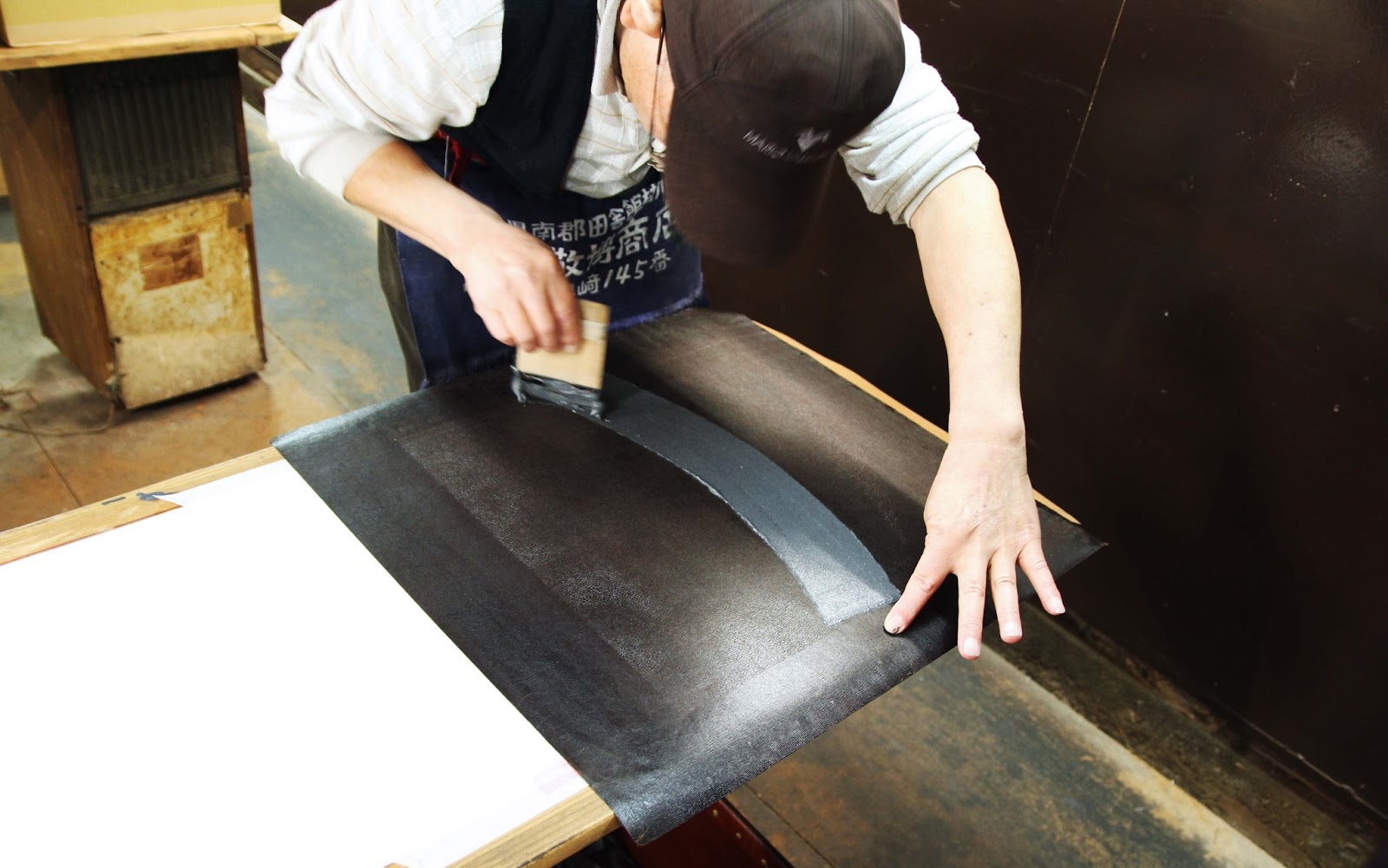
Dye brushes at Kuriyama-kobo, a katazome company
on the western edge of Kyoto
why would katazome use deer-hair brushes? Probably because 1. there were deer around and 2. an industry already existed making deer-hair brushes for use in traditional painting. Why would one utilise thin rods of bamboo with sharp spikes at the end to stretch fabric taut? Presumably because bamboo was already being formed into products for other purposes at the time. Katagami stencil paper could not have developed without the existing Japanese skills in washi papermaking - from which the stencil paper is made.

Very traditional stencil paper - shibugami
The thing is, if we look at the technique of katazome as it stands now, there is a very polished, established and institutionalised way of practicing it. It is basically understood to involve a set of specific tools and materials (mochi rice flour, komon rice bran, stencil paper, soybean & seaweed derived fixative). These are presumed to be the ultimate, most refined and correct way to achieve the best results. Of course it is fair to think that. These are not tools and materials that are used by accident - they have gone through a few hundred years of use and modification.

Whilst there is now some deviation from these very traditional and quintessential ingredients and processes, like a modified plasticised stencil paper or a chemical pre-dye fixative, there is still a very set way of doing things.

Newer plasticised stencil paper
How about if you want to use katazome in a country where those quintessential tools and materials are not only unavailable, they're simply not part of our culture. Bamboo, deer hair, rice flour and washi paper have only, if at all, recently been part of our vocabulary let alone available to purchase. They simply aren't part of our natural environment or resources.

Applying shinshi stretchers to long narrow fabric

So okay, why not seek to uncover what function these ingredients and tools perform within the katazome process and utilise something locally available to perform the same task?

Instead of lamenting that shinshi (bamboo fabric stretchers) are unavailable in Australia (they have no reason to be; historically we've never needed to be able to stretch a narrow kimono-width fabric out to dry) why not consider what function they are performing (stretching the fabric taut whilst leaving the back side accessible) and seek to replicate that function? A wooden frame with pins to hold the fabric out taut performs the same function. Of course, this is not as flexible as the centuries-tried-and-true shinshi approach but it is a workable solution.

Funori - looks natural and traditional, I guess
Manutex - not pretty but same stuff on the inside
Alright, what about the funori  - a seaweed derived gloopy thickener used in the pre-dye fixative? Well, if you get down to the nitty-gritty of what's actually in that stuff, you'd find that it's the same seaweed gloop that we use as a food thickener in Australia and it also already exists as a substrate for use in screen printing. Powdered "Manutex F" does not have the same natural look or roll off the tongue as nicely as funori, sure, but it performs the same basic function. 

And so you can continue with all the necessary tools and ingredients in the hallowed katazome tomes and see what can be used to achieve the same result.


For some ingredients the swap is simple. Others are proving more difficult. Soft, dense dye brushes, fine de-fatted rice-bran, water erasable ao-bana ink.... But it is really just a matter of thinking outside the box. To be able to source tools and materials locally would be the ideal situation. Not to remove the technique from its Japanese roots entirely, but to make it viable.


There are many specialised businesses in Kyoto, for example, which have operated as family-run enteprises for some hundreds of years. They each have their own niche of the textile process to support; the nori (resist paste) manufacturer and shop, the shinshi (bamboo stretcher) specialist, the kimono-width silk salesroom, the specialised craftsmen making circular punches for intricate stencil carving...More and more these businesses are struggling to survive. With the demise of the kimono as daily and common wear, these businesses that thrived and supported the kimono industry now have little patronage to subsist on. If I were still in Kyoto, I would continue to support these businesses with my own hard-owned yen and utilise them in my artwork but I fear even that is simply not enough.

Just one example of the many kimono industry support businesses that are often now finding it hard to stay afloat

If, and it would seem likely, these businesses continue to shut-down, there is no-one left to make the traditional katagami, to bulk-produce batches of nori paste, to make specific lengths of shinshi, to craft tiny sharp circular punches. Like any loss of knowledge and skills, this is tragic, it really is. But this is the way it goes. Crafts are only in demand so much as they are an active and necessary part of our daily lives. Without that demand, they become obsolete. There are many example of innovative companies and individuals who are thinking outside the box to continue supporting Kyoto's craft industries and make them relevant to today's society (these are something I plan to touch on in future) but I think we also need to be realistic. Whilst continuing to support traditional industry where possible, I think we need to start accepting that there are alternatives, so that the techniques can actually survive - even if some of the tools cannot.

It seems to me that in the end, even if it means modifying many of the components of the technique, having the ability to actually practice the technique at all, and see it survive into the future is the best way to honour tradition.

A tradition is kept alive only by something being added to it. - Henry James

On that note, I'm off to continue testing out new resist-paste recipes!

Sunday, October 18, 2015

One last Studio Visit - Edo-style Komon Dyeing 工房見学 ‐ 「古今」 江戸時代の小紋を守りながら、現代の染色を作り出す

**This post is really going back now...I visited this studio over 6 months ago! I was so warmly welcomed there though, that I at least owe them this blogpost...better late than never!**

In the last weeks of my big Kyoto Adventure, I was invited out to visit a dyeing Atelier in the west of Kyoto called "古今 Kokon". I was taken there by a friend of a friend, Kumie-san, resulting in Chinese-whispers style communications that meant all I knew was that we were going to see a dyeing studio that does "amazingly detailed katazome". Okay, I figured, count me in!


**この投稿はもう6ヵ月間も下書きのままに残しちゃったけど、工房のスタッフにとても暖かく迎えられたから、遅くても書かないよりはまし!**

4月、京都で最後の二週間に帰る準備でバタバタしていましたが、友だちから「すごく細かい型染をやっているところがあるのよ!絶対見に行った方がいいよ!」と言われたので、友だちの友だち久美江さんに連れて行ってもらいました。「染処古今」という工房で、四条西小路の交差点から徒歩10分ぐらいのところで、普通の住宅街に挟んでいる感じでした。

We walked for about 10 mins from Shijo/Nishikoji streets through backstreets and L-shaped short-cuts to arrive at the Kokon Atelier, established on a narrow suburban street in between ordinary looking family houses.

Mr Yasue, the fourth-generation head of the company, was there to greet us and kindly showed me all the different steps of their process in creating their unique line of kimono and obi. Turns out I even got a mention on Mr Yasue's Blog as "a very enthusiastic" visitor!

古今四代目の安江さんに迎えられて、古今の独特な着物や帯を作る工程を丁寧に説明してくれました。安江さんのブログにも登場しました!

You can see Kokon's website HERE ←これは古今のホームページです!
The process they are using at Kokon is "komon", (lit. small motif) very fine and detailed stencilled patterns. It is a form of katazome, popularized during the Edo-period when elaborate and showy clothing was periodically banned by the government.

Super-fine Komon-dyed fabric on display at Kokon 古今の超細かい小紋はステキな色で染められています。
Komon-style dyeing, in it's most traditional form, involves: 

- Carving a stencil from katagami stencil paper, using fine metal-tipped punches, or by hand with a fine cutting blade

- Applying a soft, sticky rice-flour based resist-paste through the stencil onto the fabric

- Dyeing the fabric by brush or dip-dyeing (in the latter case, the stencil is used to print the resist paste onto both the front and back of the fabric, matching the tiny pattern perfectly!!! brain explosion!!)

- Steaming the fabric to set the dye

- Rinsing off the resist-paste and revealing the delicate tiny komon patterns, which remain the white colour of the base fabric.

Just one of the crazy detailed Katagami stencil papers on display at Kokon, this one carved by a National Treasure, Nanbu Yoshimatsu 1894-1976 人間国宝南部芳松に彫られた細か~い型紙!


古今で、小紋を染めています。伝統的な小紋の工程を簡単に説明したら、

☆ 型紙を細かい刀で彫る、それとも丸きりなどの道具で模様を彫リます。

☆ 場合によって型紙を丈夫するため、漆で絹の紗を表に張ります。

☆ 型紙を布に載せて、柔らかい餅粉と糠からできている糊をヘラで敷いて、模様は布に置かれます。

☆ 刷毛で布の表を染めます。乾いた糊は染料を防ぎます。浸染する場合もあって、その時は布の両面に糊を置かないといけない。しかも、両面の模様がぴったり合うようにしないと!(なんてこと!!

☆ 染料を布に定着するため、100度で蒸します。

☆ 布を洗って、糊を落とします。やっと繊細な模様が見えます。糊が置かれたところは布の色のままです。つまり模様は白いです。


multicoloured patterns are their trademark at Kokon. Yasue-san said he spends hours figuring out colour combinations that  are just right. 古今に特有の色合い。

At Kokon Atelier, they are using a more modern technique which allows the application of multiple colours. That is, instead of applying plain resist paste onto white fabric resulting in a dyed background with a fine white pattern, 
they are also sometimes applying a coloured resist paste and dyeing the background, resulting in both a coloured background and finely detailed coloured patterns. This way, none of the white base fabric is left showing through.

If I managed to confuse you just now (sorry!), then check out the below photo.
The black and white fabric has used traditional resist paste + black dye, whilst the second fabric has used a khaki paste, then a black dye.

Top fabric= normal rice/bran resist paste, then dyed black.
Bottom fabric= a green tinted resist paste, then dyed black.

染めどころ「古今」にて、伝統的な小紋の知識を守りながら、現代な雰囲気も加えていると感じました。得に使っている色によって感じます。昔の小紋といったら、白い生地に一色の模様が染められました。(細かい模様はもう織物に見える!)古今で、色糊の使用によって、生地も模様の所も染められます。(上の写真を参考に)。また、色糊の上に暈し染をしたり、何枚かの細かい小紋をデザインの中に使ったりするから、とてもフレッシュな雰囲気の染物が出来上がります。

The practice of using coloured resist paste became popular during the Meiji era when chemical dyes were introduced from Europe (they had been discovered and developed in France, England and Germany) which could be mixed straight into the traditional rice flour/rice bran resist paste. This meant the paste was both colouring the fabric where it was applied as well as resisting the colour of any additional layers on top of it. Clever, huh!

色糊は明治時代に発達されました。ヨーロッパ(特にイギリス、ドイツ)の研究者が開発した化学染料は日本へ輸入されました。化学染料は糊と混ぜることができて、新しい染め方が現れました。
染料が入っている色糊は、上から挿される染料を防ぎながら、置いた所も染めてしまいます。
かしこいでしょう!

見学した時、糊の作る段階が見えました。古今では、色糊は毎回、職人さんの感覚で作られています。染料は何パーセントとかのレシピが無しで、普通の糊に、染料を少しづつ加えて、良さそうな色になると、生地に敷いて、蒸して洗います。色は予想と異なると、染料の量を調整して、もう一回蒸して洗ったりするの繰り返しでやっと糊ができます。
すごい努力の要る作業だと思っていましたが、安江さんたちがこだわっている綺麗な「生じゃない色」を作るにはやっぱり必要ですね。

Normal paste on left, dye concentrates, then a Blue paste getting mixed on right. 左は普通の防染糊、真ん中は各色の染料、右はできた青色の色糊。とても濃く見えますが、蒸して洗うとかなり薄い色になてしまうから何回も確認しないと。

Mr Yasue showed me their rows of tubs of mixed coloured resist paste and was explaining to me how they mix the colours.  He told me they don't use measures or a notebook of dye to paste ratios but by mix their colours by eye. Every time!

To do this, they have various dye concentrates all lined up and add these to a bucket of plain paste little by little to produce a batch of paste in the desired colour. This colour sample needs to be dried, steamed and washed to check what the true resulting colour will be. They continue to adjust and repeat the tests until the desired colour is achieved. This seems like an awfully tedious way of mixing colours, but as Mr Yasue pointed out, this ensures they achieve rich, subtle colours; colours that do not look like they came "straight-out-of-the-tube".

Yasue-san showing me their swatch book of paste colours. This is only a visual reference though because they remix the colours by eye each time! (写真は古今のブロッグから)

糊の作業場から、型紙の展示へ移動しました。何人かの人間国宝に彫られた型紙も所蔵されているそうです。「道具彫り」に使う道具も見せてもらいました。道具自体は美しいと思いました。丸、葉っぱ、月などの形を切る道具もあって、これらは職人さんが自分で作るらしいです。型紙を彫る職人さん、何名も「人間国宝」とされていますが、この道具も近いうちに国宝にもなるのではないか?将来に作れる職人さんが減ると貴重品になるでしょうね。

After the paste-mixing room, we had a look at the different kinds of stencils and cutting tools for komon. Aside from tiny blades, punch shapes are also used for cutting stencils (dougu-bori). The stencil-cutting artisans tend to make their own punches, hammering fine strips of metal to form the desired blade shapes (like dots or moons or small leaves). Many stencil-carvers have been designated as "National Treasures"; their craft is so skilled. Aren't the punches also beautiful objects?? They will become national treasures themselves before long because there are now very few craftsmen actually making these amazing tools.

The one-off handmade cutting tools, some shaped like crescent moons, others circles and dots 美しい道具。
次は大きな作業場へ入りました。頭の上に5メートルの糊板がたくさん並んでいて、背が高い人はここで働けないなあと思いました!笑 いくつかの板に帯や着物の反物が貼っていました。
Next, we went into the biggest workroom. The ceiling is very low as all the 5 metre long wooden pasting boards are stored up above their heads. Many had kimono and obi-belt fabric in progress pasted on them.
Three staff were working in the space. One was applying layers of lacquer to old stencils to prolong their use. Another was printing fabric, matching a ridiculously fine repeat pattern down a length of fabric and washing the stencil between every repeat (! they take pride in their product!)

Lacquering old stencils to extend their life. 古い型紙に漆を引いていました。 All the 5 metre long narrow pasting tables are stored overhead. Couldn't be a tall person working here!

In the middle of printing a fine pattern with coloured resist paste, very carefully matching the pattern repeat each time. You can barely even see the pattern at all here, but check out the next photo!!
小紋の糊置きの最中。毎回、柄がぴったり合うように練習が必要ですね!模様はここで見にくいですが、次のショットで見ると...

ギャー!こまかい!eeeeek! Super fine komon pattern freshly printed with a coloured resist paste.

Best of all though, was Mr Nomura. He has been with the company since he left school at 16 (I think his spine kind of gives that fact away..) and as such, he is the resident expert. He was printing when we went in, working to combine multiple fine patterns on what will become the ornate hemline of a kimono. 

最後に野村さんの仕事をお邪魔しました。16歳からこの工房で働いていたそうで、(姿勢を見るだけで分かるんですがね)小紋のプロです!見学のときは、ちょうど着物の裾の所に色んな小紋を一枚ずつ「熨斗」のデザインに入れ込んでいました。とても複雑な仕事ですが、結果はきれいですね。

Nomura-san, looking like a pro. because, well...he is. プロのしぐさですね!

Nomura san printing different patterns selectively to create the impressive effect below ↓
野村さんは小紋を部分的に糊を置くと下のような効果がでた↓
various komon patterns printed carefully within the design of "noshi" a curly ribbon-like motif in Japanese art and design.


Yasue-san surrounded by his company's products
古今の着物や帯に囲まれている安江さん


帰る前に、古今の商品が置いてあるビルを案内させていただきました。古今の複雑な工程を見たばかりので、完成品の帯や着物に感動しました。
Before heading out to a sushi lunch, Mr Yasue took us to a second compant building and showed us some of their finished products. After having seen the complex process Kokon uses to dye their fabrics, it was even more impressive to see the final products, all shiny and packaged up.

Obi with the same pattern in different colourways.
同じ柄の帯。ぜいたく!

I was really taken with the modern colour pallete they are using in their products. Without modifying the traditional process, tools or fabrics, they are giving their kimono and obi a really contemporary look just by using really unique colour combinations.

After all, this is reflected in the name of the company: Kokon. The two characters mean "Old" and "Now"; Bringing together the knowledge and expertise of the past generation and utilising it to skillfully make beautiful clothing for the generation of today.

古今でうまいことに小紋の道具、生地、素材を伝統のままにして、色やデザイン感覚だけを変えることによって、面白い染物を作り出していると思います。

「古今」の字のように、過去の職人さんの知識と技法を使って、現在の人々のテーストにあう染物をフレッシュな感じに作っている、と思います。小紋の伝統を次の世代にも伝えたらいいですね。

Tuesday, October 6, 2015

Jumping back in!

Oh hi there, world.
It's been a while between posts lately. I've been a bit stuck, uninspired and dragging my feet through the mud of procrastination. I've also been stewing over a bunch of posts and been too much of a perfectionist to let any of them go out into the ether. But done is better than good, so here we go...

It's just ticked over 5 months since I came back to Canberra after finishing up my Graduate studies in Japan. Returning to Australia, I was most worried about leaving behind a supportive art network that I had built up over more than 5 years. I also felt the pressure of continuing to make work (and because I'm a perfectionist, good work) when my teachers had taught me so much and told me they expect big things from me. (gah!)

But it's all a process and I refuse to let all the things I have learnt, practiced and developed sit shriveling in the corner out of fear.

New work since coming back to Canberra, "Call of Crimson Rosellas" July 2015. 184cm wide. silk, katazome, yuzen.


Hacking "sacred" techniques.

Katazome and yuzen and many other Japanese-conceived ways of getting dye onto fabric (and making it stay there!) are complicated.

It's not like Painting, where you could pick up rolled canvas and paints and brushes almost anywhere around the world and you'd be set to go. That makes me incredibly jealous. It makes artists like painters ideal for artists' residencies or Studio rental because their materials are easy to procure anywhere and easy to move. (not to mention easy to market and the fact that they are a culturally understood format/genre - but that's another kettle of fish)

Katazome and yuzen require tools and materials that just aren't part of the culture outside of Japan. Rice bran, used for pickling vegetables in Japan, is not a supermarket staple in Australia. Bamboo, as used in making fabric stretching rods "shinshi", is the jack of all trades in Japanese construction, gardening and even cuisine, but it's often considered a pest plant in Australia. As for katagami stencil paper made from mulberry fibre paper, that has been painted with astrigent persimmon juice and then smoked for 10 days? YEAH RIGHT!

Beautiful Nuka (Rice-Bran) pickles - something I came to love but they are definitely not part of Australian culture and hence, neither is the crucial ingredient, Rice bran (image by Max Wheeler)

But using the lack of perfectly suited tools and materials as an excuse not to do anything is a mistake.

I'm figuring out how to "hack" these techniques in Australia, tool by tool and ingredient by ingredient. I'm finding out which ones are non-negotiable and which can actually be easily replaced with something else. Bye-bye toxic lacquer for applying mesh to stencils, hello Dulux wall paint! (yay, washes off in water!) Bye-bye giant, beautiful bamboo sifter and oversized rice paddle for making resist-paste, hello $2 shop sieve and a Kmart giant wooden spoon.

Using Dulux house paint to adhere mesh to the front of the stencils in the foreground. Thanks to hints from a process John Marshall in the U.S has pioneered.

Even just figuring out what the real ingredient in some of the Japanese-sold auxilliaries has been helpful. Turns out funori, a shrivelled up seaweed used as a thickener in Japan is just the same as Manutex, a product we use here in textile printing and as a food thickener. Or something simply known as "Fixer 10" in Japan is actually sodium silicate or "Maypro-gum" used in thickening dye in Japan is pretty much the same as Guar Gum - a.k.a the gluten-free baker's favourite assistant.

So it's do-able! It may not be very travel-friendly but certainly the sketching/designing stage can be portable. It may not be as elegant of a set-up or as Japan but hey, here's a secret, even my very successful professor just washes stencils in a bath tub and had the old guy down the street rig up a board with nails in it and castors on the base to hold her dye brushes. Done is better than good, it would seem.

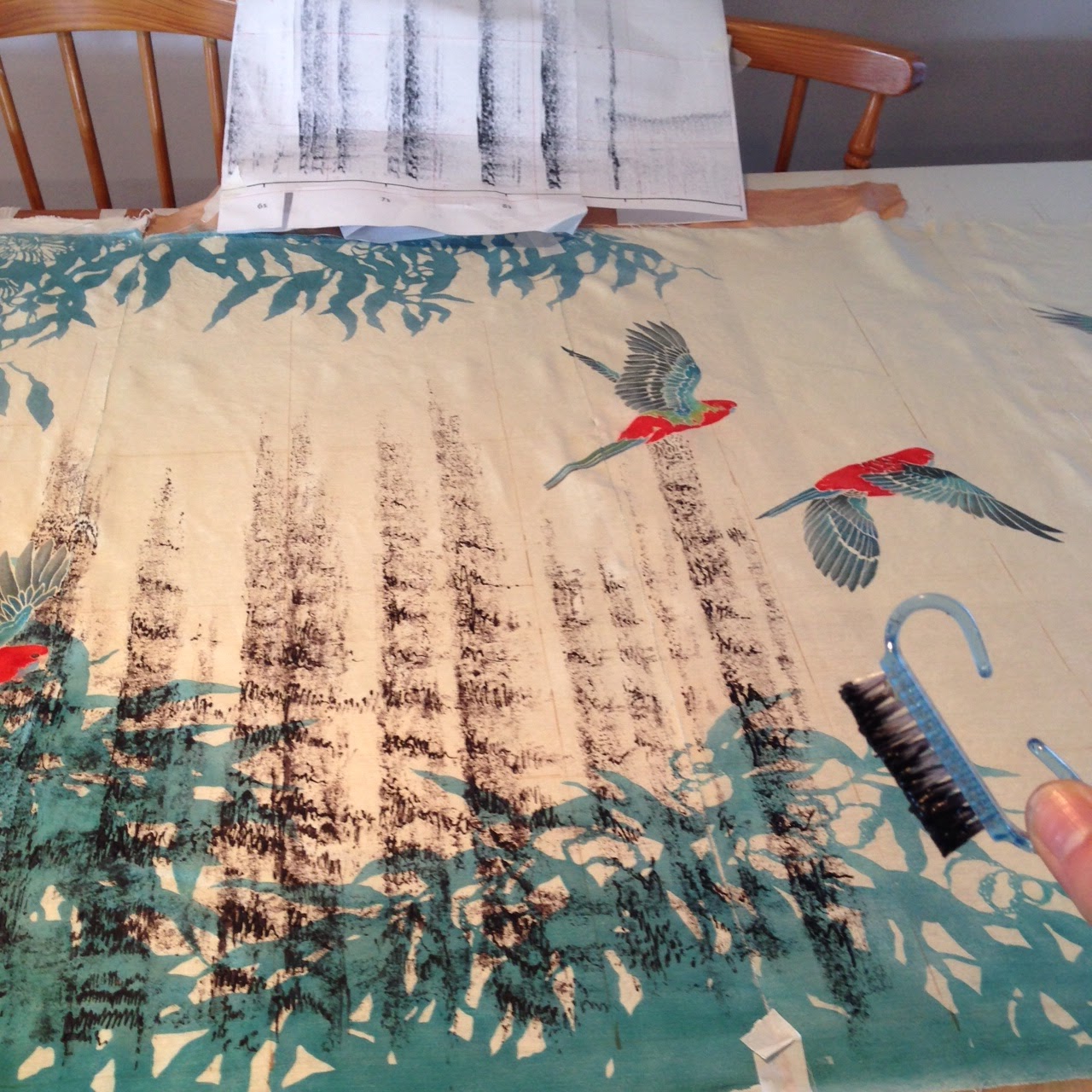
Sure, the setup is a little bit "sticky-tape and cardboard" but it works!

Dining table + sticky-tape + $1nailbrush = good enough

Even though Katazome and Yuzen are traditional techniques, they are not sacred. Culture is not static, and traditions grow and change with it.

So I can't use the lack of materials or tools as an excuse anymore. I have new ideas, some people interested in commissioned pieces, and the means to make them.

Consider this my jump back into regular posts. Less perfectionism, more output coming your way!

Sunday, March 8, 2015

Kyoto's backstreet Textile Industry 京都の裏道にある染色世界

When people call Kyoto the Textile Capital of Japan, it's easy to write it off as some kind of nostalgic comment.
京都が「染織の都」と呼ばれているのは、昔を懐かしむくせに過ぎない、と思いやすいですね。

But there is still a very real and functioning network of textile companies in Kyoto today, tucked between carparks and petshops, incomprehensible from the next house on the street besides a small company sign, and taking up multiple floors on non-descript 1980's office buildings.
しかし、決まり文句っぽいのに、今でも本当にその通りです。もちろん、昔のように盛んでいるとは言えないですが、今の京都では染織関係の会社がいっぱい残っています。コンビニとペットショップに挟まれたり、80年代っぽいオフィスビルや何も目立たない町屋で営業しています。

Looks like any old house right? 普通の家に見えるでしょう?
Almost all of the signage and information about these companies is in Japanese, of course, so visitors to Kyoto probably don't even notice. These businesses also tend to be concentrated in pockets of the city that are removed from the tourist areas, so it's easy to miss them. I think even Kyoto residents don't even really notice.
この会社の看板はほとんど漢字で書いてあって、観光客はもちろん、京都人でも気づいてないだろうと思います。場所的に、街からちょっと外れている通りに集中しているから、気づかないでしょう。

近く見たら、染織関係だ!看板小さいね。A closer look at the building above shows it houses a Textile Artists' Association and a decorative textile research office.
As a kind of experiment last week, I walked around some of the streets I know to be textile areas just to see how many of these companies I could spy. The answer? In just 30 minutes, stacks!
先週、京都市内の染織が有名な町を散歩したら、何軒の染織関係の会社が見えるのかという実験をしました。その結果は?いっぱい見えました!

I was excluding those specialising in weaving (you can hear the whirrs and clacks of the looms beyond the frosted windows); trying to just narrow it down to businesses related to dyeing and the kimono industry. The number is practically exponential, once you start looking up and reading the signs.
織物関係を別にして(窓の向こう側に織り機のカシャカシャが聞こえます!)、染物屋さんだけに限りました。それでも、上を見て看板を探し始めたら、数え切れないほどあります!

A company specialising in dyeing Black. Black is known as a very technically difficult colour to dye well, hence entrusting that step to a separate business. 黒染屋さん。黒って、染めにくいから、分業して、黒染専門の工場が作られたでしょう。
黒染屋さんの看板。着物の形。Black Dyeing shop with it's Kimono shaped Sign.
tiny sign to indicate this is a dye workshop. In the Nishijin district of Kyoto. 西陣にある染め工房。
This one was a triple line-up. Dyeing workshop with the blue signs, then a business that does dye finishing processes and then a flag business. 三つも並んでいた!
Right next to a pet shop, this one is more weaving oriented, silk fibre company. 
Typical looking house on a typical looking street.. 普通の通りに普通に見える家は
but it turns out to be another business that does specialised Black Dyeing. 黒染屋さんでした!

Business making chirimen silk kimono
Another dyeing company...
and another...

And another...

and another!!
This business sews Japanese clothing like kimono or haori etc.
This one specialised in Kyoto style embroidery. Probably for embellishing kimono
the shop with the red noren curtain sells kimono lining fabrics.
これは紅型の会社だそうです。This one is a Bingata (okinawan style stencil dyeing) business.
I think you can start to get a sense of how numerous these businesses are. There were many others I didn't take photos of because it felt rude. I know there were also many more that I missed or that are not specifically marked on the building even though they are operating some kind of textile business. You can see below where these businesses are concentrated.

the red dots are dyeing-related businesses in Kyoto
Now that kimono are no longer standard everyday wear, many businesses such as these presumably have less work than they used to. I wonder what will happen to them in the future? They are powerhouses of knowledge and specialised equipment as well as links in the chain of kimono production. The division of labour means that when one business closes down (such as a steaming company that shut down 2 years ago) then the rest of the chain is affected. As more start to close, the chain will end up with some big holes. Can the individual businesses find ways to keep their services relevant in future? I guess it remains to be seen.

Thursday, January 22, 2015

New Works and Revelations 新作と気づいたこと

I was bent over the outdoor wash trough wearing industrial rubber gloves and washing resist paste off my fabric in FREEZING cold water as it SNOWED on a SUNDAY and thinking, "how did it come to this?!"ある日曜日、雪が降っていて、教室の外で凍りそうな水に生地を洗っていたところに、「こうゆう作業状況って何なん〜!」と泣きたくて思った。

even the industrial rubber gloves were feeling a bit thin that day. 雪が降っている間、外での水洗い
Why do I always end up finishing things at the last minute? Sometimes it's even after the last minute, getting extensions, being a pain and asking for allowances. Why do I end up giving up every free day and every waking moment to go to School and work on these artworks? Why do I end up cancelling on friends and putting off social occasions to do this?
どうして、いつもギリギリまで仕上げているんだろう?ギリギリまでといっても、締め切りが終わった後にも制作が終わっていない時も最近多い。休みの日にも学校に行ったり、友達に迷惑をかけたり、イベントとかパーティーに全然行けなくなったりするとはなんだった?

Of all the days for it to snow on campus..wash day! 雪の京都精華大学キャンパス
Well, partly it's because I love what I'm doing. I'm excited to make new works, so I do it. But the pace of that making has been overwhelming this past year and I figured out that there's a few reasons for that. 
制作が好きで、新しい作品を作る時にワクワクするということもあるんですけど、2014年の制作ペースがあまりにも厳しかった。その理由は幾つかあると思っている。

One reason would be the university artwork deadlines, which were set arbitrarily and out of my control. 

Another is that I did too much yes-ing: agreeing to take on too many things outside of school; jobs, exhibitions, applications...

Combine that with taking a too-perfect approach to everything, whereby only the most time consuming effort is good enough...

Then add to that a decent dose of procrastination.

All in all it was a recipe for becoming a manic artwork-producing machine.

一つの仕方が無い理由は大学側に指定される締め切り。

それで、いつもYESをすぐに言ってしまうタイプなので、参加する展覧会とかバイトが増えた。

それで、なんでも完璧にやりたい癖もあるから、なんでも時間をかける。時にはすごい時間をかけてしまう。

最後に、procrastination!! やらないといけないこと以外のぜーんぶをやって、やらなきゃとおもいながら、やらない。っていうのが上手!

2014 was an incredible year. This shot is from a show I was in with my 2 fellow Textiles Masters students in Kyoto in July. 2014年7月、ギャラリーマロニエでの展示
Don't get me wrong. Last year was incredibly rewarding and exciting and I grew a lot as an artist. That growth is something I could only have gained through all those different opportunities. But there is definitely a point where the benefits are outweighed by the physical and emotional stress brought on by such ridiculous, back-to-back deadlines.
こういうふうに分析しても、2014年は凄く豊な一年だった!色々な機会や経験があったからこそ、作家としても成長した気がする。

I have this quote hung in my kitchen from a young designer called Imai-san who works in the Chiso yuzen kimono company. He comes to speak at Kyoto Seika regularly as part of a course that introduces students to the many different traditional craft companies in Kyoto (kimono, bamboo, paper, lacquer etc). When I saw him speak in 2012 he gave out a great handout that included these words
"The essentials for creativity are seeing, experiencing, studying and enjoying as many different things as you can. All those things enrich your sensitivity...
Achieving your goal: It's important to have a strong belief in yourself and hold firm. You need toughness and gusto to accomplish what you want without being influenced by your surrounds..."
たまに京都精華においでも講演しているCHISO(手描き友禅の着物会社)の今井さんの言葉が台所にはってある。
"クリエーションに必要なことは、できるだけ多くの物を見たり、体験したり、勉強したり、また遊んだり、そんないろんなことで自分自身の感性を豊かにしていく…目的を達成する: 自分自身の信念を強くもち、ブレないことが大切です。そして環境に左右されず、やり遂げるタフさやたくましさが必要です。"

It's so true. Notice that he emphasizes the importance of play and seeing many different things. When tight deadlines force out that time for play, we lose chances to think new things, to get more creative ideas and probably, paradoxically, to be more productive.
遊びの時間もつくらないとだめですね。締切のせいで、遊ぶ時間が無くなったら、もしかして創造的に考えるのも難しくなります。

perfecting swift parrots? Sketches upon sketches. オトメインコのクロッキー
Will I ever get that balance though? Probably not. Since perfectionism and procrastination are part of my personality, I don't think I'll ever be someone who finishes early.  I've found the idea of just doing "good enough" has been helpful in getting me over some perfectionist hurdles though: ask yourself, what would I do right now if this didn't need to be perfect? If I could just do "good enough" right now, what would that be? and then try and do that.
いつかそういうバランスを達成するのだろうか?性格的には無理かもしれない。ですけど、「完璧」を求めるよりも、「十分に良い」に目指したら、制作がもっと楽になる気がします。


Like I said, I'm not regretting any of the experiences I had in 2014 though. I am also glad I made it through it all because now I am part of this huge panel-selected exhibition starting Sat 24th January at the Kyoto Musem! Flyers are on the trains and in department stores and everywhere! It's part of a string of events to take place throughout 2015 to mark the 400th anniversary of the Rinpa School of Japanese Painting and features about 40 young artists who base themselves in Kyoto. It's opening on the weekend and I'm super excited!
See more details here and here. Also come along to the artist's talk on the 7th of February to hear me stumble through 5 minutes in Japanese!

sneak peek at the work "Floriferous" I'm showing as part of the Kyoto Museum show.
2014年、色々頑張って良かったと思うのは、こういうステキな展覧会に選抜されたこと!京都文化博物館で「琳派400年記念 新鋭選抜展」は約40人の作家による展覧会。この週末から開催されていて、ワクワクしています!ちなみに、2月7日のアーティストトークで5分ぐらい喋るので、京都に居る方、ぜひ応援しに来てくださいね!詳しい情報はここから

More to come soon too on my graduation artwork which is THIS CLOSE to being finished! もうちょいだけで終わる修了作品についても近々にアップしますので楽しみにしてください!

Eeep! Graduation will be here before you know it!