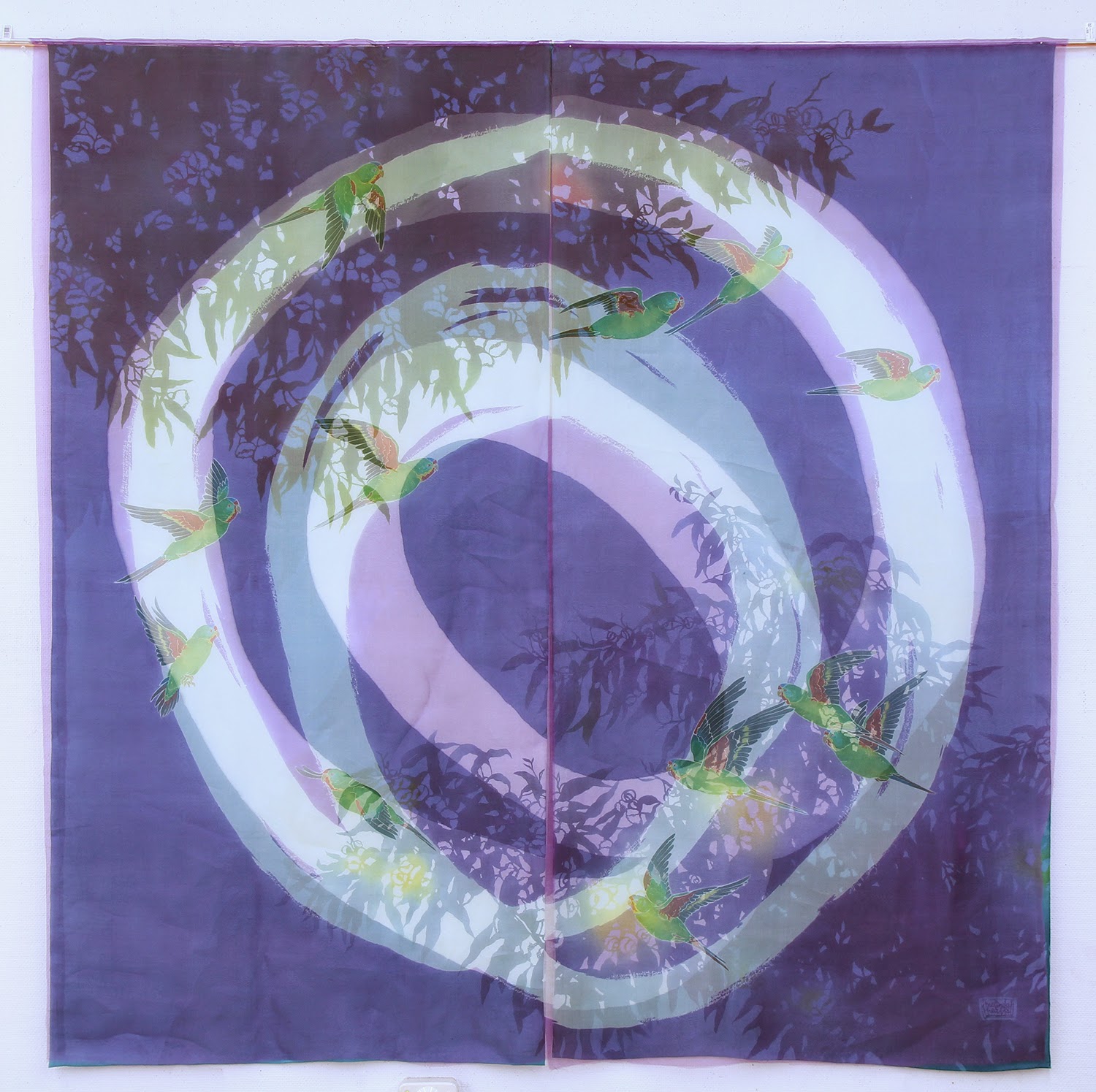
Showing posts with label birds. Show all posts

Monday, December 11, 2017

2017 - a hectic year of TRYING

Wow, how is it already December!?

Apologies to my sadly neglected blog but this year has been a heck of a ride.

In looking back over all the things I've done and struggled with this year, I suddenly had a (mildly incensed) urge to write it all down and make sense of it before another year rolls around.

Let me paint a picture of the hectic year just gone.

→ I dyed a commissioned noren (split curtain) for an Australian Tea-master who lives up in Newcastle with his own tatami-floored tea-room. It's a homage to spring with magpies, which also happen to be the emblem of the area where he studied Tea.

privately commissioned Noren featuring Australian magpies

→ I started making textile jewellery that I've called tameshi, using trial dye samples and un-used edges from dyed works. These have been proving popular and I feel good about the fact that they are mini artworks in themselves and re-use fabrics that I would have thrown away or put in a box somewhere.

Tameshi jewellery - tameshi means sample or test. Available through stockists in Canberra and on my etsy store https://www.etsy.com/au/shop/someru

→ I sent work to a group show by dyeing artists in New York. As the only artist out of the group who wasn't Japanese, apparently people said mine looked the most Japanese! With all the deadlines for later in the year, I didn't manage to get to go the US to see the show but still, it felt like an achievement.

My series of 6 yuzen/katazome dyed works on display as part of "Wafting II" at Medialia Gallery in New York, June-July 2017

→ I participated in a four-day residency out at Tidbinbilla nature reserve thanks to Craft ACT. Four of us selected artists got to stay in a newly renovated cottage inside the reserve and spent four lovely sunny days at the tail-end of winter hiking in the bush, sketching, writing and sharing tales over cheese and wine.

The delights of early spring at Tidbinbilla - Gibraltar Peak, Early Nancy, Flame Robin.

→ I travelled to Japan and held a solo exhibition in Galerie H20 in Kyoto. My first solo show there in 4 and a half years, always a joy to be there and to catch up with so many friends and new connections.

entryway and Japanese garden at Galerie H20 in downtown Kyoto

view of solo show at Galerie h20, October 2017

→ Whilst in Japan I made time to visit and interview a bunch of great humans, friends new and old who are doing innovative and interesting dye-work. The plan is to write up a series of interviews from all the meetings and I've created a new project Somé 20:20 to house them and to move forward with. It's a reference to being able to see clearly - without acknowledging tradition how do we move forward? and how will dyeing art survive into the future, 2020 is just around the corner. A work in progress, my new website for the project is over at some-20-20.com

the wonderful people who agreed to be interviewed for my Somé 20:20 project.

→ I came back and setup another solo show at ANCA gallery in Canberra! The theme of my works this year have been "beautiful weeds", and I managed to create some new works that are really where I've been wanting to head for a while now; layered and sheer works that are a new form of collaged landscape.

Solo Exhibition "Naturescapes" at ANCA Gallery & Studios, Canberra, Oct-Nov 2017

detail of "The Beautiful Weeds of Canberra" series, on show at ANCA Gallery, Canberra

→ I ran workshops and demonstrations in dyeing at the 2017 Canberra-Nara Candle Festival. For the demonstrations, I dyed a massive 9 metre length of resist-printed cotton in one go while a crowd watched and revealed pattern and birds and text as I went. The workshops saw nearly 100 people dye their own kata-yuzen bookmark using pigments and stencils.

Kata-yuzen workshops and Hikizome demonstration at the Canberra Nara Candle Festival, October 28, 2017

→ I ran another afternoon of workshops on the last day of my exhibition, dyeing katazome postcards. Participants could dye pre-printed washi and wash away the paste to reveal the patterns. We had great warm weather and it was a lovely bunch of enthusiastic people who came along.

wonderful postcards dyed by participants, drying on the outside windows at ANCA

→ I even had an article published in the Kyoto Journal, on katagami stencils.

Kyoto Journal, a volunteer-run publication, making a return to print from this issue.
It's great! you can get your hands on a copy here


PHEW!

What this run-sheet doesn't show is the sleep-deprivation, self-doubt, expenses, rejection letters, missed deadlines, extensive preparations, hours spent at a day-job and the constant juggle.

On paper, (or in digital text, I suppose) this looks like a hugely successful year. In a sense it was.
But it was also really, really hard.
I don't think this level of productivity is sustainable, or even very enjoyable.
I also didn't really sell much art. Not through exhibitions.
Where I really made progress and, to some extent, a profit, was through connecting with like-minded people, through making custom pieces, through sharing affordable things, and through trying to promote the unique genre of Somé.
Which has me re-thinking my approach to all of this.

Given that my work places me in a sort of odd position in between ART, CRAFT & RESEARCH, (odd in the sense that I don't fall neatly into funding categories or job titles) I'm thinking that instead of struggling against that and trying to slot myself into prescribed categories, why not embrace it?

Can I be a CRAFTISAN?
Can I be a RESEARCHIST?
Can I be a CRAFTIST?

I'm tired of feeling like my specialties (being able to dye pictorial textiles, being interested in craft, being knowledgeable about tradition, having Japanese abilities -though not bilingual by any means, being interested in smaller, affordable art) are a liability, or something I need to adjust so I can be in the same game as everyone else. And of feeling like my particular set of skills don't add up to anything. When in fact they do! and they are a killer combination despite what the grants categories, arts bodies, or professional membership organisations would have me think.

So consider this my personal passion project for 2018; finding a way to be my own kind of craftisan, pursuing research and researching through making.


Thank you for putting up with the silence on this blog but do feel free to check in over at my website and project site to see what things I get up to in 2018.

Wednesday, June 17, 2015

Hello from the Southern Hemisphere ! 南半球からこんにちは!

Hello from Australia!!
お久しぶりです!!オーストラリアからこんにちは!


It's been a very long time between posts, sorry! It's coming up to two months since I moved back to Canberra, Australia after four years living and studying in Kyoto. I've been a bit all over the place, getting settled and gathering my books and supplies back together which have been arriving in boxes one by one via Sea mail. I've been ever-so-slowly getting back in touch with galleries and the art-scene in Canberra. It's a little overwhelming to be spat back into the "real world" again but step-by-step I'm working on finding my place in it.

前に書いた時から結構時間が通ってしまいました! すみません!なぜかとういと、4月末、京都で染織を勉強する4年間がようよく終わって、帰国したのです。帰って来てから、荷物も頭もごっちゃごっちゃでしたが、色々がやっと落ち着いてきました。京都から船便で送った染色用の刷毛や生地などが一個一個ちゃんと届いて、最低限のものは揃っています。

少しずつ、キャンベラ市のギャラリーを巡って、作家として生活している友だちなどと再会して、作品を作るやる気がなんとか戻ってきた感じがします。大学から卒業して、現実の世界へドンと戻るのがちょっと辛かったけれども、一歩一歩、前へ進んでみます!

Group-show I took part in at M16 Last winter. This time, I'll have one of the gallery spaces all to myself! 去年M16でグループ展に参加したんですが、今回は個展です!DMができたらまたおしらせします!
I have a solo exhibition coming up in Canberra in August (6th-23rd at M16 Artspace). It's one of those things that my "other self" organised on my behalf. You know when one part of you is being super practical and objective and says "Yeah! You know what would be awesome for you? Go and sign yourself up for a solo show! Or even an artist's talk! Yeh!!" and the other half of you nods along and goes and does just that. Then when the deadline is approaching, it all becomes real and your whole self wonders "Wait, what!? When did I do this to myself?" But anyway, the orgainsed half of me knew best and I'm looking forward to it, just have to start treating it like it's real and get organised!

この8月6日~23日、キャンベラ市の「M16アートスペース」で個展を開催します。3月の卒作を展示するつもりですが、それ以外にも何点の作品も必要です。そろそろ本格的に準備をしないといけないですね!

I am having to figure out new ways of making work, now at home Australia. Most materials and ingredients for yuzen and katazome can be sourced here. Silk is available online at comparable prices to Japan (thanks in part to our obsession with handmade white silk wedding dresses!), rice flour is an Asian Supermarket staple and alternative stencil papers can be found.
At the moment (with the help of my engineering-minded Dad. Thanks Dad!) I'm getting together parts for a stainless steel fabric steamer. It will be a rocket style steamer so I can roll my fabric in newspaper or non-woven fabric and steam-set for an hour before washing out resist paste. Exciting!

京都精華大学から離れると、その素晴らしい設備や使い放題の作業場からも離れたんですね。そのため、「じゃあ、今住んでいる所でどうやって友禅の作品が作れるのか?」と自分で挑戦しないといけないです。友禅や型染に必要な材料はオーストラリアでなんとか購入できます。絹は通買で日本の値段とそんなに変わらないし、糊に使う餅粉はアジア食品スーパーで普通に買えます。一番工夫しないといけないのは「蒸し器」です。新しい場所で、新しいブランドの材料や染料をつかうという事情になっているので、前と同じく蒸し器で染料を定着したいです。できるだけ慣れて来た工程で作れば失敗の可能性を減らせるだろうと思っています。自分で作れば、日本やアメリカで買える簡易蒸し器よりずっーと安くできます。今のところ、部分を集めていて、(お父さんの手を借りて)組み合わせるのを楽しみにしています!

I'd like to make some small new works for my exhibition in August. I'm thinking about using some natural dyes and making small layered works with organza. Hmm, ideas! I'll post photos as the process gets underway.

Samples from immersion dyeing with Eucalypts. I'd love to get this kind of colour for yuzen brush dyeing too! 浸染でとれたユーカリの深いオレンジ色。友禅での色差しや引き染にも使えたらなあと思うんですが、まだ実験中です。
個展までに植物染料の使った小さな作品を作りたいと思っています。絹オールガンジーを何枚か重ねるタイプの作品にしたいです。今から生地の試しなどをしているから、進んだらまた見せますね。

For now, I'd like to leave you with some photographs I took around our suburb in Weston Creek, Canberra. People in Japan sometimes expressed disbelief that some of the plants and birds featured in my work really were just commmon species and found around my hometown. I assured them proudly that yes they were. Now, I have photographic proof! Even I was a little surprised to see them around the 'burbs. Thanks a lot reverse culture shock! Haha anyway, look forward to seeing lots more posts here soon.

それまでに、今間実家の周りに撮った写真をシェアしたいです。日本で作品を展示した時、日本人がよく、「こんな鮮やかな花や鳥って普通に居る訳ないでしょう!」みたいなコメントをした。そしたら、私は自慢いっぱいで「普通にいるよ!」といつも答えました。先月帰国したら、私もちょっとびっくりしました。作品で描写した花、鳥、色、葉っぱ、本当にどこにも見えます!
ここでやっと、写真で証拠を提供します!笑。では、また色々アップしますので楽しみにしてください。

Callistemon in my Yuzen Kimono 2013 友禅染振袖にあるブラシの木の花
本物。The real one

Eucalyptus cinerea in "Bluegums" 2014


Red flowers on Eucalyptus Trees ユーカリの紅色の花
detail of Swift Parrots from my Master's Graduation Work 2015 卒業作品にも染めた。

Gumtrees, gumtrees, gumtrees everywhere!! どこでもユーカリの木です!!
Sketch of flowering Gumtree 卒作に向けてやったユーカリのスケッチ

Saturday, March 14, 2015

Why can't you touch Art? 作品を触っちゃダメって何?

The lady in her lurid yellow fitted jacket raced over to me and told me not to touch the artwork.

I told her, "But I'm the one who made it; this is my artwork!"

She frowned and did that Japanese suck-air-through-your-teeth thing and said that if I touched it, other people would think it's okay to touch it too.
In the moment, I couldn't gather my thoughts well enough to give a level-headed response so I just sort of nodded. What I really wanted to say was "So what?! What if I actually don't mind people reaching out and touching my work? Its fabric, it's washable, it's FINE!"

Pretty sure it's not just me that sees something like this fabric and hears a little voice scream "touch me!!!!" こういうのを見て、触りたくなるのが私だけじゃないでしょう?!

派手な黄色スーツ姿のおばさんが走ってきた。「すみません、作品にはさわらないでください。」

「あっ、でも、私の作品です」と返事したら、黄色のおばさんが困ったように歯の間から息を吸って、「すみませんが、他のお客様が触っているのを見るなら、触ってもいいと思ってしまうので」と言った。
その場で上手く返事ができなかったけれども、言いたかったのは「それで!?別に触ってもいいんだよ。生地だし、洗えるし、逆に触って欲しいかも」

This was just another glimpse of conservative Kyoto that I got when I exhibited at the Kyoto Museum last month.まあ、京都のミュージアムでも、世界のミュージアムでもそういう態度ですね。

The work I recently exhibited at the Kyoto Museum: "floriferous - 咲き乱れる" 
京都文化博物館で展示した作品です。

Perhaps a MUSEUM is not the place for textiles.
ミュージアムという場所は、もしかしたら染色の作品を展示するには合ってないのではないか?

As a kind of pipe dream, I would love to make textile installations. Wait! Don't roll your eyes at the word "installation", often used by arty-farty types as a blanket term to legitimise anything from a room full of bits of garbage to an empty room with a soundtrack on loop.
いつか将来に作りたいの一つは「染色インスタレーション」なのです。「インスタレーション」という言葉がこの頃使われすぎで、意味なくなるぐらいように色んなものがインスタレーションと呼ばれています。(何も置いていない暗い部屋がインスタハレーションだとか、古い工場の床に散らされたゴミがインスタレーションだとか)

Fly free my pretties! "Freshly" dyed and washed pieces of fabric hanging out in this wicked autumn wind as if trying to get free. It was a beautiful sight and I stopped there and thought: "THIS! this is what a textile is supposed to be like" 水洗いしたあと、乾かしている生地の動きが本当に綺麗で感動した!その瞬間に「テキスタイルってこれや!!」と思った。

What I mean is, a room or even better a semi-outdoor space full of hanging dyed fabric, that you walk through, look at, which moves as you walk by and shows off the best of Australia's brilliantly coloured scenery or birds. And it would be something you are free to touch.
そういうわけわからないインスタレーションではなく、私が作ってみたいのが自然光がたっぷり入る一部屋(または半野外の場所)に染めた生地をいっぱい吊り下げたインスタレーションです。生地にオーストラリアの鳥や色や言葉を。人が通ると生地が動く。森へ覗きこんでいるように感じる。何よりも、触ってもOKの物を作りたいと思っています。

This time there was no gallery minders and no alarms to set off!
卒展で自分の作品をよく触ったよ!
You can't do this kind of installation in your average museum or city gallery-type space. For one thing, they often don't allow you to hang anything from the ceiling (another sticking point I'm still annoyed about with the Kyoto-city Municipal Museum of Art), which reduces you to hanging against a wall or to creating some kind of nifty wall-fittings. And then there's those sneaky Gallery Minders (as in the ones in yellow suit jackets) who are going to tell you off for touching, photographing, getting too close, using your phone, reaching for a pen... This kind of stuffy, rigid atmosphere somehow doesn't allow the artwork to be what I intended.
普通の美術館または博物館では、こういったインスタレーション作品は無理ですね。できない理由の一つは、ほとんどの場合、天井から作品を吊り下げるのは不可。それと、触ろうと・携帯を使おうと・ペンを出そうと・近すぎに行こうとしたら、最初に書いた厳しい当番の人に言われますね。このかたい雰囲気で作品が楽しめますか??

Sneaking a photo amongst my own work at Some-seiryukan Gallery in Kyoto, November 2014. 自分の作品に入って写真を取っちゃった。去年の11月、京都の染・清流館で。
I liked the way the author of this article “PLEASE DON’T TOUCH THE (TOUCHABLE) ART” described this gap between museums and the art shown in them: 
"...more and more contemporary art is created by artists who intend you to play with it. The full meaning and experience of the work requires you to interact...
Unfortunately, for...contemporary artwork that gets its primary meaning, emotion and significance from interacting with it, keeping it locked behind glass isn't good enough. Most museums and galleries have not caught up to this idea...All objects, regardless of the artist’s intent, are treated the same."
*私の適当な訳*「作品と遊んで欲しい作家さんが増えています。その作品を理解・経験するには、作品と接する必要があると。しかし、ミュージアムでのガラス張りの所に展示したりすると、そういった作品の意味がなくなる。殆どのミュージアムやギャラリーはこのギャップを気付いていない。つまり、作家(が触ってほしいなど)の意志にかかわらず、ミュージアムで展示するすべての物は同じく扱われる。」*

So it doesn't really matter how eccentric or open an artist might be about displaying their work, when you go it stick it in the museum mould, you're stuck playing by their rules.
つまり、作家さんが作った物に対していくらでも自由に考えていても、ミュージアムで展示してしまうと、ミュージアムでのルールに従わないといけないですね。

Weee--ooooo---Weeee-ooooo! Can you hear the alarms going off?
It's an unfortunate catch 22 (which is probably changing for the better but still remains, especially in the considerably conservative art scene of Kyoto) that artists feel they have to exhibit in museums or art galleries to feel validated as a "real", "made-it-and-can-afford-to-stop-eating-cereal-as-dinner" artists when those are the very places curbing the unique creative streaks which make them artists in the first place.
作家たちが、いわゆる「プロの作家」になりたかったらギャラリーやミュージアムで展示しなきゃと思ってしまうですね。でも、そういった場所はルールがいっぱいあるから、作家になるには必要な「創造性」こそが抑えられます。ジレンマですね。。。

Another part of this is the way we've managed to make art so precious and segregated; raising it to un-touchable status (literally) in galleries and museums. The art world manages to segregate itself with it's words too.
この問題に含んでいるのが、Artが手が届けないもの(文字通りの意味でも!)にする概念です。ミュージアムやギャラリーで展示することによって偉いものにしてしまうし、ARTについて話す時に使う言葉によっても、別の世界にしてしまうことがあります。

An old favourite, http://www.artybollocks.com/ which generates random artist statements and shows you just how meaningless they really are
and you can refresh and refresh the page into increasing obscurity...
I was reading this really great article by Steve Lambert about artists using vague speech and losing the chance to engage ordinary people because of their wordiness. Here's a quote,

"artists are already too cloistered off from the rest of our culture; isolated in elite institutions, appreciated by small numbers, and/or segregating ourselves in confusing social difference alone as some kind of admirable attribute. Around 45 years ago John Berger disparagingly called this phenomena the needless “mystification” of art. If we want to change this, and we should, we need to speak clearly in a language people can understand – not by adopting academic language for institutional appeal or trying to cover over our insecurity with pompous nonsense"

*適当な訳*
作家さんはもう一般社から離れすぎている。偉い学校に閉じ混んでいたり、少人数にしか認められていない。あれは尊敬する資質のように思っているのか?45年前にジョン・バージャーさんが、この行為を「アートの秘訣化」と呼びました。この事情を変えたたかったら (変える必要がある)、使っている言葉を変えるべき。学的な言葉や、自分自身不足を隠すようなわけわからない言葉じゃなくて、皆が分かるような言葉ではっきり表現しないといけない。


The way we show and speak about art has the potential to scare people away. The kinds of airy-fairy words as in the randomly generated statements like the ones above can make people uncomfortable. Hey, even just the word ART can make some people feel out of place.
アートについて話す時に使う言葉を考える必要があると思います。ARTというだけで、避ける人もいるから、もっとリアルに作品やコンセプトを説明したりしないともったいないと思います。

There's a need for artists to be less exclusive and more relate-able. One way to do that could be to bring art out of the museums and galleries and put it into real life. I don't mean reproducing artworks onto cushions for the masses or in the sense of having beautiful things in our homes, I mean actually putting the real deal artwork into public places. Why not? What's the point of making art if you're going to show it to only some  people, or let it be touched only sometimes ?
美術の作品をもっと日常の物にすればいいじゃないか?作品をより日常生活にありそうな雑貨にするのではなく、美術作品自体を色々な場面に出すのはどうでしょうか?

Maybe it's fabric dyed with plants that hangs from a naturally lit ceiling in a shopping centre? Maybe it could be dyed birds and John Gould text across the walls of the cafe? Maybe it's a see-through hanging beside the rest area in a hospital? Maybe it's an artwork in an office space, as a giant room divider? Maybe it's in artwork hanging in a national park information centre?
例えば、モールの天上から草木染の生地の作品を吊り下げる?カフェの壁に鳥と鳥類者の文章が染めてある作品を展示する?大きな半透明の作品を事務室の間仕切りに使ってもらう?病院の接客室に掛ける?国立公園のビジターセンターに展示する?

I touched that thing endlessly to make it, but for some reason, you're not allowed to touch it once its done. 作る最中は触るばかりのに、出来上がった作品は触っちゃダメだ。不思議だなぁ。
I don't know but I'm getting the feeling that making artworks needs to involve an act of generosity, of adding value to peoples lives. Not the unconscious act of telling people they are not worthy because they are not "art people".
色々が分からないし、考え方は甘いかもしれないですが、最近はこういう人々にすこしでも何か貢献する作品は一番いいだろうと思ってきました。ちょっとでも日常生活にアートとの接する機会があると。

Because in the end, we are all born artists and you show me one person out there whose first natural instinct is to NOT touch the artwork.

だって、人間はみんな生まれながらのArtistだもの。本能的に作品に触りたくない人間って世の中居ないはずのだ。

Friday, April 11, 2014

Bird-calls and Colours Across Cultures 鳴き声や色+言語と文化

I've written very briefly before on how birds are given different names in Japanese and often kanji characters as well. Well, it's not just the names we give to birds that differs across languages, it's also the birds' language itself; their vocalisations. This was brought back to mind when I found a lovely picture book in the Kyoto Seika library today illustrating the different calls of Japanese birds.
海外の鳥でも漢字の名前があると前に軽く書きました。でも、言語によって変わるのは鳥名だけではなくて、鳥の鳴き声も変わりますね。当たり前なことかもしれないけれども、今間図書館で鳥の鳴き声の絵本を見つけたら、改めて面白いと思いました。

Perhaps the most well known bird call in Japan is that of the Japanese bush warbler, uguisu in Japanese. This little harbinger of spring cries 'ho-hokekkyo'. I had learnt this in a class before ever hearing the real thing and on comparing the two...well, it required some mental aerobics.
日本では一番よく知られている鳴き声はウグイスではないでしょうか?春に「ホーホケキョ」という独特な鳴き声をしますね。初めて本物を聞いた時は、「うーん、ホーホケキョのかな?」と疑問に思ったけれども!


♪♪HO-HokKEKYo!!!♪♪♪ホーホケキョ!♪
Other birdcalls in the book I was leafing through today include:
* the black Kite (tonbi)  English "shrill whistle" or "whinnying call" becomes (ready for this?!) "pi-hyororororo…"
* a Japanese robin (komadori) cries "hinkarararara"
* a Japanese Paradise flycatcher (sankoucho), get this, chirps "tsukihihoshi-hoi-hoi-hoi"!
and one last one,
* the brown-headed thrush sings "kyoron, kyoron, chiriri"

その絵本にこういう面白い鳴き声もありました:
* トンビの「ピーヒョロロロ」
* コマドリの「ヒンカラカラララ」
* サンコウチョウの (これが一番面白いかな!?) 「月日星ホイホイホイ」
*アカハラの「キョロンキョロン、チリリリ」

♪Tsukihihoshi-hoi-hoi-hoi!!!♪♪♪ツキヒホシ、ホイホイホイ♪♪
I suppose in English it's just as difficult. In bird identification books you often read equally abstract descriptions such as "a high pitched pink-pink" or "abrupt, guttural screeches".確かに英語にも鳥の鳴き声を言葉に表現するのが難しいですね。鳥類本には「低いスクリースクリー」とか、「高調子のピンッピンッ」という曖昧な説明をよく見ます。


♪♪pink-pink-pink!♪♪♪♪ピンッピンッ♪♪
Even among Australian-English speakers, there's huge variations in how someone describes the scream of a Cockatoo, for example, so it's no wonder it differs across languages and oceans. It makes sense that someone with a different linguistic background and different set of sounds in their alphabet would put a sound down in language in a different way. I wonder what birds call in something like French?!オーストラリア英語をしゃべる人の中でも、例えば、オウムの鳴き声を色んな言葉で表現します。そう考えたら、違う言語又は違う国では鳥の鳴き声を違う言葉で書くのは当たり前ですね。もちろん、音を自分が慣れている母国語で表します。フランスなどの鳥は何の鳴き声かとは気になりますね。
Japanese colours...いわえる「日本の色」
I had also been pondering this question of language in terms of colour names. I was given a book recently on "Japanese colours". The book has pages upon glossy pages of colour swatches and gives their names in Japanese (mainly in kanji) and then gives some history of why this name came into use. It's probably just because I am looking in from the outside, but these kanji names are often whimsical and beautiful. 
For example 京都紫 Kyoto Purple, 小豆色 Red-bean paste, 金茶色 golden tea/golden brown, 鶯色 Japanese warbler green... (ho-hokkekyo anyone?)

この言語の問題も「色名」にもかかわっていると思いました。
最近、「日本の色」という本を貰いました。ツルツルのページに色のサンプルがぎっしり並んでいて、漢字での名前とその色の歴史も書いてあります。
漢字は自分の文化にはないからかもしれないですが、色の漢字名がとても美しくて魅力的だと思いました。
例えば、京都紫、小豆色、金茶、鶯色 (ホーホケキョだね) など。

LtoR: Kyoto Purple, Red-bean, Golden Tea, Uguisu 左から京都紫、小豆色、金茶、鶯色 
I have some hesitations when Japanese people proudly tell me about "Japanese colours" as if they are something unique borne of Japanese culture. Colours are colours, just a result of reflected light hitting a certain wavelength. So-called Japanese colours are just those that have, for various reasons, been favoured in Japanese culture. いわゆる「日本の色」についてちょっと疑問を持っています。日本の文化から生まれた独特なものだという自慢しているように言われると、うーん、そうなん?って思います。
色って、ただ色です。太陽による理化学的な現象だけです。その中に、何かの理由で昔から日本人にただ好まれて来たものは「日本の色」だというのではないか?
colours are just science. who's to say this isn't Uluru, Eucalyptus Green and Wattle Yellow?
色は理化学から生まれた物です。これをオーストラリア的な名前でも呼べるでしょう?
ウルル色、ユーカリ緑、アカシア黄色(オーストラリアの代表花)などは?
is it an earthen wall or ready for tea dunking? 
これは「生壁」? それとも  「クッキー」?
Given the same colour-swatch, an English painter, for example, would no doubt have his own name to describe that particular shade. In fact, this painter might even give a name for that colour that comes from such a different angle that it's laughable. How about "生壁色 freshly rendered earthen wall" being turned into something like "biscuit"? 日本の色のサンプルを見たら、例えば、イギリス人の絵師は違う名前で表現するでしょう。それに、イギリス人が使う色名は、おかしいほど全く違う歴史や意味を持つ場合が多いと思います日本の文化に根している「生壁色」は英語でBiscuit(クッキーの意味)というですし。

Despite being almost the exact same shade, see the linguistic chasms between "young bamboo green" and "parrot green" or "Japanese mugwort" and "olive" or even more simply put, "tea" and "coffee"? Isn't colour an interesting way that cultures overlap and then shear away from each other?
殆ど同じ色なのに、二つの言語で違う言葉があって、その言葉の由来は違うのは面白いと思います。「若竹色」は「インコグリーン」に近い、「よもぎ」は「オリーブ」で表現できるでしょう。代表例として、「茶色」は「コーヒー」とよく言い表します!

I sat in on a lecture last year by the widow of a famous Japanese painter who made his work using oil paints (introduced to Japan). She raised an interesting point that a pigment colour is the same, whether it is mixed with oil to make oil paint, a binder to make acrylics, powdered to form water colours or mixed with animal glue to form Japanese 'iwaenogu' pigments.
We are all making artwork with the same set of colours, just utilising them in different applications and, as you can now see, with different names.
去年、日本画の作家さんによる講演を見に行ったとき、絵の具についての面白かったことが頭に残っています。それは、油と混ぜて油絵にしても、膠と混ぜて岩絵の具にしても、バインダーと混ぜてアクリル絵の具にしても、豆汁と混ぜて染色用顔料にしても、その原料の「色」は一緒ということです。色んな国で、違う使い方で用いながら、違う名前で表現しながら、同じ色を使っています。

The names for these birds, colours and birdcalls are just differing references based on our own cultural and linguistic backgrounds. And they are all the richer for them. 鳥名、色名、鳴き声は、文化や言語に基づいて異なっているけれども、それこそ豊な世界ではないかと思っています。

Wednesday, February 26, 2014

Australia - Land of Parrots オーストラリア ~ オウムの地域

When I first began living in Japan, I was acutely aware of the lack of birds. I couldn't hear bird calls out my window and I rarely saw any birds besides crows and the fierce kites which prey on unsuspecting picnickers. I almost always depict colourful birds, especially parrots, in my artwork and often Japanese people comment that surely those birds are not real or that the colours must be taken from my imagination. I proudly correct them that no, they are indeed all depicted as true to life as I can and in fact, these birds are a normal part if daily life. They are everywhere!

初めて日本に住んで来た時、鳥がほとんど居ないことにびっくりしました。窓から鳥のさえずりが聞こえませんでした。カラスや川原で座っている人の食べ物を盗むトンビ以外はあんまり鳥が見えませんでした。作品では、大体鮮やかな鳥を描写するので、よく日本人が「その鳥は本物じゃないでしょう?」など、「その色は嘘でしょう?」を聞きます。自慢いっぱいで、この鳥はもちろん本物のように書いていると語ります。それで、どこにも居ると伝えます。

No doubt these guys are circling above some tourists ready to ruin their picnic. おにぎりを盗むのが大好きなトンビたち。
Clever crows making a mess on garbage day. ゴミの収集日が大好きなずるいカラスたち。
Well, returning home recently for a holiday, I experienced some kind of reverse culture-shock at the abundance of wildlife. I travelled to Byron Bay, Canberra and Melbourne as well as many smaller places in between and everywhere I went I heard and saw parrots and cockatoos and just generally birds! I enjoyed seeing Kookaburras, Sulphur-crested Cockatoos, Rosellas, Corellas, Galahs, Black Cockatoos, Lorikeets and even Emus in the wild. It was sort of gratifying to see that when I tell Japanese people that birds are everywhere, I really am telling the truth!

この2月、オーストラリアで三週間を過ごしていたら、野生鳥の数で逆カルチャーショックのような物を体験しました。海が綺麗なバイロンベイー、首都のキャンベラ、南にあるメルボルンやその間にある小さな都市にも行けました。どこに行ってもインコ、オウム、色んな鳥が見えました。野生のキバタン、アカクサインコ、黒オウム、ゴシキサイインコ、モモイロインコ、ワライカワセミやエミューでも見ました。日本人に「鳥がどこにも居るよ!」と言うときは全然嘘じゃないと気づくのが嬉しいことでした。

歌う中のカササギフエガラス Australian Magpie warbling away
Juvenile Crimson Rosella hunting out a nest spot in a Eucalyptus. ユーカリに巣を作る穴を探していた幼いアカクサインコ
Waddling Superb Parrot at a bird enclosure in Canberra
歩き方が可愛いいカジキインコ
人生2、3回ぐらいしか見ていない野生エミューと雛2羽も見えた!
Even saw a wild Emu and her two chicks! Maybe only the 2nd or 3rd time I have ever seen an Emu in the wild.
Cute little Musk Lorikeet at a walk in Aviary in Canberra. ジャコウインコも可愛かった!
Whilst in Canberra I went to see the huge exhibition "Mapping Our World: Terra Incognita to Australia" at the National Library of Australia. There were all kinds of amazing maps and voyage records on show from the 1400's onwards. They traced the gradual discovery of pieces of Australia's coastline by European explorers and the way that Australia had once been a great, mysterious southern land-mass; undiscovered and unfamiliar. See an overview video of the exhibition here.

今キャンベラにあるオーストラリア国立図書館で開催している「Mapping Our World」という展覧会を見に行きました。色々な素晴らしい地図や大航海時代の書類が展示されていました。オーストラリアがまだ知られていない時代から、海岸の形ががどんどん地図に載っていた時代への歴史が見えました。


A reproduction similar to Ortelius' 1564 Map of the "New World"
Most interesting was a map from 1564 by Flemish mapmaker Abraham Ortelius called the "New world Map". It shows the mysterious undiscovered southern continent as a large piece of land connected to the southern tip of South America and conglomerating Australia and Antarctica. One inscription in Latin describes the region as Psittacorum Regio: Land of Parrots. The inscription reads: psitacorum regio sic a Lusitanis appellata ob incredible earum avium ibidem magnitudinem

気になった地図の一つのはフラマン人のオルテリウスに制作された世界の地図でした。まだ発見されていなかったオーストラリアの一位に大きな大陸が見えます。あそこにラテン語で書いてあるの一つは「Psittacorum Regio」です。

Detail from a different version of Ortelius' Map reads "Psitacorum Regio"
Sounds cool doesn't it? If only I could read Latin! With some help from the Internet it seems to translate as something like: Region of Parrots. So named by the Portuguese for the incredible size of the birds there.
ラテン語が分かればよかったのですが、大体その文章が「オウムの地域。凄い大きなの鳥が見えたポルトガル人にこう呼ばれた。」という意味のようです。

Since this land mass on the map is in an odd location it's not clear whether Psittacorum Regio is refering to Australia but some suspect it is describing the West Coast of Australia. Which is curious because most history books tell us that the Dutch were the first to sight Western Australia in the 1600's. I'm interested to do some more digging on where this "Land of Parrots" description came from but for now I am proud to say that Australia really is still just that; Psittacorum Regio.

現在の国の場所がこの地図とちょっと違うから、この「オウムの地域」がオーストラリアのことを指しているかどうかは確かなことではないが、西オーストラリアの海岸のだと考える研究者もいます。歴史の本はよく、西オーストラリアをはじめて見たのがオランダ人だと書いてあるので、ポルトガル人がその前に見た可能性のはとても面白いです。この「オウムの地域」という名前がどうして、どうやって、いつ付けられたのが興味深いことです。とりあえず、昔に言われたように、オスとラリアはまだオウムの地域であるのを自慢しています。