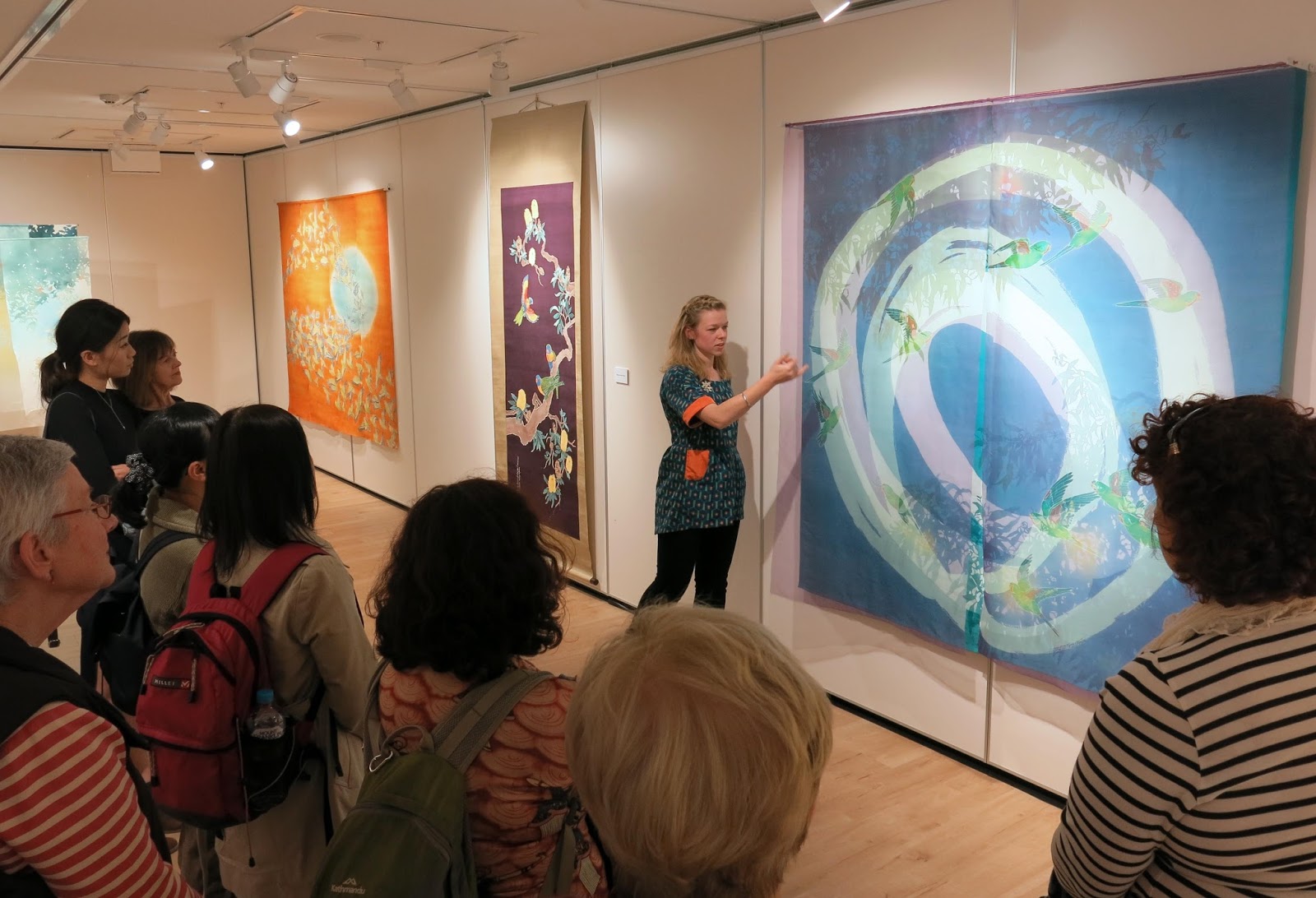
In August/September this year I was lucky enough to be invited to hold a solo exhibition of my work at the Japan Foundation Gallery in Sydney. It was titled "Somé - Dyeing the Australian Environment".
It's been a long while coming but here are some images from the show.
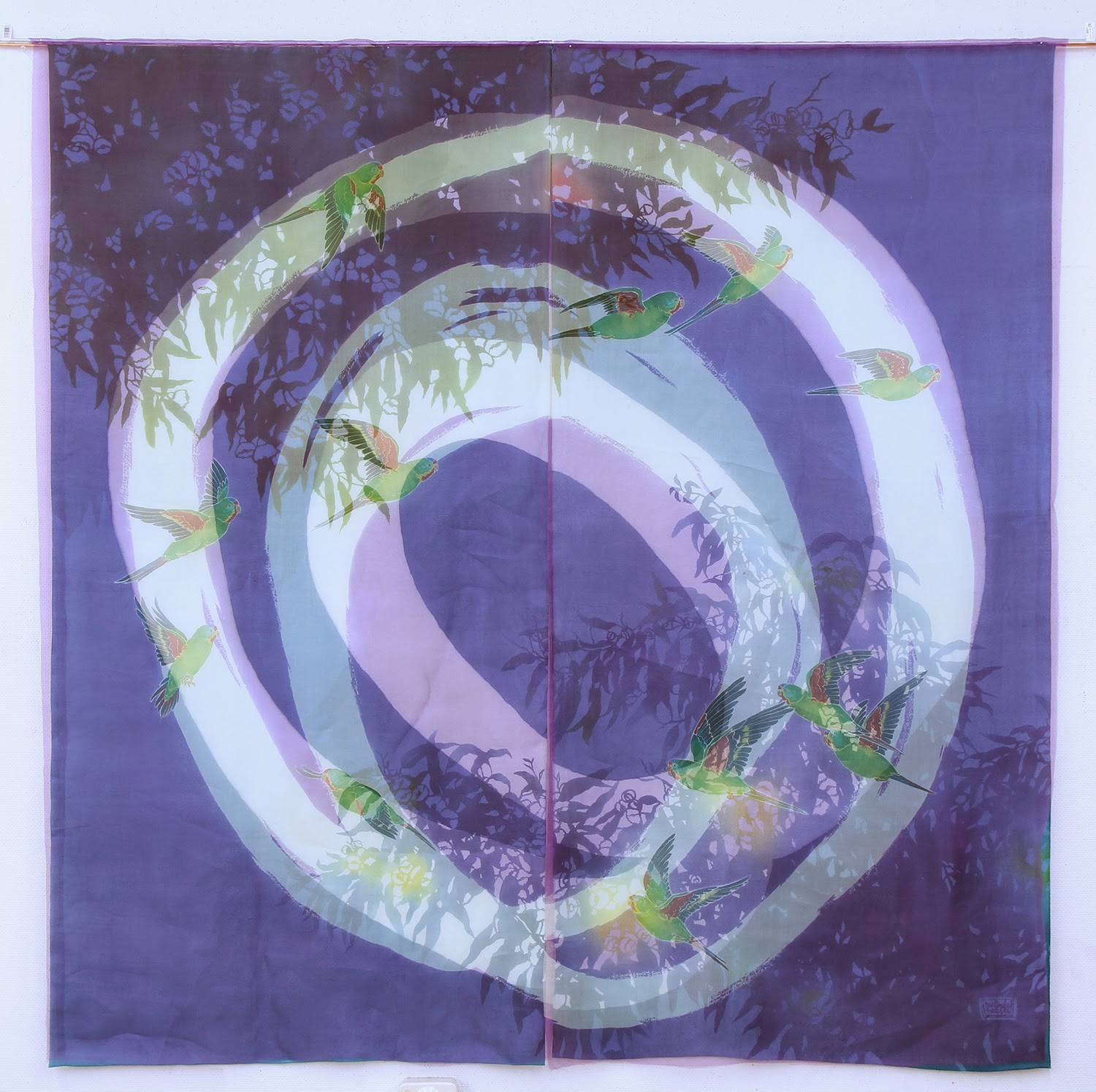
I made some new work for this show, a large noren for the entry to the gallery space and a series of pieces called "The Beautiful Weeds of Canberra".
Entrance to the exhibition. "A Hearty Welcome" on left
I called the noren "A Hearty Welcome", referencing its function as a gateway to the exhibition. I dyed it using katazome on hemp fabric which I sourced in Australia. Previously I'd dyed several noren but on Japanese linens which have a certain stiff feel to them and are rather open weaves so that a glimmer of the space behind the curtain is also visible. I'm yet to find a fabric with similar qualities in Australia but the hemp fabric was a new experiment using a natural looking slubby cellulose fibre. It's a little softer than I would like, as it creases easily and softens in the washing stage of katazome.
The noren was tied back during the opening event - Photo by Document Photography
The imagery I used for the stencil was of the droopy branches of Eucalyptus Cinerea (Argyle Apple). I've used them as subject matter before because I love their dusty blue-green leaves with their almost circular forms. They really lend themselves to being carved into a silhouette-y stencil.
The other new work I produced was a series I've been calling "The Beautiful Weeds of Canberra". I've become even more obsessed with weeds since starting these pieces but the idea behind them is that our natural environment is a composite of all kinds of species native and otherwise. When you look closer you realise that a good many of them are actually "weeds" but to me they are familiar parts of the landscape and also quite beautiful in their own right.
Keeping a little distance from the complex conservation and environmental problems connected with "weeds" I'm trying to just depict them in all their weedy glory - kind of weed portraits.
This is a series I will be further developing and expanding for future exhibitions but the initial weeds I've dyed are Wild Blackberry, Rosehip, Umbrella Sedges and Japanese Honeysuckle. For these pieces I used vibrant acid dyes to dye the weeds themselves - true to nature- and applied natural dyes as the background colour. I really like the russets and orange tones you can extract from local eucalyptus varieties and onion skins so I've used a combination of these against the vibrant colours of the weeds I chose.
Blackberries and Sedges - first trials in "the Beautiful Weeds of Canberra" series.
Japanese Honeysuckle - Beautiful Weeds of Canberra. A garden favourite in Japan but a creeping weed in South East Australia.
For future pieces I'm planning on featuring many many more beautiful weeds and trying to get even deeper, richer background colours. I've also started research for a series on "the Beautiful Weeds of Kyoto". It's interesting to see which weeds overlap with Australia; the weeds which we "share". It's also cool finding those species which are natives in Australia but invasive in Japan or the reverse. I think there's some deeper subject you could read into that if you chose to.
detail of "Sedges" - Beautiful Weeds of Canberra Series. 2016
Anyway, back to my exhibition in Sydney, the general response from the audience was really good. I had never shown work in Sydney, let alone so many pieces all at once before, so it was great to come across all these people who I'd never have had the chance to meet. I held a floor talk and two workshops whilst I was there too. Both went really well. It was my first time to hold workshops with so many participants but everyone was very enthusiastic and got great results.
Each participant dyed two washi postcards using powdered pigments.
looking like a pro giving my floortalk for Japan Foundation Members before the opening
during the opening
the opening
workshops underway
workshops
Participants results from the workshops. really nice!!
It would be nice to do more workshops in future, maybe on less of a tight schedule next time!
Anyway, I'm now working towards new things for 2017. A few exhibitions on the horizon so I have to get making!
Studying the techniques of Katazome and Yuzen in Japan opened my eyes not only to the unique and culturally-ingrained processes and materials of these techniques, but also to the mind-set surrounding them.; the way the finished textiles are categorised, presented and discussed.
Since returning to Australia, it's been no real surprise to see that Textiles here (with a capital T) is an entirely different kettle of fish.
TEXTILES TODAY: black and red. cardigans. berets and wine. apparently.
テキスタイルの現状なのか。服は赤と黒で決まっているみたい。もちろんワインも登場しないと。
Earlier this year I was accepted for inclusion in theWangaratta Contemporary Textile Award Exhibition for 2015. I didn't win the prize (of course, the 10K prize went to an artist already rolling in recognition and opportunities... sorry, still a little bitter...) but my work ("Canberra Blues") was displayed in a beautiful historic building along with that of 48 others!
Wangaratta Contemporary Textile Award Exhibition 2015
my work displayed beside beautiful wooden doors and stained glass
The exhibition really had a bit of everything
I was unable to attend the opening (Wangaratta is over 400km away from Canberra...if only Australia had Bullet-trains!) but went down later to see the show on display. I was really impressed with the breadth of textiles included. There were a few pieces that I wasn't too sure about, like miniature origami units of patterned envelope insides forming a large wall piece (how is that a Textile?) and a ceramic Budgie with a pair of "budgie smugglers"(speedo's) tossed on it's head (Yes, I can understand the Textile in that one but not the point...)
Anyway, I thought the selection committee and organisers had done a really good job of representing the many facets of what it means to make Textile Art. There was a bit of everything; and all of a really high standard. It felt like each piece had something to say. But contemporary Textiles is not always so well represented or carefully curated...
Wangaratta市美術館。煉瓦の本館は元々教会だったらしい
The Wangaratta Art Gallery heritgae building with lovely
red-brick, stained glass, high ceilings and polished wooden
floors. Apparently it used to be a Presbyterian Church.
I may be about to offend people...but I need to say it anyway.
What's with the way that Textiles is a Naff-magnet? (naff is such a great word...)
Other genres of Art, let's take Painting as an easy example, may attract masses of mediocre artists or uninteresting paintings. There may be plenty of ordinary Print-makers or average Sculptors, or maybe uninspired Photograhers. But Textiles, unlike the others, seems to have this unrivaled ability to generate the Naff. The Tacky. The just...not quite right.
This is probably in part because of the way that Textiles teeters on the cusp of "Art" and "Craft" (whatever they are anyway) and seems to encompass such a huge breadth of things. I'm all for diversity in Art, and in Textile Art. I'm all for using whatever medium or technique allows you to express yourself best. But I can't be the only one who is sick of the fluffy reputation hanging round Textiles. What's the deal?!
What spurred this rant was when I made an attempt to connect with the Textiles scene outside of Japan by joining some moderated groups on Facebook. One is called "Textile Arts" which purports to showcase Textile ART, to the point of declaring this mission statement,
"Our mission: To elevate textile fine art beyond the craft arena into the realm of conventional galleries. View the latest works from both well known and emerging artists.
and they even show this visual guideline for prospective posters. And yet....
...I am constantly awed by the, shall we say "variety", of posts to the group.
Textile "art" posted to the group
I'm sorry but WHAT THE?
Don't misunderstand me. I'm not trying to make an arrogant proclamation that MY TEXTILES IS THE ONLY WAY or DOWN WITH CRAFT!
But I think the way Textile Art is spoken about is confused.
To put a Textile in the Art basket, I think it needs to be addressing an idea; trying to say something of value. I think this is why I was so impressed by the Wangaratta exhibition, the artists all had something unique and interesting to say with their work, and that made it interesting!
View Denise Ferris' website here → http://www.deniseferris.com/
Denise Ferris, an Australian artist, Photography Lecturer and current Head of the ANU School of Art comments in a recent article about focusing on technique versus saying something with that technique.
Denise.."specialises in nineteenth century photographic techniques, but says it’s important not to get too caught up in the technical aspects of photography.
“For us (Canberra School of Art practitioners) it’s never just about the skills, it’s about the body of work that talks about concepts through materials,” says Ferris.
“I practice these old world techniques, but I’ve never practised this for the skill itself. I’m only interested when it’s parlayed to a concept or an idea, and is about pushing those ideas further.
“That might not seem so revolutionary, but I think...this research and practice mentality is something different for [other Art Schools]”
With this way of thinking, quilts, knitting or felting could be quite welcome on "Textile Art"s Facebook page - but only if they are exploring or untangling some kind of idea.
This Artist Luke Haynes might be onto something. I still have reservations but at least he is pushing the envelope and creating quilts that are more like contemporary art. Maybe it's something he can get away with because he's not a woman. Also, he graduated from Cooper Union, which is supposed to give him instant hipster Art street-cred. Youtube Link
Or perhaps this quilt of a $10,000 note by Nina Paley is on the right track. It ticks the conceptual box... but I disagree with her opinon about high art being a price tag issue.
Having said all this, I'm not sure an exclusive mindset is beneficial for Textiles practice. It doesn't leave room for the talented makers with amazing skills. Nor does it leave room for Textile-ans who are still finding their voice.
But it sure would be nice for a change if Textile Art could lose it's fluffy reputation.
The lady in her lurid yellow fitted jacket raced over to me and told me not to touch the artwork.
I told her, "But I'm the one who made it; this is my artwork!"
She frowned and did that Japanese suck-air-through-your-teeth thing and said that if I touched it, other people would think it's okay to touch it too.
In the moment, I couldn't gather my thoughts well enough to give a level-headed response so I just sort of nodded. What I really wanted to say was "So what?! What if I actually don't mind people reaching out and touching my work? Its fabric, it's washable, it's FINE!"
Pretty sure it's not just me that sees something like this fabric and hears a little voice scream "touch me!!!!" こういうのを見て、触りたくなるのが私だけじゃないでしょう?!
This was just another glimpse of conservative Kyoto that I got when I exhibited at the Kyoto Museum last month.まあ、京都のミュージアムでも、世界のミュージアムでもそういう態度ですね。
The work I recently exhibited at the Kyoto Museum: "floriferous - 咲き乱れる"
京都文化博物館で展示した作品です。
Perhaps a MUSEUM is not the place for textiles.
ミュージアムという場所は、もしかしたら染色の作品を展示するには合ってないのではないか?
As a kind of pipe dream, I would love to make textile installations. Wait! Don't roll your eyes at the word "installation", often used by arty-farty types as a blanket term to legitimise anything from a room full of bits of garbage to an empty room with a soundtrack on loop.
いつか将来に作りたいの一つは「染色インスタレーション」なのです。「インスタレーション」という言葉がこの頃使われすぎで、意味なくなるぐらいように色んなものがインスタレーションと呼ばれています。(何も置いていない暗い部屋がインスタハレーションだとか、古い工場の床に散らされたゴミがインスタレーションだとか)
Fly free my pretties! "Freshly" dyed and washed pieces of fabric hanging out in this wicked autumn wind as if trying to get free. It was a beautiful sight and I stopped there and thought: "THIS! this is what a textile is supposed to be like" 水洗いしたあと、乾かしている生地の動きが本当に綺麗で感動した!その瞬間に「テキスタイルってこれや!!」と思った。
What I mean is, a room or even better a semi-outdoor space full of hanging dyed fabric, that you walk through, look at, which moves as you walk by and shows off the best of Australia's brilliantly coloured scenery or birds. And it would be something you are free to touch.
This time there was no gallery minders and no alarms to set off! 卒展で自分の作品をよく触ったよ!
You can't do this kind of installation in your average museum or city gallery-type space. For one thing, they often don't allow you to hang anything from the ceiling (another sticking point I'm still annoyed about with the Kyoto-city Municipal Museum of Art), which reduces you to hanging against a wall or to creating some kind of nifty wall-fittings. And then there's those sneaky Gallery Minders (as in the ones in yellow suit jackets) who are going to tell you off for touching, photographing, getting too close, using your phone, reaching for a pen... This kind of stuffy, rigid atmosphere somehow doesn't allow the artwork to be what I intended.
"...more and more contemporary art is created by artists who intend you to play with it. The full meaning and experience of the work requires you to interact... Unfortunately, for...contemporary artwork that gets its primary meaning, emotion and significance from interacting with it, keeping it locked behind glass isn't good enough. Most museums and galleries have not caught up to this idea...All objects, regardless of the artist’s intent, are treated the same."
So it doesn't really matter how eccentric or open an artist might be about displaying their work, when you go it stick it in the museum mould, you're stuck playing by their rules.
つまり、作家さんが作った物に対していくらでも自由に考えていても、ミュージアムで展示してしまうと、ミュージアムでのルールに従わないといけないですね。
Weee--ooooo---Weeee-ooooo! Can you hear the alarms going off?
It's an unfortunate catch 22 (which is probably changing for the better but still remains, especially in the considerably conservative art scene of Kyoto) that artists feel they have to exhibit in museums or art galleries to feel validated as a "real", "made-it-and-can-afford-to-stop-eating-cereal-as-dinner" artists when those are the very places curbing the unique creative streaks which make them artists in the first place.
作家たちが、いわゆる「プロの作家」になりたかったらギャラリーやミュージアムで展示しなきゃと思ってしまうですね。でも、そういった場所はルールがいっぱいあるから、作家になるには必要な「創造性」こそが抑えられます。ジレンマですね。。。
Another part of this is the way we've managed to make art so precious and segregated; raising it to un-touchable status (literally) in galleries and museums. The art world manages to segregate itself with it's words too.
この問題に含んでいるのが、Artが手が届けないもの(文字通りの意味でも!)にする概念です。ミュージアムやギャラリーで展示することによって偉いものにしてしまうし、ARTについて話す時に使う言葉によっても、別の世界にしてしまうことがあります。
An old favourite, http://www.artybollocks.com/ which generates random artist statements and shows you just how meaningless they really are
and you can refresh and refresh the page into increasing obscurity...
I was reading this really great article by Steve Lambert about artists using vague speech and losing the chance to engage ordinary people because of their wordiness. Here's a quote,
"artists are already too cloistered off from the rest of our culture; isolated in elite institutions, appreciated by small numbers, and/or segregating ourselves in confusing social difference alone as some kind of admirable attribute. Around 45 years ago John Berger disparagingly called this phenomena the needless “mystification” of art. If we want to change this, and we should, we need to speak clearly in a language people can understand – not by adopting academic language for institutional appeal or trying to cover over our insecurity with pompous nonsense"
The way we show and speak about art has the potential to scare people away. The kinds of airy-fairy words as in the randomly generated statements like the ones above can make people uncomfortable. Hey, even just the word ART can make some people feel out of place.
There's a need for artists to be less exclusive and more relate-able. One way to do that could be to bring art out of the museums and galleries and put it into real life. I don't mean reproducing artworks onto cushions for the masses or in the sense of having beautiful things in our homes, I mean actually putting the real deal artwork into public places. Why not? What's the point of making art if you're going to show it to only some people, or let it be touched only sometimes ?
美術の作品をもっと日常の物にすればいいじゃないか?作品をより日常生活にありそうな雑貨にするのではなく、美術作品自体を色々な場面に出すのはどうでしょうか?
Maybe it's fabric dyed with plants that hangs from a naturally lit ceiling in a shopping centre? Maybe it could be dyed birds and John Gould text across the walls of the cafe? Maybe it's a see-through hanging beside the rest area in a hospital? Maybe it's an artwork in an office space, as a giant room divider? Maybe it's in artwork hanging in a national park information centre?
例えば、モールの天上から草木染の生地の作品を吊り下げる?カフェの壁に鳥と鳥類者の文章が染めてある作品を展示する?大きな半透明の作品を事務室の間仕切りに使ってもらう?病院の接客室に掛ける?国立公園のビジターセンターに展示する?
I touched that thing endlessly to make it, but for some reason, you're not allowed to touch it once its done. 作る最中は触るばかりのに、出来上がった作品は触っちゃダメだ。不思議だなぁ。
I don't know but I'm getting the feeling that making artworks needs to involve an act of generosity, of adding value to peoples lives. Not the unconscious act of telling people they are not worthy because they are not "art people".
色々が分からないし、考え方は甘いかもしれないですが、最近はこういう人々にすこしでも何か貢献する作品は一番いいだろうと思ってきました。ちょっとでも日常生活にアートとの接する機会があると。
Because in the end, we are all born artists and you show me one person out there whose first natural instinct is to NOT touch the artwork.




.jpeg)


.jpeg)


.JPG)
