Showing posts with label katazome. Show all posts

Monday, December 11, 2017

2017 - a hectic year of TRYING

Wow, how is it already December!?

Apologies to my sadly neglected blog but this year has been a heck of a ride.

In looking back over all the things I've done and struggled with this year, I suddenly had a (mildly incensed) urge to write it all down and make sense of it before another year rolls around.

Let me paint a picture of the hectic year just gone.

→ I dyed a commissioned noren (split curtain) for an Australian Tea-master who lives up in Newcastle with his own tatami-floored tea-room. It's a homage to spring with magpies, which also happen to be the emblem of the area where he studied Tea.

privately commissioned Noren featuring Australian magpies

→ I started making textile jewellery that I've called tameshi, using trial dye samples and un-used edges from dyed works. These have been proving popular and I feel good about the fact that they are mini artworks in themselves and re-use fabrics that I would have thrown away or put in a box somewhere.

Tameshi jewellery - tameshi means sample or test. Available through stockists in Canberra and on my etsy store https://www.etsy.com/au/shop/someru

→ I sent work to a group show by dyeing artists in New York. As the only artist out of the group who wasn't Japanese, apparently people said mine looked the most Japanese! With all the deadlines for later in the year, I didn't manage to get to go the US to see the show but still, it felt like an achievement.

My series of 6 yuzen/katazome dyed works on display as part of "Wafting II" at Medialia Gallery in New York, June-July 2017

→ I participated in a four-day residency out at Tidbinbilla nature reserve thanks to Craft ACT. Four of us selected artists got to stay in a newly renovated cottage inside the reserve and spent four lovely sunny days at the tail-end of winter hiking in the bush, sketching, writing and sharing tales over cheese and wine.

The delights of early spring at Tidbinbilla - Gibraltar Peak, Early Nancy, Flame Robin.

→ I travelled to Japan and held a solo exhibition in Galerie H20 in Kyoto. My first solo show there in 4 and a half years, always a joy to be there and to catch up with so many friends and new connections.

entryway and Japanese garden at Galerie H20 in downtown Kyoto

view of solo show at Galerie h20, October 2017

→ Whilst in Japan I made time to visit and interview a bunch of great humans, friends new and old who are doing innovative and interesting dye-work. The plan is to write up a series of interviews from all the meetings and I've created a new project Somé 20:20 to house them and to move forward with. It's a reference to being able to see clearly - without acknowledging tradition how do we move forward? and how will dyeing art survive into the future, 2020 is just around the corner. A work in progress, my new website for the project is over at some-20-20.com

the wonderful people who agreed to be interviewed for my Somé 20:20 project.

→ I came back and setup another solo show at ANCA gallery in Canberra! The theme of my works this year have been "beautiful weeds", and I managed to create some new works that are really where I've been wanting to head for a while now; layered and sheer works that are a new form of collaged landscape.

Solo Exhibition "Naturescapes" at ANCA Gallery & Studios, Canberra, Oct-Nov 2017

detail of "The Beautiful Weeds of Canberra" series, on show at ANCA Gallery, Canberra

→ I ran workshops and demonstrations in dyeing at the 2017 Canberra-Nara Candle Festival. For the demonstrations, I dyed a massive 9 metre length of resist-printed cotton in one go while a crowd watched and revealed pattern and birds and text as I went. The workshops saw nearly 100 people dye their own kata-yuzen bookmark using pigments and stencils.

Kata-yuzen workshops and Hikizome demonstration at the Canberra Nara Candle Festival, October 28, 2017

→ I ran another afternoon of workshops on the last day of my exhibition, dyeing katazome postcards. Participants could dye pre-printed washi and wash away the paste to reveal the patterns. We had great warm weather and it was a lovely bunch of enthusiastic people who came along.

wonderful postcards dyed by participants, drying on the outside windows at ANCA

→ I even had an article published in the Kyoto Journal, on katagami stencils.

Kyoto Journal, a volunteer-run publication, making a return to print from this issue.
It's great! you can get your hands on a copy here


PHEW!

What this run-sheet doesn't show is the sleep-deprivation, self-doubt, expenses, rejection letters, missed deadlines, extensive preparations, hours spent at a day-job and the constant juggle.

On paper, (or in digital text, I suppose) this looks like a hugely successful year. In a sense it was.
But it was also really, really hard.
I don't think this level of productivity is sustainable, or even very enjoyable.
I also didn't really sell much art. Not through exhibitions.
Where I really made progress and, to some extent, a profit, was through connecting with like-minded people, through making custom pieces, through sharing affordable things, and through trying to promote the unique genre of Somé.
Which has me re-thinking my approach to all of this.

Given that my work places me in a sort of odd position in between ART, CRAFT & RESEARCH, (odd in the sense that I don't fall neatly into funding categories or job titles) I'm thinking that instead of struggling against that and trying to slot myself into prescribed categories, why not embrace it?

Can I be a CRAFTISAN?
Can I be a RESEARCHIST?
Can I be a CRAFTIST?

I'm tired of feeling like my specialties (being able to dye pictorial textiles, being interested in craft, being knowledgeable about tradition, having Japanese abilities -though not bilingual by any means, being interested in smaller, affordable art) are a liability, or something I need to adjust so I can be in the same game as everyone else. And of feeling like my particular set of skills don't add up to anything. When in fact they do! and they are a killer combination despite what the grants categories, arts bodies, or professional membership organisations would have me think.

So consider this my personal passion project for 2018; finding a way to be my own kind of craftisan, pursuing research and researching through making.


Thank you for putting up with the silence on this blog but do feel free to check in over at my website and project site to see what things I get up to in 2018.

Wednesday, March 29, 2017

"Translating" a Technique in a Different Country - Katazome in Australia

It's been 8 years since I first tried to replicate katazome resist dyeing in Australia. After spending a year on exchange at Kyoto Seika University during my undergraduate studies, I'd come back with a burning enthusiasm to try and see if the same technique could be achievable with local supplies. It turns out, yes - but with much modification.

When you start to look at traditional crafts without applying the lens of "sacred and untouchable", you find at the core of it all a basic process that utilises a series of specific tools and ingredients to achieve a beautiful end result. The gadgets and materials that have come to be synonymous with a particular traditional craft (think shibugami stencil paper with katazome) have only obtained that status because they've developed over time in line with that culture and with other industries developing simultaneously.

What I mean is,
Dye brushes at Kuriyama-kobo, a katazome company
on the western edge of Kyoto
why would katazome use deer-hair brushes? Probably because 1. there were deer around and 2. an industry already existed making deer-hair brushes for use in traditional painting. Why would one utilise thin rods of bamboo with sharp spikes at the end to stretch fabric taut? Presumably because bamboo was already being formed into products for other purposes at the time. Katagami stencil paper could not have developed without the existing Japanese skills in washi papermaking - from which the stencil paper is made.

Very traditional stencil paper - shibugami
The thing is, if we look at the technique of katazome as it stands now, there is a very polished, established and institutionalised way of practicing it. It is basically understood to involve a set of specific tools and materials (mochi rice flour, komon rice bran, stencil paper, soybean & seaweed derived fixative). These are presumed to be the ultimate, most refined and correct way to achieve the best results. Of course it is fair to think that. These are not tools and materials that are used by accident - they have gone through a few hundred years of use and modification.

Whilst there is now some deviation from these very traditional and quintessential ingredients and processes, like a modified plasticised stencil paper or a chemical pre-dye fixative, there is still a very set way of doing things.

Newer plasticised stencil paper
How about if you want to use katazome in a country where those quintessential tools and materials are not only unavailable, they're simply not part of our culture. Bamboo, deer hair, rice flour and washi paper have only, if at all, recently been part of our vocabulary let alone available to purchase. They simply aren't part of our natural environment or resources.

Applying shinshi stretchers to long narrow fabric

So okay, why not seek to uncover what function these ingredients and tools perform within the katazome process and utilise something locally available to perform the same task?

Instead of lamenting that shinshi (bamboo fabric stretchers) are unavailable in Australia (they have no reason to be; historically we've never needed to be able to stretch a narrow kimono-width fabric out to dry) why not consider what function they are performing (stretching the fabric taut whilst leaving the back side accessible) and seek to replicate that function? A wooden frame with pins to hold the fabric out taut performs the same function. Of course, this is not as flexible as the centuries-tried-and-true shinshi approach but it is a workable solution.

Funori - looks natural and traditional, I guess
Manutex - not pretty but same stuff on the inside
Alright, what about the funori  - a seaweed derived gloopy thickener used in the pre-dye fixative? Well, if you get down to the nitty-gritty of what's actually in that stuff, you'd find that it's the same seaweed gloop that we use as a food thickener in Australia and it also already exists as a substrate for use in screen printing. Powdered "Manutex F" does not have the same natural look or roll off the tongue as nicely as funori, sure, but it performs the same basic function. 

And so you can continue with all the necessary tools and ingredients in the hallowed katazome tomes and see what can be used to achieve the same result.


For some ingredients the swap is simple. Others are proving more difficult. Soft, dense dye brushes, fine de-fatted rice-bran, water erasable ao-bana ink.... But it is really just a matter of thinking outside the box. To be able to source tools and materials locally would be the ideal situation. Not to remove the technique from its Japanese roots entirely, but to make it viable.


There are many specialised businesses in Kyoto, for example, which have operated as family-run enteprises for some hundreds of years. They each have their own niche of the textile process to support; the nori (resist paste) manufacturer and shop, the shinshi (bamboo stretcher) specialist, the kimono-width silk salesroom, the specialised craftsmen making circular punches for intricate stencil carving...More and more these businesses are struggling to survive. With the demise of the kimono as daily and common wear, these businesses that thrived and supported the kimono industry now have little patronage to subsist on. If I were still in Kyoto, I would continue to support these businesses with my own hard-owned yen and utilise them in my artwork but I fear even that is simply not enough.

Just one example of the many kimono industry support businesses that are often now finding it hard to stay afloat

If, and it would seem likely, these businesses continue to shut-down, there is no-one left to make the traditional katagami, to bulk-produce batches of nori paste, to make specific lengths of shinshi, to craft tiny sharp circular punches. Like any loss of knowledge and skills, this is tragic, it really is. But this is the way it goes. Crafts are only in demand so much as they are an active and necessary part of our daily lives. Without that demand, they become obsolete. There are many example of innovative companies and individuals who are thinking outside the box to continue supporting Kyoto's craft industries and make them relevant to today's society (these are something I plan to touch on in future) but I think we also need to be realistic. Whilst continuing to support traditional industry where possible, I think we need to start accepting that there are alternatives, so that the techniques can actually survive - even if some of the tools cannot.

It seems to me that in the end, even if it means modifying many of the components of the technique, having the ability to actually practice the technique at all, and see it survive into the future is the best way to honour tradition.

A tradition is kept alive only by something being added to it. - Henry James

On that note, I'm off to continue testing out new resist-paste recipes!

Monday, November 28, 2016

Somé - Dyeing the Australian Environment

In August/September this year I was lucky enough to be invited to hold a solo exhibition of my work at the Japan Foundation Gallery in Sydney. It was titled "Somé - Dyeing the Australian Environment".
It's been a long while coming but here are some images from the show.


I made some new work for this show, a large noren for the entry to the gallery space and a series of pieces called "The Beautiful Weeds of Canberra".

Entrance to the exhibition. "A Hearty Welcome" on left

I called the noren "A Hearty Welcome", referencing its function as a gateway to the exhibition. I dyed it using katazome on hemp fabric which I sourced in Australia. Previously I'd dyed several noren but on Japanese linens which have a certain stiff feel to them and are rather open weaves so that a glimmer of the space behind the curtain is also visible. I'm yet to find a fabric with similar qualities in Australia but the hemp fabric was a new experiment using a natural looking slubby cellulose fibre. It's a little softer than I would like, as it creases easily and softens in the washing stage of katazome.

The noren was tied back during the opening event - Photo by Document Photography
The imagery I used for the stencil was of the droopy branches of Eucalyptus Cinerea (Argyle Apple). I've used them as subject matter before because I love their dusty blue-green leaves with their almost circular forms. They really lend themselves to being carved into a silhouette-y stencil.


The other new work I produced was a series I've been calling "The Beautiful Weeds of Canberra". I've become even more obsessed with weeds since starting these pieces but the idea behind them is that our natural environment is a composite of all kinds of species native and otherwise. When you look closer you realise that a good many of them are actually "weeds" but to me they are familiar parts of the landscape and also quite beautiful in their own right. 

Keeping a little distance from the complex conservation and environmental problems connected with "weeds" I'm trying to just depict them in all their weedy glory - kind of weed portraits.


This is a series I will be further developing and expanding for future exhibitions but the initial weeds I've dyed are Wild Blackberry, Rosehip, Umbrella Sedges and Japanese Honeysuckle. For these pieces I used vibrant acid dyes to dye the weeds themselves - true to nature- and applied natural dyes as the background colour. I really like the russets and orange tones you can extract from local eucalyptus varieties and onion skins so I've used a combination of these against the vibrant colours of the weeds I chose.

Blackberries and Sedges - first trials in "the Beautiful Weeds of Canberra" series.

Japanese Honeysuckle - Beautiful Weeds of Canberra. A garden favourite in Japan but a creeping weed in South East Australia.

For future pieces I'm planning on featuring many many more beautiful weeds and trying to get even deeper, richer background colours. I've also started research for a series on "the Beautiful Weeds of Kyoto". It's interesting to see which weeds overlap with Australia; the weeds which we "share". It's also cool finding those species which are natives in Australia but invasive in Japan or the reverse. I think there's some deeper subject you could read into that if you chose to. 

detail of "Sedges" - Beautiful Weeds of Canberra Series. 2016
Anyway, back to my exhibition in Sydney, the general response from the audience was really good. I had never shown work in Sydney, let alone so many pieces all at once before, so it was great to come across all these people who I'd never have had the chance to meet. I held a floor talk and two workshops whilst I was there too. Both went really well. It was my first time to hold workshops with so many participants but everyone was very enthusiastic and got great results.
Each participant dyed two washi postcards using powdered pigments.

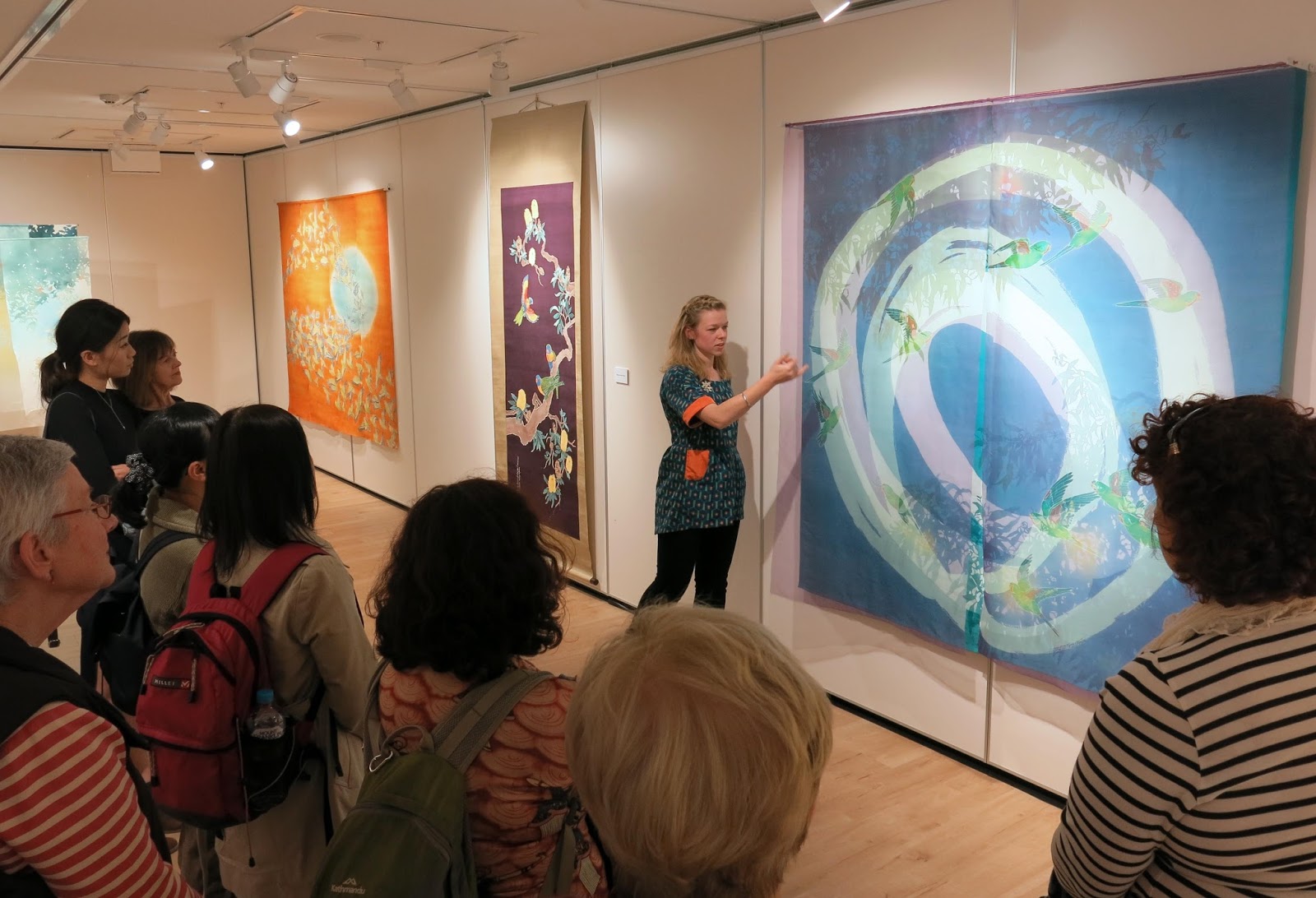
looking like a pro giving my floortalk for Japan Foundation Members before the opening

during the opening

the opening

workshops underway


workshops

Participants results from the workshops. really nice!!
It would be nice to do more workshops in future, maybe on less of a tight schedule next time!

Anyway, I'm now working towards new things for 2017. A few exhibitions on the horizon so I have to get making! 

Saturday, August 6, 2016

It's all in the details.... The Making of Katazome and Yuzen works for my new exhibition! 型染と友禅での新作~工程動画

After some reluctance, much procrastination and a lot of shaky filming, I bring you some short video clips that give some insight into the processes I use in making my work. Katazome and Yuzen are mixed together in these but I have made them abstract on purpose - I just want to show the many and diverse steps in making a piece using these traditional methods. I hope you enjoy them!

Here's part one and two


and here's where these works will be on show from the 13th of August (one week from now!!)

http://www.jpf.org.au/jpfevents/16-some/


Saturday, July 30, 2016

Solo Exhibition Coming up soon! Somé: Dyeing the Australian Landscape

"Somé: Dyeing the Australian Environment" will be on show at the Japan Foundation Gallery in Sydney from August 13 to September 17!!
It's a large space to work with and it means I can show some of my older works alongside new ones - all incorporating varying ratios of Australian imagery x Japanese dyeing techniques. 

I titled the show "Somé : Dyeing the Australian Environment" to emphasise a few things.

One is that I've been coming more and more to the conclusion that the term Textiles, in the manner that it exists in Australia, doesn't fully explain the work I do. I don't mean that in an arrogant way like "I'm so unique, the categories don't apply to me". I mean that the term Textiles in a bit misleading. I don't think just saying "dyeing" comes across the right way either. Especially with the surge of popularity in Natural dyeing and "eco-dyeing" in the last few years, perhaps the wrong image of simmering fabric in a pot is what people will think.

Somé (pronounced so, as in socks and me as in melinda)
means "dye" or "dyed work" and in Japan that is understood to include all manner of dyeing work - wax resist, paste resist, dip dyeing, natural dyes, hand painted dyes - plus more.
Textiles in Australia tends more to refer to woven, embroidered, printed and sculptural fibre-work. Though there are plenty of artists using dyeing as their medium in Australia, I don't know that the term Textiles alone describes pictoral dyed textiles.

It would be a whole lot easier if the term somé just existed in English!
There are already plenty of Japanese words bouncing around in everyday English. How about karate, sushi, manga, tempura, wabi-Sabi, bokeh and lately even Kaizen and Kintsugi! Why not add a new concept to the import list? After all sometimes a word in another language just does a feeling or concept better justice. 

So I titled the exhibition to reflect that aspect of textile work that doesn't tend to feature for Australians.

Also, it's about the Australian environment - and more broadly, imagery of Australian nature. When I first started learning katazome, my first urge was to mix in some Aussie influence - parrots, english lettering, rusty orange and bright blues. I think I went a bit too far in those early works on the "cheesy scale" but the same intent still remains: I want to show what the techniques can do when turned toward a whole new set of imagery and cultural connotations. 

Instead of plum blossoms and sparrows or cranes and pine trees, my works depict Rainbow Lorikeets and Banksias, Cockatoos and Gumtrees. In place of subdued landscapes with bamboo or chrysanthemums, I'm dyeing vibrant colours of wild-flowers and dry grasses.

I'm excited to be showing so much of my work all at once in Australia, especially in Sydney where I've never had the chance to do so before. I've also been lucky enough to get a grant from ArtsACT which means I can be present at the opening and run a couple of workshops too!

You can see the information about the exhibition here:
http://www.jpf.org.au/jpfevents/16-some/index.html


Saturday, June 25, 2016

Using Katazome in Contemporary practice? 型染~伝統的な技法を現代のアートに

I never considered the issue of tradition much whilst a textiles student in Australia but Japanese textiles are so steeped in history that it becomes impossible to avoid.

オーストラリア国立大学でテキスタイルを専攻した時は、「伝統」というものをめったに考えませんでした。アボリジニの植物繊維で作られている籠や羽を使った服などを含まなかったら、オーストラリアではテキスタイルの歴史が短いです。ここで発展した技法などがなくて、現在のテキスタイルはだいたいイギリスやヨーロッパから来た刺繍・編み物・織物の継続なのです。
しかし、日本で染織を勉強したら、伝統だって避けられない複雑なものになりました。


For many Japanese artists I saw around me in Kyoto and Japan, the technique of katazome was just another technique at their disposal. 
In their eyes, it seemed to be a given that it could used to create dyed pictures or dyed artwork and they saw no disparity in utilising a traditional technique in a very contemporary context.
It may seem nothing special to you either but when you start to break it down, it's really quite an odd situation.


A contemporary artwork in katazome by fellow Kyoto Seika graduate Ohmura Yuri "Blue Evening" Katazome on Cotton, 2015  「青い夕方」 大村 優里 木綿/型染

日本、得に京都で出会ったテキスタイル作家さんにとっては、「型染」はただ表現のやり方の一つのようでした。伝統的なルーツがある型染を現代的な作品、または絵画みたいな作品に利用するとはなにも矛盾がなかったようです。

つまり、現代の作品を伝統的な技法で作るのは平気だったようです。

可笑しくないでもあるはずですが、この「現代の絵画アート」+「伝統的な工芸技法」という概念はどこかが奇妙じゃないですか?

Let's think about this using the example of katazome - stenciled resist dyeing. Katazome was traditionally used as a way to put a pattern onto fabric, often one that repeated down the length of a bolt of fabric. It could be used to reproduce very fine detailed patterns over and over.
This explains why it was popular as a way of dyeing bolts of kimono fabric, which are 12 metres or more long; it's efficient and detailed enough to produce patterns that resemble more costly fabrics like woven or embroidered cloth.
In this context, katazome is a technical process, used to achieve a certain known result and applied by craftsmen or workers who are experts in the technique.

型染めを例にしてちょっと考慮しましょう。型染めは江戸時代には、布に模様を染めるやり方でした。繰り返しで使ったら、一つの型紙で長い布が染められる大生産向きの技法なのです。
着物用の一反に繊細な模様を素早く、それに丁寧に染めることができる技法として人気を得ました。この場合、型染で布を染めた人々は、熟練した職人さんですね。今頭に浮かぶ「美術」とは関係なく、工芸のようなものでした。

Since there's now less man-power reliant ways of getting a detailed pattern onto fabric, katazome is rarely used in this way anymore. Cotton yukata (summer kimono) that were once dyed with katazome are now often dyed using an industrial rubber resist that is screen-printed onto folded fabric before dye is poured on (a process called Chuusen - lit. pour-dyed) . It's still an impressive process *check it out HERE* but it is far removed from the accurate and detailed nature of katazome (read: dirty and industrial)
.
Divorced from it's heavy role in industry, katazome is now being used as an art medium. From the 1950's and 60's onwards in Japan you can see dyed-work starting to make an appearance in art galleries and shifting perceptions of 'Dyeing as Craft' to 'Dyeing as Visual Art'. My Professors working in katazome or roketsu (wax resist) use traditional dyeing techniques in a contemporary way thanks to the generation of pioneers that came before them.

現在、布に模様を付けるにはもっと早い方法が沢山あるので、型染は産業的な役割を殆ど失いました。普通の店で買う浴衣は大体プリントされたか注染で染められたわけです。しかし、日本で1960年代ぐらいから型染をアートの感覚で利用した作家が登場しました。「型染は工芸」より、「型染はアート」のように使われて、展覧会にも型染の作品が展示されました。私の先生も、その

Here are just a couple of examples of artworks by my teachers and others - who are using katazome in this new pictorial way; to create something akin to a painting but with qualities that are essentially textile. By the way, this is the way that katazome is now taught in universities too - from the first lesson it is presented as a pictorial dye technique, not a repetitive patterning tool.


A visionary in pictorial katazome - Nishijima Takeshi. b1929-2003. katazome on tsumugi silk
西嶋武司の作品。現代風の作品に型染を使った先駆者の一人。

Toba Mika's dyed scenery take traditional katazome to a new scale. 'Early Morning - Seiryutei in February' 2009. Toba-sensei is a student of Nishijima (above). 鳥羽美花先生の作品。「払暁 清流亭 - 二月より」2009年


Naito Hideharu - "Tree" Indigo and plant dye (black) on cotton.
]「樹」 内藤英冶  木綿布、植物染料(黒)、藍/型染 2009

Though a Contemporary artwork made with Katazome might appear visually similar to a Painting (and some artist's strive to make it appear so) there are fundamental characteristics of a Katazome work - legacy of it's traditional process.
The two most obvious differences that characterize a contemporary piece executed in Katazome are
* the necessity of a stencil, & * the use of dyes.
Since the technique requires the use of a stencil (traditionally made from smoked, persimmon juice steeped Washi paper but now often made from thin plastic) there are certain limitations visually of what can be achieved. A design that is to be made into a stencil needs to have all its areas connected in some way so that when you cut it out, it remains as one unified piece. Therefore you have to make choices about how you incorporate this factor into your artwork. Different katazome artists find their own ways of doing this, congruent to their own style - some choose to include 'bridges' within the stencil design that are later erased during the printing stage, whilst others include sneaky 'bridges' as part of their design that you don't necessarily notice. Many will use both these approaches. It's certainly not something you have to think about when painting!  
Another factor, fundamentally different from a painting is the use of Dyes rather than pigments or paints. Unlike painting, where the pigment rests on top of the substrate and can be layered and can potentially completely cover previous layers, dyes soak into the fibres of the fabric and can't be reversed. This requires you to decide at the outset of dyeing what colours will go where and it what order/shade/brilliancy to achieve the desired outcome. Dyes can be bled into each other, faded out, applied in layers that maintain transparency, and watered down or concentrated. The liquid-y state of dyes also gives an interesting depth to colours - it's very hard to achieve a flat solid colour when brush applying dye by hand but this is one of katazome's advantages and can be a feature.
型染で作った現代の作品は見た目で似ていても、大きな違いが少なくとも二つあります。(わざと絵画にみえるように作る作家もいますけど)
この二つの違いは
*型紙の必要性
*染料の使用

というのは、絵画と違ってイメージを布・紙に染めるには型紙が必要です。型紙は渋紙(現代はプラスチック製の紙も多く使われている)を彫ったものです。デザインの彫らない部分が繋がっていないと、彫る時にバラバラになってしまいます。だから、デザインのあっちこっちが接しているように、線か三角形などの「ツリ」を含みます。作家によってやり方が異なるですが(例えばツリを入れるけど糊置きの時に糊で消すので最終的に作品には見えないとか、賢く気づかないようにデザインに残るツリを入れるとか、その両方とか。。。)
型紙が必要のため、上述の工夫によって型染の作品の雰囲気はなんとなく独特です。

そして、もう一つは染料の使用ですね。染料は生地の繊維まで染み込むものなので、うえから別の色で隠せないし、どの順番に、どの濃度で付けるかを最初から考えないといけないですね。でも染料の長所もあります。暈しができる、透明感がある、染めた色には深みがあって、混ぜ合わせると無限な色が作れます。

So okay, the technique of Katazome is different from say, Painting, on a technical and visual level. It is being used for Contemporary Art - in a way that is removed from it's traditional usage, but it is still undeniably connected to that history and tradition.
Are there any implications of this seemingly opposed pairing?
I think it can lead to some confusion over how it fits into our visual art world - but in my mind the best thing about using katazome in a contemporary context is that it opens doors to innovation and evolving traditions.


tradition and change. 

伝統そのものを守りすぎ傾向もあると思います。もちろん、昔のステキな技術を尊敬するべき、記録べきだと思います。しかし、考えれば、伝統だって、何百年、何千年の間に改良が加えられて、少しずつ変わってきた物ですね。

友禅染は偶然登場したわけではない。最初は布に墨などで描くやり方だけで、だんだん複雑な段階が発達された(染料を使う、防染糊を使う、染料に糊剤を入れる、乾いた糊の破片を撒くなどなど)。現在、本物の友禅ト呼ぶ「京友禅」や「加賀友禅」は沢山の変化や年月を経たものなのです。

でも今使われている「本友禅」は30年前、80年前行われた工程とあんまり変わらないです。つまり、「これは伝統的なものだ」と決めると、変化があんまり起こらないです。守りたいから。

でも、守れないんです。伝統が実はいつも少しずつ変わっていっているものなので無理な対処法なのです。

I think we can be too precious about 'tradition' sometimes. Of course it is important to value, respect and record ingenious traditional methods of creating things (whether it be dyeing or making pigments or carving stone or glazing ceramics). The very nature of a traditional skill is that it has been developed and honed over many generations, each perpetuating it and maintaining it. That is something to honour and appreciate.

But on the flip-side of that, weren't those very traditions borne of innovation and shifts it society's needs and tastes? Yuzen dyeing, for example, didn't just appear, it was a shift sideways from painting on fabric; a revolutionary idea that we have chosen to kryogenically freeze in about the 1800s and keep in perpetuation as "true yuzen". I think there is a danger in this idolisation of particular traditional practices - without allowing innovation to happen. I think it's important to acknowledge that traditions are fluid - they are borne of change and will continue to do so. And that is a good thing - not some betrayal of those who have gone before.

Try these on for size: 

“Those who feel guilty contemplating "betraying" the tradition they love by acknowledging their disapproval of elements within it should reflect on the fact that the very tradition to which they are so loyal—the "eternal" tradition introduced to them in their youth—is in fact the evolved product of many adjustments firmly but delicately made by earlier lovers of the same tradition.”
Daniel C. Dennett
"The word traditional has often been misleading and confusing. It connotes a static and fossilised art form, unchanged and unaffected, come what may, over the years. This is not true for what may be traditional today, may not necessarily be tomorrow. Societies change, and so must their arts, if they are to be meaningful, functional and express the sentiment inherent in that society. This is not a radical and complete break from the past, but rather a compatible and gradual modification to suit the new values, identities and concerns of that society."
- Vilsoni Tausie Art in the New Pacific. Fiji: Institute of Pacific Studies, 1979
 「『伝統』という言葉は紛らわしい。無変化、無転移、時代に影響されないような物という意味合いがある。そうでもない。今伝統であるものは明日そうでもないかもしれない。社会が変化する。芸術は社会の意見や好みを表すものだから、同時に変化しないといけない。変化によって過去との関係を断絶するわけではない。代わりに、少しずつ、社会にかかわるアイディアや需要と合うものになるように変化する。」 (注*私の適当な翻訳)
The same issue about freezing time and perpetuating something traditional often comes up with regard to Kimono. Some people may want to keep Kimono "pure" and "untainted", so to speak, but the very thing we call a kimono today has been changing and morphing for hundreds of years. From something worn loosely and tied at the hip during the Muromachi period to something with short fixed sleeves and no extra length during Edo, to something that gets folded and tucked and wrapped and tied tightly around the body today. Why then is it blasphemous to introduce kimono that are made in two pieces? Or to suggest that the Kimono fabric could be thick denim? Sticklers for tradition are eventually left behind if no space is allowed for gradual modification. Even worse, when there's no room for change, the traditions they were so desperate to see continue into the future are not carried forth in any form at all.

着物も「伝統」のままであってほしい声もありますね。でも、着物も様々な時代を経てスタイルが変わってきたものですね。室町時代のゆるいものから、江戸時代の短い袖の小袖へ、現在のギュッと着るものまで。これからも「着物」というものが変わっていくのが当然じゃないですか?

So to wrap up this meandering post, I think what I want to state is that yes, Katazome comes from a place of history and years of development. Yes, it is a complex and ingenious technique and the craftsmen and traditional practice deserve to be celebrated and appreciated. But there is also space for contemporary interpretations; katazome as contemporary visual art. In fact, by using katazome in contemporary work, isn't that the ultimate compliment? It honours the "tradition", keeps many of the tools and materials in demand (which supports those specialised businesses that boomed with the kimono industry but now struggle) and it keeps katazome relevant and meaningful to Today.

これは長くなって分からなくなってきた!
とりあえず言いたいとは、
型染の歴史や伝統を尊敬する同時に、現代アートに使う余裕もあります。
しかも、型染を現代に利用するのは褒めることでしょう。

Whether katazome could grow beyond Japanese borders and truly become a global medium of expression is another question but who's to say it can't?

Thursday, March 3, 2016

Katagami Stencil Collection - 古い型紙に感動されました!

Hello! It's been a while, so welcome to 2016!
I was hoping I might clock up my 100th blogpost in 2015 but didn't quite make it, so there is another goal for this year! For now, here comes post #94. I think this is finally the last of my better-late-than-never posts, wrapping up some textile-y experiences from early 2015. Anyway, enjoy!

お久しぶりです!2015年はにあんまり投稿しなかったから、今年はもっと頑張りたいと思っています!(気づいたらもう3月になっちゃってびっくり!)2016年、100稿目に達しそうのでワクワクですが、とりあえず今回の94稿目をどうぞ楽しんでください。

It was last April and my Textiles Professor had a pile of enormous boxes on her desk. She opened the first one to reveal a mountain of amazing hand-carved katagami stencils. Each frail sheet was made from the old-style katagami paper; a rich brown washi that had been coated in persimmon juice and then smoked. That very particular earthy smell had faded from these 100-year-old stencils but the incredible craftsmanship was still preserved.

When told to take our time and leaf through as many we liked, the look on our faces must have been akin to that of a child being told they are allowed to help themselves to the lolly jar!

去年の4月でした。私の先生が大きな箱を何個も準備してくれていました。一つ目を開けて、古い型紙が山ほど入っていました。昔の型紙に使った渋紙の独特な香りはもう無くなっていましたが、繊細は技術は明らかでした。ゆっくりと一箱ずつに型紙を見て、感動しました。

OMG. Awed by the details is↑fellow Katazome-ian Amy from moyou.com.au
I've written about katagami before and the different cutting methods (although if you translate the Japanese terms, it's called carving). The boxes we were leafing through were filled with all different kinds of katagami, each as impressive as the next.

These stencils are part of a collection of pieces that were gifted to Kyoto Seika University by the Tanaka Nao Dye supply company of Kyoto. They were carefully sorted and catalogued by the University and since 2008 they form a part of their strong 'Traditional Craft' resources collection. They even house some of these resources in a special dedicated room in the library with lacquer-ware and things on display too! Oh, how I miss that little room....

この型紙は京都で有名な染料店「田中直」が京都精華大学に寄贈されたコレクションです。私が勉強していた間、京都精華大学は伝統技術や京都の産業を大事にしていると感じました。図書館の中に「伝統工芸・産業資料室」という部屋でもあって、工芸について色んな貴重な資料や、漆の展示もありました。あんなに珍しい本や専門の資料があったのを今考えたら、もっともっと勉強しに行けばよかったなぁとよく思いますね!

前にも型紙の種類について投稿しました。この箱にも色んな道具や技術を使った型紙がはいっていました。
さて、箱に入っていた型紙のハイライトを見ましょう。

So let's take a look at some of the different styles and techniques we found in this collection.

1. Dohgu-bori 道具彫りの型紙
Stencils carved with shaped punches.

These stencils are all cut with tiny, sharp metal-tipped punches, pressed with force through several layers of washi at once, over and over and over, with incredible precision. Often these punches have simple circular tips, but they can also be petal shaped, oblongs, crescents, leaves, you name it!

The most impressive dohgu-bori stencil we came to would probably have to be this one. The stencil itself was pretty worn out, a bit shrunken and wrinkled from use, but the combinations of different patterns was amazing! Waves, autumn leaves, autumn flowers...

a detail of the stencil above この一枚は凄くきれいでした。
Other impressive dohgu-bori stencils included this very fine design of bunches of grapes (i think?)

ブドウの模様なのかしら?
And below, this uber fine scalloped design! those "punched" circles are more like pin pricks in this one! Can you imagine sitting there and punching out each and every hole, one-by-one and still maintaining  symmetry? Not to mention your sanity?!

うわっ!この模様は超細くて、針で彫られたみたい!

2. Stencils that require silk thread mesh to keep them together.
紗張りされた型紙

In stencil cutting, you tend to avoid very long thin parts in a design because they are inherently weak. You also stay away from parts that jut out because they are likely to catch your spatula edge when it comes time to apply the resist paste over the top.

BUT! Never ones to shy away from difficult obstacles, the craftsmen of years gone by came up with a method of applying very fine silk threads to the stencil to reinforce it and keep all its parts aligned and secure. The threads are so fine that they do not affect the application of resist paste. This mesh method is still used today but the mesh is very uniform and machine made, often it is synthetic.

modern synthetic mesh applied to the front of one of my Katagami stencils from 2012

But the old mesh was more labour intensive. Sometimes it was strung up on a board by craftswomen, and sandwiched in between two sheets of the same stencil. At others, it was literally sewn in, to catch all the little edges.

"Ito-ire" the meticulous process of creating a grid of silk threads and then sandwiching it in between the two layers of cut stencil with lacquer. Eek!

An example of a sewn-in mesh!

Willows and the surface of a pond, so so so detailed!

Here's the detail. you can see the little skimmer insect as well as the silk mesh

detail of mesh that has been sandwiched to keep these open curvy areas and long thin lines under control.

3. A clever style where the thickness of vertical lines creates a pattern within a pattern. 縞彫りの種類。

How cool is this? Edo-period craftsmen knew all about optical illusions! Just by carving varying thicknesses of lines, they can make you see clouds, birds, patterns, plants...These definitely have silk threads running horizontally to keep all those pesky verticals in place.

This one below, like most of the stencils, repeats on its long side. in the image below you can see two lines that stick out just a tiny bit further than the others. These are the "registration marks", if you want to use screen-printing terms. They are the tiny guides, to show where to match up the repeat each time it is printed.


Swallows, clouds, those diagonal lines may be representing rain because the swallows are numerous in the rainy season in Japan.


4. Pairs of stencils - 二枚型 Nimai-gata (or sometimes 文久小紋 Bunkyu-komon)

This type is really mind blowing. So a stencil has some limitations right? It's got to have parts that connect to each other so that the whole thing doesn't just fall apart That means you can't have design elements that float; everything has to be touching. BUT!
If you create two stencils, that get pasted one after the other in the same spot, you can actually "erase" some of those connecting parts and achieve the look of separate, floating design parts.

This is pretty hard to explain. The first or base stencil is called the "Main stencil" (omo-gata) and the second stencil applied on top is the "Erasing Stencil"(keshi-gata).

This Japanese site has excellent visual explanations and here is one example below.

Stencil one, 
plus stencil 2...
equals this! 
It is truly Japanese ingenuity in practice. What a lot of trouble to go to, simply to get a particular 'look'. These days, a screen-print can quickly produce the effect that the elaborate 'nimaigata' were developed to produce. But a machine-printed design will never have the same touch as one printed from a hand-carved stencil.

Here is one of a pair. We couldn't find it's matching stencil.
4. 最後に、とっても遅いですが、新年の祝いとして、松竹梅の型紙も!
And lastly, some very belated New Year wishes with an auspicious "Sho-chiku-bai" pattern. This traditional motif combines pine needles (a long-lived and evergreen tree), bamboo (produces many shoots) and plum blossom (flowers even in the cold season).