Wednesday, October 14, 2015

Autumn Grasses and Cultural Glasses 秋草と異文化

 "The Culture of Dyeing"
by Fukumoto Shigeki
Recently I've been slogging my way through reading "Somé no bunka", literally titled, "The Culture of Dyeing". It's a relatively long book in Japanese (hence the slog) by Fukumoto Shigeki, a Dyeing Artist and author who trained at the somewhat conservative Kyoto City University of Arts in the late 1960's. The book is a philosophical look at the cultural history and relevance of dyeing in Japan. Fukumoto has some strong opinions regarding dyeing, which is making it an interesting read (e.g "frame a textile?! What are you, an idiot?"or "Japan is surely the only country who can boast such an accomplished Dye culture!"*translated with some creative licence...).

最近、「染めの文化」という本を読もうとしています。染色作家の福本繁樹氏が書いた内容は興味深いですから、漢字を辞書で調べたり、面白い文章をノートに写したりして頑張っています!「染めの文化」は(読んだ所までにはといえば)、染めという物・行為は日本においてどの意味を持つのか、どのように進展してきたのか、を色々な角度から考察する本です。日本の染めをより深く理解できるように、アメリカでの染織の歴史・現状なども取り上げられていて、面白いです。

Back to Fukumoto and his strong opinions in a moment....but now for something completely different!!

Autumn Grasses in Moonlight by Shibata Zenshin
月に秋草図屏風、柴田是真

What do you make of this painting above Is it a nice painting of a pretty bunch of weeds? Or perhaps a wistful ode to the passage of life? (...how insightful of you!)
福本の話は後述の部分に戻るのですが、ここで違う話をしましょう。
上の絵を見ると感想はどうですか?ただ、綺麗に描いてある雑草に見える?それとも、秋のモチーフによって世の哀れを感じさせる?(まさかの玄人じゃないですか?!)答は、個人の文化的な背景によるのでしょう。

Perhaps that all depends what cultural glasses you are looking through!
つまり、どの文化の眼鏡をかけて見ているかによると思います。
(←豊原周延の真美人が格好いいでしょう!和服と眼鏡の組み合わせで違和感を感じますけどね。この真美人も面白い!)

In Japanese there is the term "akikusa"秋草. It literally means "the grasses of Autumn"and refers to a stylized motif that can be seen in traditional Japanese paintings (as above!) and designs. It's a popular motif in contemporary Japan too, appearing on everything from Kimono to notepaper. 

日本語の「秋草」が上の絵のように、秋に生える雑草を描写するモチーフです。琳派などの絵や伝統工芸において人気なモチーフでしたが、今も着物やレターセットなどにも多く使われています。

尾形光琳の秋草図屏風 'Autumn Grasses Folding screen" by Rinpa School Master artist Ogata Kourin.

In it's most traditional conception, Akikusa tends to depict the so called, "Seven plants of Autumn"(seven being an auspicious number). These 7 are usually:

Pampas Grass - Chinese Bellflower - Maidenflower - Bushclover - Wild Carnations - Arrowroot - Boneset

These are often partnered with other set Autumn motifs such as the Moon, Rabbits, Red Autumn Leaves, or Chrysanthemums. 
But why go to all the trouble of painting 'a bunch of weeds' anyway??

秋草のモチーフはよく「秋の七草」を描写しています。その七つは萩・薄・藤袴・桔梗・葛・女郎花・撫子だそうです。秋草はよく、ウサギ、月、紅葉、菊などの秋モチーフと一緒に描いてあるですね。
さて、なぜ草というごく日常的な物をそんな綺麗に描こうとしていたなのでしょうか?

Here's where Fukumoto's book comes back into the equation.

Something he suggests is that, unlike "the West", people in Japan have a tendency to appreciate the value of age and patina, as well as favour imagery that suggests ageing, decay and the cycle of nature. 

I think a wonderful example of this Japanese taste for the wistful is the akikusa motif. It is intended to evoke a feeling of melancholy and an appreciation of the passing seasons and impermanence. My Japanese friend described it like, "Akikusa is one of those "Withered Expressions" that Japanese people really love. Japanese people have long loved the cycle of the seasons and the cycle of life: to sprout, grow, bloom, make seeds and then die". 

ここで福本氏の話に戻ります。「染めの文化」に、いわゆる「欧米人」と違って、日本人は哀れの表現を好んで、季節の循環やほろびに深く感動される傾向がある、と書かれました。秋草はこの好みの例としてちょうどいいでしょう?

跡見花蹊の秋草図屏風 "Autumn Grasses Folding Screen" by Atomi Kakei

(Can I just say though, I get a bit annoyed when authors like Fukumoto make broad claims like "Unlike in the West where They think X, We Japanese think Y"? For starters, I really dislike the use of the term "the West". The two Kanji in this Japanese word (欧米)refer to the whole of Europe and America, and presumably in today's consciousness it has also come to include Australia. You can hardly make a sweeping generalisation about what "the whole of Japan" thinks, let alone put words in the mouth of a collective "West", comprised of at least 70 different countries, all with different cultures!! If Japanese authors are going to contrast the philosophy of their country to that of anywhere else, I wish they would at least be specific, rather than just throw them in contrast to some contradictory "other".)

話がちょっと変わりますが、日本人の筆者の「欧米人はこう思っていますが、日本人はこう思っています」というような文章はとても嫌です。「欧米」って最低70ヵ国からできている地域なので、全体的にそこに住む人の意見って簡単に説明できないのです。日本人も様々で、「日本人の考え方はこうだ」と言うのも無理でしょう?海外の思想などと比較したい時に、具体的にどの国と比べているかとか、もっと詳しく考慮してほしいだけです。

I do tend to agree with Fukumoto that, especially in the past, Japanese culture has respected and revered the wistful passage of time but I don't think that an appreciation of the fading and melancholy is exclusively a Japanese past-time, as some would have you believe.

And don't forget modern Japan is notoriously fickle in her appreciation of the weathered and worn (Think, tearing down old machiya houses to build cookie cutter apartment blocks)...

福本氏が言う日本人は物の哀れを深く感じる傾向に同感しますが、自然の循環や物の哀れをきつく感じるのは日本人に限られていると思わないです。現在の日本社会と言ったら、古いものに対してそんなに優しくないしね。(町屋の代わりに全く味がないアパートを建つとかを例にできる)

Cootamundra Wattle, an Australian Native but notoriously spreads outside it's natural range = a WEED

All this talk of Autumn Grasses led me to wondering whether I could come up with some kind of Australian equivalent. We certainly have plenty of weeds...which, if you were wondering, differ from a "plant" in that they are malicious and unwanted; a species in the wrong habitat and trying to dominate it. Seems like another case of the right glasses, does it not?

I had seen a lot of different native and weedy grasses in the nature reserve near our house and set out to document some of them. Whilst it's actually Spring in Australia at the moment, vegetation dries out in the sudden heat and there is actually quite a lot of "autumn-esque" foliage around. Strange how the seasons are opposite to Japan but not really.


grasses and weeds as far as the eye can see!

秋草について調べたりしたら、オーストラリア風の秋草もできるのではないかと思いました。家の近くにある山々の所は雑草が多くて、カメラを持って見に行きました。沢山の種類を見つけたのですが、秋の七草のような7つにこだわるなら、次の7を提案します!

I found plenty of weeds to choose from but I think I'd like to limit my "7 Canberra grasses" to the following:

Salvation Jane. A farmer's nightmare
but pretty when it forms a purple carpet over fields of grass. 
シャゼンムラサキ


Lambs Ear. Looks like a cabbage, feels like a...lamb's ear.
「ラムの耳」と呼ぶ雑草。手触りはフワフワ
Wild blackberries:
Prickly wild bushes that were supposed to have been
helpful for lost bushwalkers but are now a noxious pest.
野生のブラックベリー。いばらが多いから美味しそうけど
採るのが凄く痛い!

Random dry grasses -
which Australia has in ABUNDANCE
乾いた草。乾燥しているオーストラリアの
どこにもあるもの。

Something which I don't know the name of,
but they are everywhere around Canberra
名前が分からない雑草ですが、
形は力があって、面白い。
Another mystery weed- how cool are the floaty tendrils?
もう一つの分からないやつ。
でもリボンのような葉っぱはとても気に入る。


And finally, twisty vines of Hardenbergia,
with cute purple flowers.
最後に、小さい紫の花が沢山咲くハーデンベルギア
Technically I suppose these are Spring Grasses but in future artworks, I hope they will carry the meaning of Japan's akikusa. Australians too, are capable of an appreciation for the wilting, the fading and the impermanent.

Finally, in an interesting plot-twist, I just found out that the Australian Bourke Parrot, all little and pink and grass-loving, is translated in Japanese as the Akikusa-Inko, the Autumn Grasses Parrot! What a way to bring everything back full circle :)
最後にもう一つ!ずっと秋草を検索していたのに、このオーストラリア原産BourkeParrotの和名は「アキクサインコ」だと昨日まで知らなかった!いいね!話はなんかうまいことに染めで始まったけど好きな鳥で終わりました!

Bourke Parrots, a.k.a Akikusa Parrots!

Tuesday, October 6, 2015

Jumping back in!

Oh hi there, world.
It's been a while between posts lately. I've been a bit stuck, uninspired and dragging my feet through the mud of procrastination. I've also been stewing over a bunch of posts and been too much of a perfectionist to let any of them go out into the ether. But done is better than good, so here we go...

It's just ticked over 5 months since I came back to Canberra after finishing up my Graduate studies in Japan. Returning to Australia, I was most worried about leaving behind a supportive art network that I had built up over more than 5 years. I also felt the pressure of continuing to make work (and because I'm a perfectionist, good work) when my teachers had taught me so much and told me they expect big things from me. (gah!)

But it's all a process and I refuse to let all the things I have learnt, practiced and developed sit shriveling in the corner out of fear.

New work since coming back to Canberra, "Call of Crimson Rosellas" July 2015. 184cm wide. silk, katazome, yuzen.


Hacking "sacred" techniques.

Katazome and yuzen and many other Japanese-conceived ways of getting dye onto fabric (and making it stay there!) are complicated.

It's not like Painting, where you could pick up rolled canvas and paints and brushes almost anywhere around the world and you'd be set to go. That makes me incredibly jealous. It makes artists like painters ideal for artists' residencies or Studio rental because their materials are easy to procure anywhere and easy to move. (not to mention easy to market and the fact that they are a culturally understood format/genre - but that's another kettle of fish)

Katazome and yuzen require tools and materials that just aren't part of the culture outside of Japan. Rice bran, used for pickling vegetables in Japan, is not a supermarket staple in Australia. Bamboo, as used in making fabric stretching rods "shinshi", is the jack of all trades in Japanese construction, gardening and even cuisine, but it's often considered a pest plant in Australia. As for katagami stencil paper made from mulberry fibre paper, that has been painted with astrigent persimmon juice and then smoked for 10 days? YEAH RIGHT!

Beautiful Nuka (Rice-Bran) pickles - something I came to love but they are definitely not part of Australian culture and hence, neither is the crucial ingredient, Rice bran (image by Max Wheeler)

But using the lack of perfectly suited tools and materials as an excuse not to do anything is a mistake.

I'm figuring out how to "hack" these techniques in Australia, tool by tool and ingredient by ingredient. I'm finding out which ones are non-negotiable and which can actually be easily replaced with something else. Bye-bye toxic lacquer for applying mesh to stencils, hello Dulux wall paint! (yay, washes off in water!) Bye-bye giant, beautiful bamboo sifter and oversized rice paddle for making resist-paste, hello $2 shop sieve and a Kmart giant wooden spoon.

Using Dulux house paint to adhere mesh to the front of the stencils in the foreground. Thanks to hints from a process John Marshall in the U.S has pioneered.

Even just figuring out what the real ingredient in some of the Japanese-sold auxilliaries has been helpful. Turns out funori, a shrivelled up seaweed used as a thickener in Japan is just the same as Manutex, a product we use here in textile printing and as a food thickener. Or something simply known as "Fixer 10" in Japan is actually sodium silicate or "Maypro-gum" used in thickening dye in Japan is pretty much the same as Guar Gum - a.k.a the gluten-free baker's favourite assistant.

So it's do-able! It may not be very travel-friendly but certainly the sketching/designing stage can be portable. It may not be as elegant of a set-up or as Japan but hey, here's a secret, even my very successful professor just washes stencils in a bath tub and had the old guy down the street rig up a board with nails in it and castors on the base to hold her dye brushes. Done is better than good, it would seem.

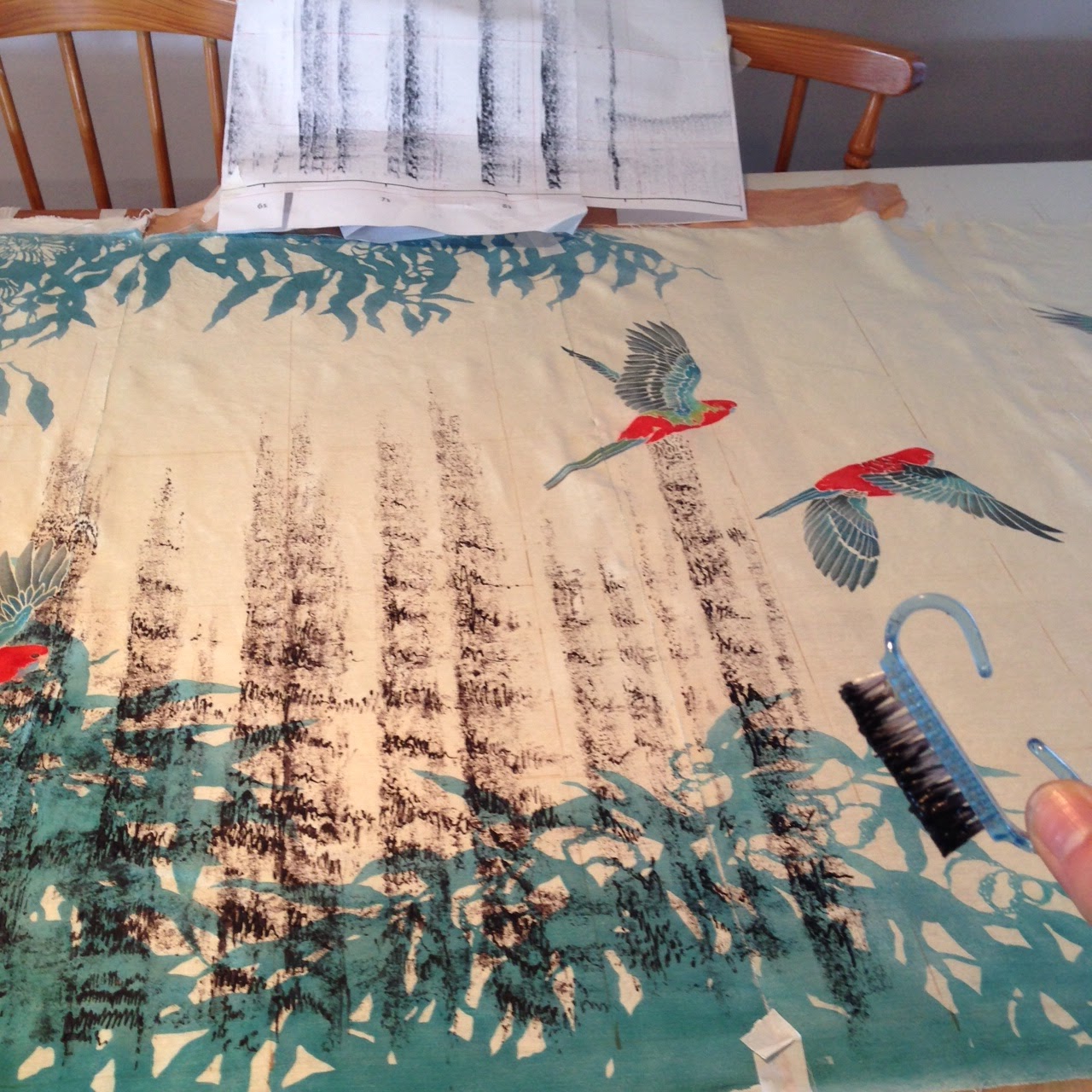
Sure, the setup is a little bit "sticky-tape and cardboard" but it works!

Dining table + sticky-tape + $1nailbrush = good enough

Even though Katazome and Yuzen are traditional techniques, they are not sacred. Culture is not static, and traditions grow and change with it.

So I can't use the lack of materials or tools as an excuse anymore. I have new ideas, some people interested in commissioned pieces, and the means to make them.

Consider this my jump back into regular posts. Less perfectionism, more output coming your way!

Thursday, August 13, 2015

Solo Exhibition in Canberra open now! キャンベラ市での個展は後8日!

I was only back in Australia for 10 weeks to the day when I found myself in Canberra setting up my next exhibition with my Dad. (Thanks Dad!)
オーストラリアへ帰国したばかりという気持ちがした10週目のところで、キャンベラでの個展の搬入なんてしていました!

My first solo show in Australia, "The Traces Between" opened on August 6th in the long and narrow space of Gallery 3 at M16 Artspace. The opening was a packed event as three separate shows opened all at once. It was great that the visitors who came to see the group show in the main gallery then drifted through to both mine and Keith Bailey's Solo shows in the two smaller galleries. Hooray for capitalising on other people's friends!
オーストラリアで初ての個展です。キャンベラのM16 Artspaceで細長いギャラリーで展示しています。そのArtspaceにて、三つのギャラリースペースがあって、同時に三つの展覧会も開きます。オープニングにたくさんの人が来ました。


Me explaining some of my work on opening night オープニングのパーティーで、友人に作品を説明している私。
Yay! other people's friends (plus lots of my friends and family too :)) 三つの展覧会が同時に始まるので、三つの作家さんの知り合いや友だちが来るわけ。いいシステムですね!
I called my exhibition the slightly vague and arty sounding "The Traces Between". I wasn't trying to be vague or sound arty (goodness knows I've learnt a whole dictionary of meaningless arty tripe I could roll out if I wanted to). Instead I was referring to a variety of gaps both literal and not.
展覧会のタイトルを「The Traces Between」にしました。訳したら「間の跡」に近いと思います。かなり微妙と思うかもしれないですが、色々な「間」をほのめかしたかったわけです。

One is the physical and visible gap that appears between areas of dyed colour when you use a resist technique like Katazome or Yuzen. In yuzen, that will be where you have drawn fine lines of paste with a metal-tipped tube. They leave behind the colour of the fabric below; white traces. A stencil is used for katazome, so you get a distinctive silhouette-style image. This positive image is merely the reverse of lots of blank gaps and spaces where resist paste was applied.
一つの「間」は、作品に見える防染された間です。友禅の場合では、防染糊の線の所ですね。型染の型紙を通した糊のところは出来上がった作品には、ただの間にすぎないです。

That is to say, resist-paste techniques rely on the preservation of the under fabric and then upon revealing them in the final piece.
つまり、防染糊の技法を使うと、糊が守った生地の色は、完成した作品には跡になります。

Yuzen detail: the writing is where the resist paste was. In the final piece it is just a trace. A blank space. 友禅の防染した文字。染め上がった作品から糊の存在が消されて、跡しか残らない。
In the case of Katazome, the blank negative space forms the image. In between all those gaps, the imagery is brought to life. 型染の場合、余白があるからこそ、イメージが見えてくる。
Another gap I was trying to allude to is the physical space between layers of fabric; the gaps that air can flow through. Since late 2012, I have been layering sheer silks in my pieces, leaving gaps in between them and allowing them to catch the breeze or the draft from an air conditioner.
もう一つの見える「間」は、生地の層のあいだにある空気です。2012年後半から、何枚かの絹を染めて、重ねる作品を作り続いています。この薄くて透明絹が風もちくはエアーコンに振られます。

By not framing my work, or stretching them tightly over a wooden board, they have a sense of life.
縁やパネルを使わないと、何かのイキイキ感がでる気がします。

sometimes the gaps between layers are even big enough to get inside! 2枚を重ねた作品です。時には入れるぐらいの間です! 
Degradation series from 2014 where I made a point of spacing layers out from each other. 2014年のシリーズでは3枚の絹を重ねて、わざと5センチずつの間で展示してみたら、良い感じでした。

Cross cultural spaces? Australian foliage meets Japanese noren
A non-physical gap is that between Art and Craft. I don't yet know where my work fits in those terms but I get the feeling it's somewhere in between; somewhere on the divide.
作品には見えない間もあると思います。それは「美術」と「工芸」の間。自分の作品はどちらに近いというのがまだわかりませんけど、確かにその真ん中に寄っていると思います。

You could also say that it straddles cultures too, swaying somewhere in the grey area between Australian and Japanese but let us not get carried away with ourselves! 文化の間というのもあると言えるでしょうが、今はあんなに自慢するのをやめよう!笑

This show is a combination of larger works that I completed whilst undertaking my Master's degree in Kyoto as well as a collection of new work. My graduation piece from Kyoto Seika University which features the migration cycle of the endangered Swift Parrot is the centrepiece (it can be helped since it's over 5 metres long!) and it catches the air nicely as people walk by in the space. 
今回の展覧会は、京都で作った大き目の作品と、帰ってから創ってみたもっと小さな作品の組み合わせです。

My Graduation work from Kyoto Seika in March 2015 is the star centrepiece of this show. 京都精華大学の大学院終了作品で作った「オトメインコの渡り」が今回の個展では、メイン作品になっています。5メートル以上なので仕方ないですけど!
Amongst the new work (some of which were completed at very VERY closely to the finish line!) are some small pieces I'm excited about that combine the fine line-work of yuzen with locally sourced natural dyes. In some inital research (much more to be had), I managed to find foliage from three eucalypts found around my suburb and boiled them down to extract some shades of yellow-brown and peachy orange-brown. Then I used those dyes to dye little "portraits" of Eucalyptus blooms and leaves. Haha! see what I did there? it's like a textiles pun or something.
新作の中、近所にあるユーカリから煮出した染料でユーカリのイメージを染めたちいさな作品もあります。まだまだ植物染料について沢山調べないといけないと分かりましたが、はじめての実験としてとてもうれしい結果です。

New small experiments in natural eucalyptus dyes are also on show.
Anyway, the show is on at M16 Artspace in Canberra until Sunday August 23, so be sure to check it out if you are in town. Otherwise, look forward to more photos after the show is complete!
さて、個展は8月23日までです!終わったらまた写真をアップしますから楽しみにしてください!