Thursday, March 3, 2016

Katagami Stencil Collection - 古い型紙に感動されました!

Hello! It's been a while, so welcome to 2016!
I was hoping I might clock up my 100th blogpost in 2015 but didn't quite make it, so there is another goal for this year! For now, here comes post #94. I think this is finally the last of my better-late-than-never posts, wrapping up some textile-y experiences from early 2015. Anyway, enjoy!

お久しぶりです!2015年はにあんまり投稿しなかったから、今年はもっと頑張りたいと思っています!(気づいたらもう3月になっちゃってびっくり!)2016年、100稿目に達しそうのでワクワクですが、とりあえず今回の94稿目をどうぞ楽しんでください。

It was last April and my Textiles Professor had a pile of enormous boxes on her desk. She opened the first one to reveal a mountain of amazing hand-carved katagami stencils. Each frail sheet was made from the old-style katagami paper; a rich brown washi that had been coated in persimmon juice and then smoked. That very particular earthy smell had faded from these 100-year-old stencils but the incredible craftsmanship was still preserved.

When told to take our time and leaf through as many we liked, the look on our faces must have been akin to that of a child being told they are allowed to help themselves to the lolly jar!

去年の4月でした。私の先生が大きな箱を何個も準備してくれていました。一つ目を開けて、古い型紙が山ほど入っていました。昔の型紙に使った渋紙の独特な香りはもう無くなっていましたが、繊細は技術は明らかでした。ゆっくりと一箱ずつに型紙を見て、感動しました。

OMG. Awed by the details is↑fellow Katazome-ian Amy from moyou.com.au
I've written about katagami before and the different cutting methods (although if you translate the Japanese terms, it's called carving). The boxes we were leafing through were filled with all different kinds of katagami, each as impressive as the next.

These stencils are part of a collection of pieces that were gifted to Kyoto Seika University by the Tanaka Nao Dye supply company of Kyoto. They were carefully sorted and catalogued by the University and since 2008 they form a part of their strong 'Traditional Craft' resources collection. They even house some of these resources in a special dedicated room in the library with lacquer-ware and things on display too! Oh, how I miss that little room....

この型紙は京都で有名な染料店「田中直」が京都精華大学に寄贈されたコレクションです。私が勉強していた間、京都精華大学は伝統技術や京都の産業を大事にしていると感じました。図書館の中に「伝統工芸・産業資料室」という部屋でもあって、工芸について色んな貴重な資料や、漆の展示もありました。あんなに珍しい本や専門の資料があったのを今考えたら、もっともっと勉強しに行けばよかったなぁとよく思いますね!

前にも型紙の種類について投稿しました。この箱にも色んな道具や技術を使った型紙がはいっていました。
さて、箱に入っていた型紙のハイライトを見ましょう。

So let's take a look at some of the different styles and techniques we found in this collection.

1. Dohgu-bori 道具彫りの型紙
Stencils carved with shaped punches.

These stencils are all cut with tiny, sharp metal-tipped punches, pressed with force through several layers of washi at once, over and over and over, with incredible precision. Often these punches have simple circular tips, but they can also be petal shaped, oblongs, crescents, leaves, you name it!

The most impressive dohgu-bori stencil we came to would probably have to be this one. The stencil itself was pretty worn out, a bit shrunken and wrinkled from use, but the combinations of different patterns was amazing! Waves, autumn leaves, autumn flowers...

a detail of the stencil above この一枚は凄くきれいでした。
Other impressive dohgu-bori stencils included this very fine design of bunches of grapes (i think?)

ブドウの模様なのかしら?
And below, this uber fine scalloped design! those "punched" circles are more like pin pricks in this one! Can you imagine sitting there and punching out each and every hole, one-by-one and still maintaining  symmetry? Not to mention your sanity?!

うわっ!この模様は超細くて、針で彫られたみたい!

2. Stencils that require silk thread mesh to keep them together.
紗張りされた型紙

In stencil cutting, you tend to avoid very long thin parts in a design because they are inherently weak. You also stay away from parts that jut out because they are likely to catch your spatula edge when it comes time to apply the resist paste over the top.

BUT! Never ones to shy away from difficult obstacles, the craftsmen of years gone by came up with a method of applying very fine silk threads to the stencil to reinforce it and keep all its parts aligned and secure. The threads are so fine that they do not affect the application of resist paste. This mesh method is still used today but the mesh is very uniform and machine made, often it is synthetic.

modern synthetic mesh applied to the front of one of my Katagami stencils from 2012

But the old mesh was more labour intensive. Sometimes it was strung up on a board by craftswomen, and sandwiched in between two sheets of the same stencil. At others, it was literally sewn in, to catch all the little edges.
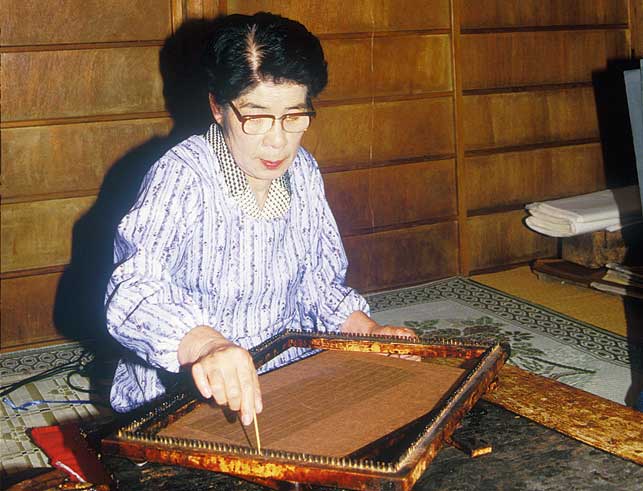
"Ito-ire" the meticulous process of creating a grid of silk threads and then sandwiching it in between the two layers of cut stencil with lacquer. Eek!

An example of a sewn-in mesh!

Willows and the surface of a pond, so so so detailed!

Here's the detail. you can see the little skimmer insect as well as the silk mesh

detail of mesh that has been sandwiched to keep these open curvy areas and long thin lines under control.

3. A clever style where the thickness of vertical lines creates a pattern within a pattern. 縞彫りの種類。

How cool is this? Edo-period craftsmen knew all about optical illusions! Just by carving varying thicknesses of lines, they can make you see clouds, birds, patterns, plants...These definitely have silk threads running horizontally to keep all those pesky verticals in place.

This one below, like most of the stencils, repeats on its long side. in the image below you can see two lines that stick out just a tiny bit further than the others. These are the "registration marks", if you want to use screen-printing terms. They are the tiny guides, to show where to match up the repeat each time it is printed.


Swallows, clouds, those diagonal lines may be representing rain because the swallows are numerous in the rainy season in Japan.


4. Pairs of stencils - 二枚型 Nimai-gata (or sometimes 文久小紋 Bunkyu-komon)

This type is really mind blowing. So a stencil has some limitations right? It's got to have parts that connect to each other so that the whole thing doesn't just fall apart That means you can't have design elements that float; everything has to be touching. BUT!
If you create two stencils, that get pasted one after the other in the same spot, you can actually "erase" some of those connecting parts and achieve the look of separate, floating design parts.

This is pretty hard to explain. The first or base stencil is called the "Main stencil" (omo-gata) and the second stencil applied on top is the "Erasing Stencil"(keshi-gata).

This Japanese site has excellent visual explanations and here is one example below.

Stencil one, 
plus stencil 2...
equals this! 
It is truly Japanese ingenuity in practice. What a lot of trouble to go to, simply to get a particular 'look'. These days, a screen-print can quickly produce the effect that the elaborate 'nimaigata' were developed to produce. But a machine-printed design will never have the same touch as one printed from a hand-carved stencil.

Here is one of a pair. We couldn't find it's matching stencil.
4. 最後に、とっても遅いですが、新年の祝いとして、松竹梅の型紙も!
And lastly, some very belated New Year wishes with an auspicious "Sho-chiku-bai" pattern. This traditional motif combines pine needles (a long-lived and evergreen tree), bamboo (produces many shoots) and plum blossom (flowers even in the cold season).


Saturday, December 19, 2015

Endangered Species: Just part of natural cycles of extinction?

In many of my artworks to date, I have depicted endangered species of Australian birds, especially parrots. Some of them are listed by the IUCN as Vulnerable, the lowest risk level, and others, like the Orange-bellied Parrot, are listed as Critically Endangered, which is "two steps away" from Extinction. (the next is Extinct in the Wild and then officially Extinct. done. dusted. bye-bye)

In addition to birds, I've recently begun looking into Endangered plant-life and I found out that one of the Eco-systems that used to dominate the ACT and parts of NSW is now Endangered; "Natural Temperate Grasslands". This kind of habitat is dominated by native grasses like Kangaroo and Wallaby grass, tussocky grass and many small flowers and plants. There are very few trees, covering less than 10% of the area. There are also particular insects, lizards and birds that have a reliance or affinity with this habitat, such as the Golden Sun Moth.

The Pre-European settlement (so, pre-1800's) extent of "Natural Temperate Grasslands" or NTE, is estimated at 470,000 ha. Now it is only present across 58,000ha meaning it has suffered a 98.8% decline! You can imagine how European settlers easily pictured the rolling grassy plains as prime sheep-grazing country and began its deterioration.
Some other factors in the loss of NTE have been urban/infrastructure development, invasion by weeds like exotic grass species and changed fire regimes.

an example of Natural Temperate Grassland

It's easy to feel a kind of melancholy or hopelessness about these disappearing habitats and birds. When I depicted them in my work previously, I was alluding to the sadness of their impending loss but also trying to merely capture their present-tense beauty and unique qualities without any specific message; "this is them as their unique beautiful selves."

But I wonder now, whether the sadness we attach to the loss of species is just a human projection of the fear of dying and loss? It's also interesting to realise that cycles of extinction have been taking place since...forever.

Some suggest that whilst the demise and eventual extinction of particular species is a natural process that has been repeating ad-infinitum since we can fathom, the most recent period of loss is occurring 100x faster than previously (than previous extinction events, occuring millions of years apart).
Whilst previous cycles of extinction would have happened "naturally", caused perhaps by changes in climate, ocean levels or eruptions etc, now we are adding in the reckless hand of that pesky Homo sapien.

So of course there are legitimate reasons to be angry and upset about the loss of species, for example where poaching or serious human error is to blame. For other cases though, where introduced species are encroaching on native species habitat's or where the drought has changed a landscape so that a particular bird can no longer survive in that location, maybe we can take a step back from an emotional response and realise that, cruel as it is, nature is just fulfilling its cycle.

There were some interesting articles written about the way that funding is awarded to the rescuing of species that are on the brink, based ultimately upon their cuteness or popularity with the general public (ie Yeah! let's pour loads of money into the conservation of those cute squidgy Koalas we love so much, but a green spotted tree insect? hmmm, nahhh.) Maybe we are wasting our time and money trying to intervene in an inevitable situation? I don't know, I'm just playing devil's advocate here. I want beautiful little Swift Parrots to stay in existence as much as the ANU researchers who are dedicated to studying and protecting them. But why are we trying to keep them on anyway? For our pleasure? for the future generations?

I suppose we are trying to keep all the links of the delicate eco-systems around us in place so that they don't crumble further and another crucial link slips out of place.

Some of Australia's threatened Parrots. L-R: Extinct Paradise Parrot, Critically Endangered Orange Bellied Parrot, Endangered Western Ground Parrot, Endangered Carnaby's Cockatoo and Endangered Swift Parrot...

Another reason I've been thinking about this inevitable process of change and re-shuffling is from observing the natural surroundings of suburban Canberra. There are many designated Nature Reserves that lie around the edges of the Canberra suburbs, walking trails along hillsides, creeks, river tracks, grasslands. Walking and riding my bicycle around and through some of these reserves I've been noticing different species that appear in the different seasons. There are some spectacular flowers, fruits, trees and plenty of "weeds".

What I've noticed is that if I were attempting to be a purist and only depict "native species" in my artwork, for example, I would be having to subtract a significant proportion of what I see in front of me. We have many designated "invasive species" in the ACT. They are considered introduced if they are originally from overseas or even from a different eco-system within Australia; if they are somewhere they haven't been before.

Some of these weeds are beautiful. Pink climbing roses, purple flowering Patterson's curse. Strange fuzzy leaves plants that look like cabbages. Tangled nests of prickly blackberries. They are undeniably a part of the landscape now.


Maybe, just maybe, we accept that environments change; that they are fluid and operating as they will. We can try and intervene in that (goodness knows we are excellent at meddling) or we can observe the beauty of what we see, accept that it has developed from something and will continue to change, without trying to get our itchy fingers in there to try and fix it. (* that said, I do think we have a responsibility to not make things worse, if it is within our ability and to not knowingly harm the environment...)

And it's also interesting to note that a "weed" is just another plant. To quote from a book by Environment ACT, "Animals and plants don't make distinctions between weeds and native species. Weeds to non-human organisms are just another plant..." What we have labelled "weeds" can actually make up 25-33% of the flora present in Natural Temperate Grassland and this does not necessarily transform the habitat because "species richness does not equate to dominance"... Interesting... I'm tempted to draw links here with multiculturalism and ideas about what is native and what is exotic...but that will need some more mental kneading first, I think.

"Hey! I'm not a weed! I'm just a plant who's new around here!"

Soon, I think I'm going to make a series of works that document Natural Temperate Grassland and also these "invasive species". A proud portrait of a sprig of Salvation Jane. A messy nest of flowering Blackberry bushes. A rosehip bush in all its prickly detail. Maybe they will make people squirm? Maybe they will just be a testament to the unique, details of the nature around us, now.

Friday, December 18, 2015

My Artwork going up in lights! 私の作品がプロジェクションマッピングで使われる!

I think I am finally allowed to share some exciting news...
今日はやっと嬉しいニュースを宣伝できます!

My artworks will be part of the projections on some of our National Institutions as part of the 6th Enlighten Festival in Canberra next March!
Over the 9 nights of the festival, many light-themed events bring Canberrans out to enjoy the crisp Autumn weather. The projections are a popular backdrop for live music, performances, roving performers, lit up art installations and the popular lantern-lit noodle markets.
See the promotional video below ↓


Enlighten 2014, The National Portrait Gallery

2016年3月、キャンベラで行われる「ENLIGHTEN祭」において、私の作品がいくつかのビルにプロジェクションマッピングで使われます。

来年のENLIGHTEN祭は六年目のイベントです。9日間の夜にかけて、光りをテーマにするパフォーマンス、ライブ、プロジェクションマッピング等が開催されて、キャンベラがとても賑やかになります。キャンベラは秋の3月から涼しくなるのをかかわらず、沢山の人が夜まで楽しむ祭りです。

キャンベラ市は計画都市なので、ビジネス街は一応都心部になっていますが、その南に大きな湖があって、その周りに全部の国立のビルが建てられました。(国立美術館、国立図書館、元の国会議事堂、現在の国会議事堂、国立高等裁判所, 国立なんとか、国立なんでも...)その辺の方が文化の中心地となっています。

Enlighten 2014 - Projections on the National Library of Australia

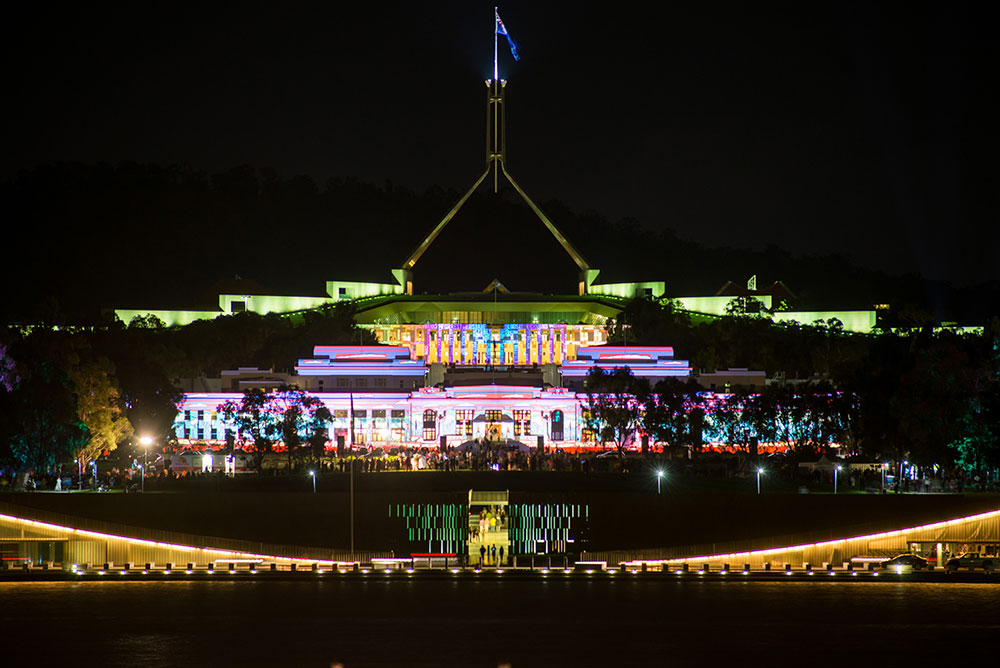
For next years' Enlighten, many national buildings will be lit up with the projections. Each building will have the work of several artists projected upon their exterior walls in a loop. I'm lucky enough to be developing imagery for three buildings: Old Parliament House (now known by the more fancy name of "The Museum of Australian Democracy"), Questcon (The National Science and Technology Centre) and the National Portrait Gallery.
Other main buildings included in the projections are the National Library and the National Gallery.


来年の祭では、5っのビルはプロジェクションマッピングに使用されます。色んなアーティストが選択されて、各ビルに数人の作品がループに写されます。
私は三つのビルの外側に写すイメージを作らせていただいています。
国立科学センター、国立ポートレートギャラリーと元の国会議事堂。

そういう偉いビルの外側なんかに私の作品がプロジェクションされるなんて想像しなかったものですね!
今は、作品を丁寧にビルの形に合わせていて、進んだらまたディテールをここでシェアしたいと思っています。
それまでには、去年の写真がこことここで見えます~

It's exciting and intimidating to think that my humble little artworks will be projected in gigantic form on the side of some of our iconic National buildings!! Especially Old Parliament House! It's such a classic building, built to house the first National Parliament of the new Federation of Australia from 1927. With all it's architraves, decorative railings and flat roof style (can you tell I know nothing about architecture?!) it is a beautiful artwork in itself.

I'm currently working on refining my planned artworks for the three buildings and hope to share some details with you as that progresses.